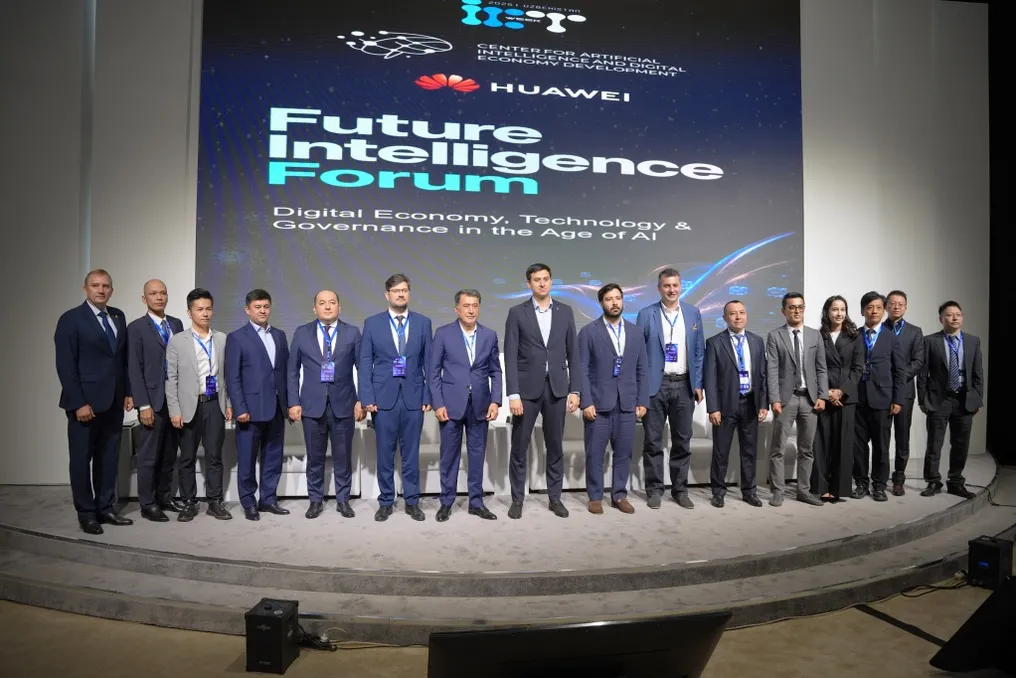
On September 23rd, the Future Intelligence Forum 2026 took place in Tashkent as part of the ICT Week Uzbekistan 2026 event. The forum gathered representatives from various sectors: state structures, international and regional organizations, technology companies, business and financial sector representatives, as well as experts from the academic community and the artificial intelligence field.
The organizers were Huawei in collaboration with the Center for Artificial Intelligence and Digital Economy Development. The event was supported by the Association of IT Education and the Ministry of Digital Technologies of the Republic of Uzbekistan.
The forum began with a speech by Deputy Minister of Digital Technologies Jamol Makhsudov. He emphasized that the development of digital technologies is under close attention from the country's leadership at all levels of public administration. Jamol Makhsudov noted that AI contributes to solving problems in medicine, education, and industry, and also stressed the importance of international cooperation, mentioning Uzbekistan's accession to the World Organization for Artificial Intelligence Cooperation.
The central theme of the conference was aspects of the digital economy, technologies, and public governance in the age of artificial intelligence. The main focus of the discussions was on finding ways to transform the potential of AI, digital infrastructure, and available data into actionable solutions for Uzbekistan that could improve public services, stimulate business, and expand opportunities for citizens.
From National Strategy to Practical AI Application
The two-hour program included strategic reports, presentations of international experience, coverage of national initiatives, demonstrations of local developments, and a panel discussion. Speakers from Huawei, the Center for Artificial Intelligence and Digital Economy Development, AI Alliance, the Committee for Competition Development and Consumer Rights Protection, the Center for Digital Government Project Development, Mohirdev, and Ant Digital Technologies covered the entire cycle of AI development—from forming state strategy and building a national ecosystem to issues of regulation, infrastructure, human resource training, and actual technology implementation.
The first segment of the forum was dedicated to the national agenda in AI and the digital economy, as well as the transition from setting strategic goals to implementing practical measures. Participants discussed the creation of a national AI ecosystem and the interaction between the state, business, educational institutions, and developers. It was noted that successful AI implementation requires coordinated efforts from all sectors—technology, infrastructure, competencies, and applied solutions.
Particular attention was paid to issues of digital sovereignty and competition. Since AI development increases the significance of access to computing power and data, there arose a need to form a competitive technological environment and rethink the role of the state.
AI for Public Services
Another important direction of the forum was the improvement of e-government and the automation of public services. The use of artificial intelligence and modern digital platforms opens new horizons for increasing the accessibility of public services for both businesses and the population, as well as optimizing processes and creating more convenient channels of interaction with government bodies.
Thus, artificial intelligence was viewed not as an isolated technology, but as a key tool for transitioning to the next stage of the digital transformation of the public administration system.
AI White Paper: Continuing Initiatives for Uzbekistan
A significant announcement at the Future Intelligence Forum was the idea of conducting research and preparing a special document—the AI White Paper—on the topic of artificial intelligence in Uzbekistan. This analytical report plans to gather information on global experience and approaches to AI development, comparing them with the tasks and opportunities specific to Uzbekistan.
The work on the White Paper aims to help structure current practices, identify the most suitable methods for the country, and formulate proposals for further strengthening the national AI ecosystem. Oleg Pekos, the First Deputy Minister of Digital Technologies of the Republic of Uzbekistan, stated that the country is entering a new phase where AI is becoming a crucial factor in economic and technological progress. He recalled that decisions regarding the development of computing infrastructure, the integration of AI into the economy and public administration, human resource training, and support for the technological environment are being made based on the approved Strategy for the Development of Artificial Intelligence Technologies until 2030, gradually moving from an institutional base to mass implementation.
This initiative also provides for knowledge exchange among experts and can serve as a platform to unite the national vision with international technological expertise.
The discussion continued in a global context, where participants examined how accumulated data, digital services, and platform ecosystems can become the foundation for a new generation of intelligent services, using examples of the development of digital platforms and the 'SuperApp to AI' model.
From Concepts to Working Solutions
A large part of the Future Intelligence Forum was dedicated to the practical application of artificial intelligence. The program featured demonstrations of local developments showing how AI technologies are already used in real products and services. This approach complemented theoretical discussions with visual, working solutions created in Uzbekistan.
One example was the demonstration of a digital AI avatar and possible scenarios for its use. Such technologies allow for the creation of new ways for users to interact with digital services and can function as virtual assistants and consultants in the fields of business and education. Thus, the practical part of the forum demonstrated the full cycle: from the initial idea and research to a product that can be immediately tested.
Infrastructure and Human Resources for the AI Economy
Large-scale AI implementation is impossible without the corresponding technical foundation. The growing demand for AI services dictates higher requirements for data centers, cloud platforms, data transmission networks, and information storage systems. Equally critical is the human resource pool. Throughout the forum, the issue of training specialists capable not only of applying ready-made AI tools but also of developing, integrating, and scaling their own solutions was actively raised.
This issue was discussed in detail during a panel discussion, which covered the role of universities, cooperation between educational institutions and technology companies and businesses, and the development of applied scientific research.
Digital Economy Acceleration: From Regulation to Real Impact
The concluding substantive part of the Future Intelligence Forum was the Digital Economy Acceleration panel discussion. This session brought together international expert perspectives with discussions on state policy, AI technologies, the interaction of the national ecosystem, e-commerce, and local AI solutions. Participants included representatives from the Central Asian Association of Artificial Intelligence (AICA), the Committee for Competition Development and Consumer Rights Protection of the Republic of Uzbekistan, Inha University in Tashkent, the Regional Communications Union (RCU), UZUM, and TBC Bank.
The discussion started with a debate on one of the most pressing issues—the need to find a balance between freedom of technological development and state control. Participants discussed how to stimulate innovation while avoiding excessive restrictions, while simultaneously defining areas where state intervention is necessary.
The focus then shifted to regional cooperation regarding standards, competencies, data, and infrastructure. Since AI poses challenges that go beyond national borders, the importance of experience exchange and joint initiatives between states is increasing. In the international context, new forms of Uzbekistan's participation in global AI initiatives were discussed.
Vladimir Norov, Chairman of the Central Asian Association of Artificial Intelligence, noted that AI has long ceased to be just a technological novelty but has transformed into a strategic infrastructure comparable to electricity, the internet, or space. He called the creation of the World Organization for Artificial Intelligence Cooperation (WAICO) an important historical step.
The discussion continued towards training specialists, implementing AI in the financial sector and e-commerce. Special attention was paid to achieving measurable results: how technologies can increase efficiency, improve customer experience, assist in risk management, and serve as a basis for new digital products.
Ultimately, the panel session managed to unite issues of regulation, international partnership, education, and real business scenarios into a single dialogue about the prerequisites for the widespread implementation of artificial intelligence in the economy. An additional element of the rich program was the live musical accompaniment by young talents, which created a more conducive atmosphere for exchanging opinions.
Continuing the Dialogue on the Digital Economy
The Future Intelligence Forum 2026 continued the professional exchange of views initiated a year earlier at the Digital Economy Forum within ICTWEEK 2025. While the emphasis in 2025 was on the general development of the digital economy, the discussion this year moved to a more advanced level.