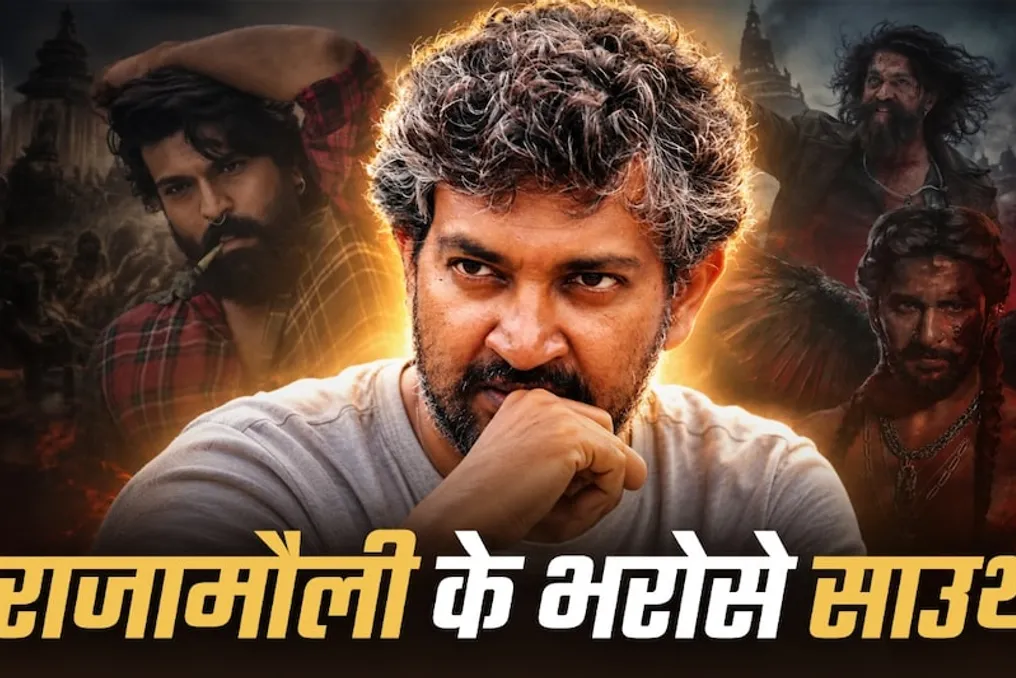
After the success of 'Baahubali', audience interest shifts to Hindi films
Read more
Aaj Tak
www.aajtak.in

After the success of 'Baahubali', audience interest shifts to Hindi films

Ten years ago, in 2015, the South Indian industry produced a film that caused a sensation. This was the movie 'Baahubali' by director S.S. Rajamouli, which did not conform to the typical South Indian masala film. Instead, it promised a grand visual experience, attracting public attention to South Indian cinema. Thanks to this film, the South Indian industry changed its destiny.

Following 'Baahubali', South India released many high-quality films such as KGF, Salaar, Pushpa, Jailer, RRR, Kalki, Kantara, and Lokah. These films possessed outstanding content, and their box office collections were impressive even in the North. After the appearance of such strong films from South India, Bollywood found itself on the defensive, as audiences began switching from Hindi films to South Indian ones.

For a long time, South Indian cinema did not disappoint the public, leading to rising expectations for new quality works. However, questions are now arising regarding the level and budget of modern films coming from there. In 2026, South Indian cinema has not performed particularly brightly. Most major films released so far have turned out to be failures or mediocre. For example, Peddi Rama Charana's film in June disappointed viewers, and CM Thalapathy Vijay's 'Jan Nayagan', despite an acceptable response, did not achieve great success in theaters. The film 'Yash's Toxic' completely shattered hopes.

'The Paradise' also failed to meet expectations. The plot of this film was shocking, and high hopes were placed upon it. The attempt to present Naani and create an atmosphere with Aniruddha's music proved unsuccessful after the film's release. The film 'Cinema' by director Srikanth Odela lacked humorous moments. This film is a typical South Indian masala film, but a weak story deprived it of strength.

It is noteworthy that the last two films from South India—'Toxic' and 'The Paradise'—caused such disappointment, while Bollywood offers good content. Recent hits like Hanuman Ansh and Awaarapan 2 serve as proof. Furthermore, Ajay Devgn releases 'Drishyam 3' next week, which is a successful franchise, and the trailer promises a good thriller with suspense. This year, Hindi cinema predominates over South Indian cinema.

Given the recent weakness of South Indian cinema, hope is now focused solely on S.S. Rajamouli. His upcoming film 'Varanasi Duniya' is one of the most discussed movies globally and in India. Its budget exceeds 1000 crores, making it the second most expensive film in India. Major actors such as Mahesh Babu, Priyanka Chopra, and Prithviraj Sukumaran star in the film. Every previous work by Rajamouli has been a box office hit or exceeded expectations. Therefore, all attention is focused on 'Varanasi'. Nevertheless, we still have to see 'Jailer' by 'Thalaiva' Rajinikanth, which will be released on October 15 and features a very large cast. Now it remains to be seen whether South Indian cinema can release a big film this year.

Similar stories

Directors of 'Lust Stories 3' discuss increasing frankness in cinema and youth attitudes towards intimate scenes
Read more
www.aajtak.in

Directors of 'Lust Stories 3' discuss increasing frankness in cinema and youth attitudes towards intimate scenes

In contemporary cinema and web series, explicit or intimate scenes have become commonplace; romantic or kissing moments can be found in every second film. Nevertheless, sometimes creators emphasize such scenes so heavily that viewers feel uncomfortable watching them in a family setting.

When excessively explicit scenes are shown on screen, creators and actors often face sharp criticism and trolling from the audience. A prime example is the 2022 film 'Gahrayan,' which featured numerous explicit and intimate scenes between Deepika Padukone and Sindhan Chaturvedi.

After the film's release, the actors were subjected to heavy trolling on social media because many disliked the depiction of extramarital affairs, intimacy, and sexual desire in the movie.

In an interview with 'News18,' directors of 'Lust Stories 3,' Vikramaditya Motwani and Shakun Batra, openly discussed the negative reaction to films and shared their opinion on whether the majority of the Indian audience maintains conservative views.

Director Sachin Batra, commenting on the trolling received by the film for depicting sex and infidelity in 'Gahrayan,' stated that such things are not unprecedented in India. He noted that people can relate to such stories and see themselves in them. However, he added that there is a huge moral burden associated with questions of what is ethical, right, or wrong. In his view, society is not yet ready to change such established perceptions, as concepts of good and evil seem permanently fixed.

On the other hand, filmmaker Vikramaditya Motwani believes the problem lies not with the viewers but with those who consider themselves guardians of public morality. Vikramaditya emphasized that box office results show that no one refuses to watch such material. He called these people 'gatekeepers' who constantly assert that certain content should not or ought not to be watched because it contradicts culture, and they voice many similar remarks.

Overall, he believes that the approach to watching films has changed over the last two decades. The younger generation has become much more open to topics of sex, intimacy, and passion and is less inclined to judge others.

For those unfamiliar, the plot of Motwani's 'Lust Stories 3' is based on the sexual desires of middle-aged married women who decide to exchange their husbands to reintroduce excitement into their dull sexual lives.

After Tamannaah Bhatia, Sharvari Waghm also celebrated Chhath Maiya festival, showing long sindoor on her forehead
Read more
www.aajtak.in

After Tamannaah Bhatia, Sharvari Waghm also celebrated Chhath Maiya festival, showing long sindoor on her forehead

Large-scale scenes related to festivals are often seen in the Bollywood film industry, but the great folk festival 'Chhath' rarely appeared in mainstream Indian films. Nevertheless, a change in trend is now being observed in Indian cinema.

Within one month, the vibrant cultural and majestic depiction of the Chhath festival was presented in two large and expensive Indian films, which won the hearts of the audience.

Following the film 'The One' starring Siddharth Malhotra and Tamannaah Bhatia, the new movie 'Ye Prem Mol Liya' by renowned director Suraj Bajaiya also presented the worship of Chhath Maiya with great respect and beauty.

Bollywood actress Tamannaah Bhatia is currently being actively discussed due to her upcoming film 'The One'. A significant part of this film is based on events taking place in Bihar, and in the plot, Chhath is not just used as a background but is explored very beautifully.

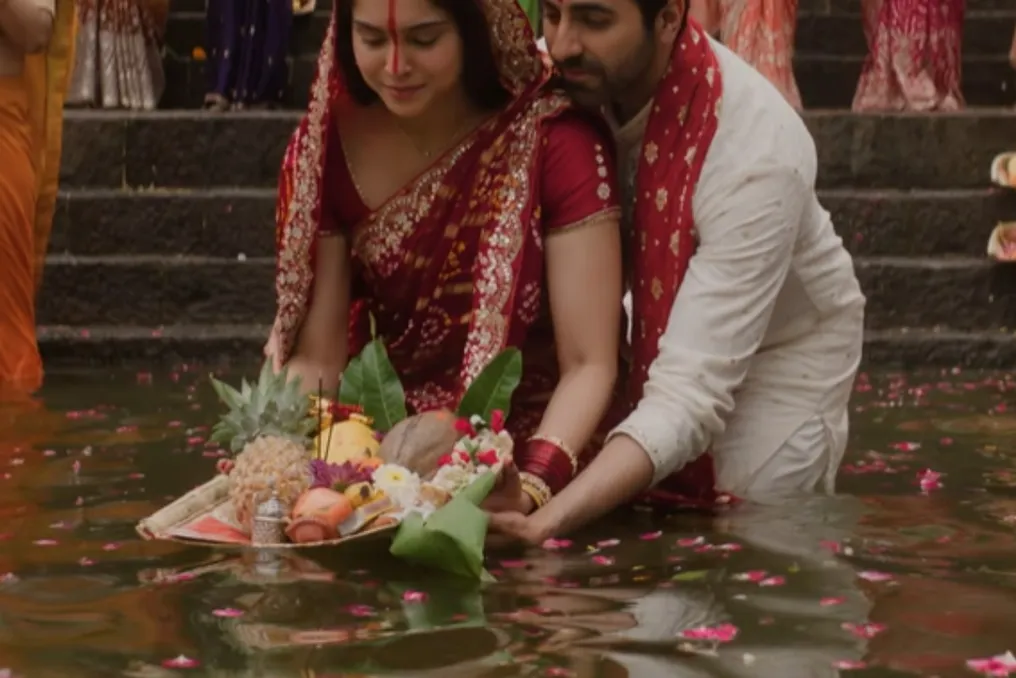
Tamannaah Bhatia's traditional look in a red saree, with a long sindoor on her forehead and a basket for offerings in her hands, is very popular on the internet. This is one of the few instances in Bollywood where this important festival of Bihar has received such a significant place in a major project.

Immediately after Tamannaah Bhatia's film attracted attention, footage from Suraj Bajaiya's new film 'Ye Prem Mol Liya' appeared. Suraj Bajaiya, known for creating films about family and cultural values, also paid great attention to the significance of this great festival in his narrative.

'Ye Prem Mol Liya' showcases crowds of pilgrims on the riverbanks, couples adorned in red attire, and the traditional way of making offerings, captured with great cinematic beauty in photos taken from the song, which is suitable for the big screen.

This is the second instance within one month where two major film studios have presented the traditions of celebrating Chhath in such a grand manner in their big movies.

While the film 'The One' featuring Siddharth Malhotra and Tamannaah Bhatia is fully ready for release in theaters on September 25, 2026, the film 'Ye Prem Mol Liya' under the direction of Suraj Bajaiya will be released on big screens on November 27, 2026. These traditional and cultural posters and photographs associated with both films have caused huge excitement among fans even before the premiere.

Film 'Bedari' banned in Pakistan due to similarity with Indian film 'Jagriti'
Read more
www.aajtak.in

Film 'Bedari' banned in Pakistan due to similarity with Indian film 'Jagriti'

In 1956, the film 'Bedari' was screened in Pakistani cinemas. It achieved enormous success, filling all halls. This film, directed by Rafiq Rizvi and starring Ragini and Santosh Kumar, became a blockbuster thanks to its songs, especially the song 'Ao Bachcho Seir Karen Tumko' performed by Salim Razi. The song became extremely popular among children across Pakistan.

However, the film was soon banned. Some viewers felt a strange sensation, as if they had seen this film before, and discovered that not only the plot but also the melodies of the songs were familiar to them. It soon turned out that 'Bedari' was an exact copy of the Indian film 'Jagriti', released in 1954, and 'Jagriti' itself was a remake of the Bengali film 'Parivartan'.

The most interesting connection in this story relates to Ratan Kumar. His real name was Syed Nazir Ali Rizvi, and he was considered a popular child actor in the Bombay film industry. Born in 1941, he began performing at the age of just five. Family friends and writer Krishna Chander gave him the role of a child actor in the film 'Rakh'. After this, Ratan Kumar worked in several famous films, such as 'Boot Polish' and 'Baiju Bawra', before getting the role of Shakti in Satyen Bose's film 'Jagriti'.

When 'Jagriti' was released in 1954, Ratan Kumar was about 13 years old. Two years later, in 1956, he moved to Pakistan with his family. Many relatives of his family had already settled in Pakistan after the partition. Limited job opportunities in India also contributed to the family's decision to move to Pakistan.

After arriving in Pakistan, Ratan Kumar's elder brother, Wazir Ali Rizvi, founded a production company called 'Hayat'. The first film of this company was 'Bedari', and it was here that the story took an unexpected turn. The film 'Jagriti', in which Ratan Kumar himself acted, was recreated in Pakistan under a new title and in a new context.

'Bedari' featured Ratan Kumar in two roles. He played Ajay, whose name was changed to Jaffar in the Pakistani film. Furthermore, the character Shakti from 'Jagriti' was renamed Sabar Ali. Notably, despite the change in names, the essence of the characters was preserved: both Ajay and Jaffar mean 'victory' in Hindi and Urdu, respectively.

However, the similarity between the two films was not limited to the plot and characters. The most striking similarity was in the songs. In 'Bedari', the original melodies and harmonies were largely retained, but the lyrics were altered. Instead of Indian nationalist references, Pakistani nationalist motifs were added.

For instance, the famous song from 'Jagriti' sounded like: 'Ao Bachcho Tumhen Dikhaen Janki Hindustan Ki'. In 'Bedari', this song was changed to 'Ao Bachcho Seir Karen Tumko Pakistan Ki'. Similarly, where the original featured 'Vande Mataram', 'Bedari' used 'Pakistan Zindabad'.

Another song from 'Jagriti' contained the lines: 'De Di Hme Azadi Bina Kadg Bina Dhaal, Sabarmati Ke Sant Tune Kar Diya Kamal'. In 'Bedari', these lines were replaced with 'De Di Hme Azadi Ki Duniya Hui Haran, Ai Kaide-Azm Tera Ehsan Ha Ehsan'. Thus, instead of Mahatma Gandhi, Muhammad Ali Jinnah appeared.

This process was not limited to a couple of songs; in many songs of the film, the original melodies were preserved while the lyrics were changed, replacing the Indian context with a Pakistani one. How was the truth about 'Bedari' revealed?

Initially, the similarity between the two films might have gone unnoticed because there was a ban on the public screening of Indian films in Pakistan at the time. Consequently, most of the Pakistani audience could not see 'Jagriti'. Later, a member of the Pakistani censorship board informed Donna about this situation, noting that Lahore filmmakers created 'Bedari' in 1956, which was a carbon copy of 'Jagriti' in terms of plot and songs, utilizing the ban on the import and public screening of Indian films.

Initially, 'Bedari' enjoyed great commercial success in cinemas. However, after some time, viewers began to realize its true nature, understanding that the film they were watching bore a resemblance to a previously existing Indian film in terms of plot and melodies. Following this, protests against its public screening began, and the situation escalated to the point where the Pakistani censorship board immediately banned 'Bedari' and restricted the screening of its songs.

Did this affect Ratan Kumar's career? For a long time, there have been speculations that after moving to Pakistan, Ratan Kumar sought to establish himself in the local film industry, and perhaps that is why he participated in creating a film similar to 'Jagriti' in a new form. Nevertheless, Ratan Kumar, being a very popular child actor, could not achieve the same level of success as a leading adult actor.

Popular