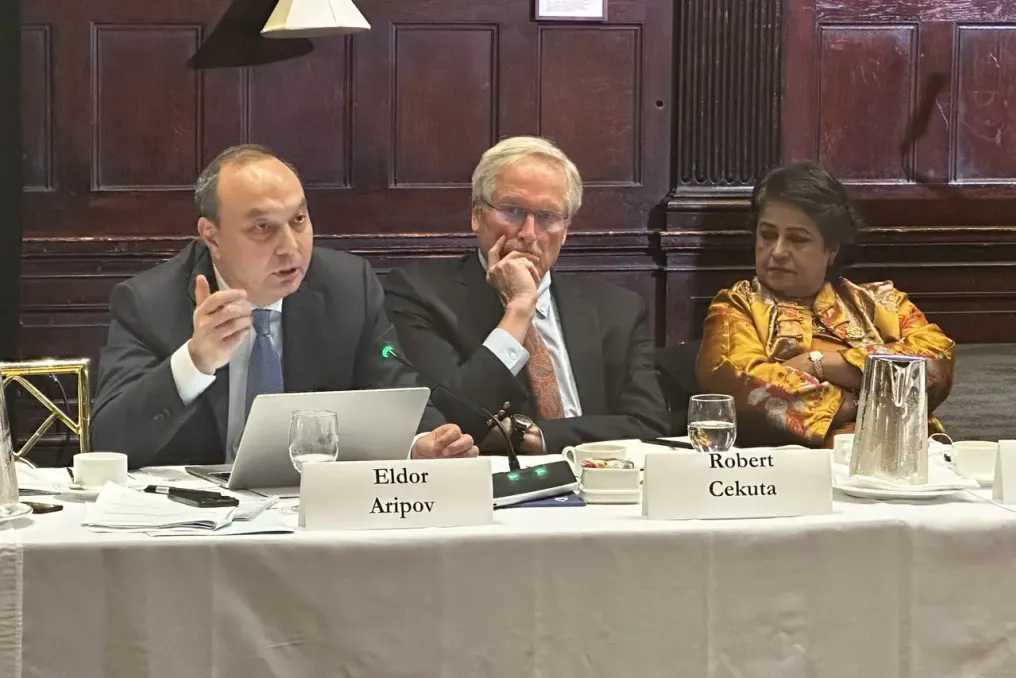
At the 37th high-level meeting of the Nizami Ganjavi International Center, held on September 23–24 at the Harvard Club in New York parallel to the 81st session of the UN General Assembly, issues of rebuilding trust, cooperation, and global stability for a common future were discussed.
Eldor Aripov, Director of the Institute of Strategic and Regional Studies under the President of Uzbekistan (ISRS), participated in this event. The meeting served as a platform for exchanging views on international cooperation, sustainable development, energy and climate security, as well as the role of digital technologies in world governance.
Speaking at the session on climate cooperation amidst global fragmentation, Aripov noted that despite growing political disagreements, climate change, conversely, enhances the interdependence of states. In his opinion, climate problems are becoming not only a source of new risks but also an impetus for strengthening regional partnership.
This is particularly evident in Central Asia, where issues of water, food, and energy security are closely interconnected. The Director of ISRS emphasized that the temperature in Central Asia is rising twice as fast as the global average, and the area of glaciers has decreased by approximately 30% over the last six decades. Glaciers play a critical role in the region's water resources, feeding the Amu Darya and Syr Darya rivers, upon which agriculture, energy, and the lives of millions of people depend.
Demographic and economic growth create additional pressure on resources. According to forecasts mentioned by Aripov, the population of Central Asia could reach 100 million by 2050. Simultaneously, the demand for water, food, and energy is increasing, and climate change makes the availability of these resources less predictable.
Discussing ways to solve these problems, Aripov highlighted the importance of regional cooperation. He noted that while the UN sets global climate goals, their implementation requires taking into account the specific characteristics of individual regions. This is especially relevant for Central Asia, where river basins and glacial systems span several countries and require coordinated action.
The Director of ISRS stressed the importance of regional interaction mechanisms, especially when global dialogue faces difficulties. In his conviction, such mechanisms allow for maintaining practical cooperation and jointly addressing issues of common interest.
Special attention was paid to climate finance. Aripov observed that international support is often directed towards individual countries and projects, whereas climate risks affect many states simultaneously. Therefore, he called for the development of financial instruments for implementing joint projects aimed at preserving natural resources and adapting to climate change. According to him, such an approach would take into account the interests of all countries dependent on the state of shared river basins.
The Director of ISRS defined climate change adaptation as one of the key priorities for the region's countries. He insisted that for developing countries, in addition to long-term energy transition goals, practical issues directly affecting the population must be addressed: ensuring farmers' access to water, increasing preparedness for floods and droughts, and preserving people's sources of income.
Concluding his speech, Aripov emphasized that geopolitical disagreements should not become an obstacle to international cooperation on climate and environmental issues. In his view, water resource management, environmental monitoring, and climate change adaptation must remain areas of constant and constructive dialogue between states.
The high-level meeting gathered current and former heads of state and government, representatives of the UN and international organizations, as well as members of parliaments and representatives of the expert and business communities. Among the distinguished participants were the current presidents of Latvia and Montenegro, as well as former presidents and prime ministers of Bulgaria, Croatia, Serbia, Slovenia, Finland, Bosnia and Herzegovina, Austria, the United Kingdom, Belgium, Czechia, Romania, Greece, and other countries.
Welcome remarks were delivered by Tedros Adhanom Ghebreyesus, Director-General of the World Health Organization; Miguel Ángel Moratinos, Deputy Secretary-General of the United Nations World Alliance of Civilizations; Tatiana Molchan, Executive Secretary of the UN Economic Commission for Europe; and U Hongbo, former Special Representative of the Chinese Government for European Affairs.