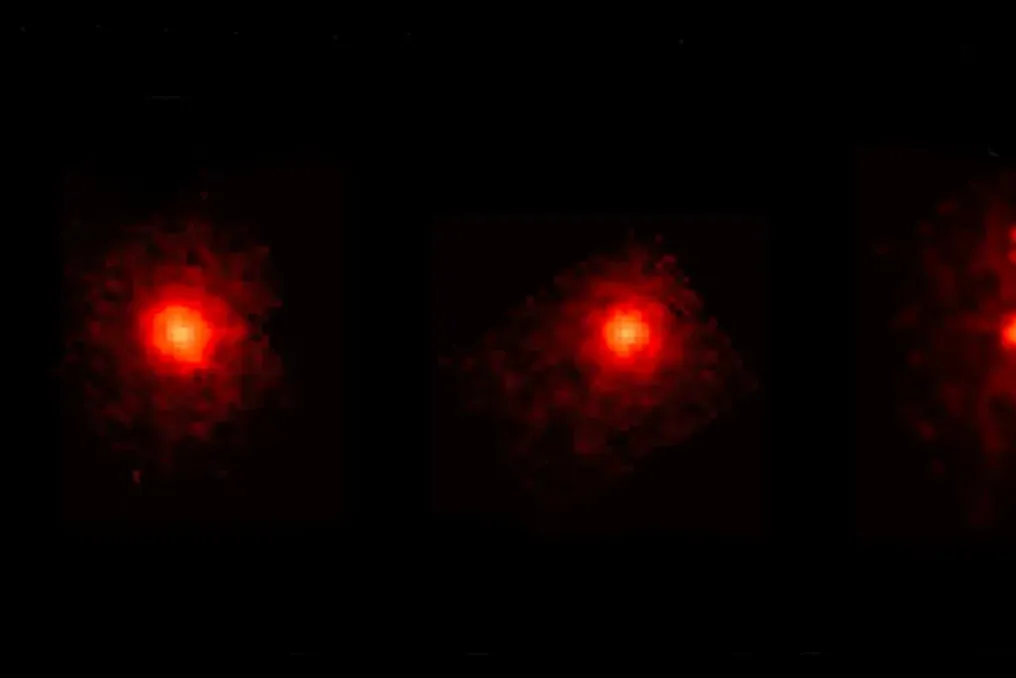
The interstellar comet 3I/ATLAS, which generated great scientific interest in 2025, is now at a distance of 1.77 billion kilometers from Earth. Due to its receding speed, which reaches 209 thousand km/h, telescopic monitoring becomes challenging; however, the collected data is beginning to clarify the origin of this body coming from outside the Solar System.
Recent research conducted by various groups of scientists suggests that the comet originated in an environment characterized by very low temperatures and near a star with a low concentration of metals.
Observations made using the William Herschel telescope, located in Spain, detected a high concentration of nitrogen in the coma, which is the gaseous cloud surrounding the comet's nucleus. The analysis of the relationship between molecular nitrogen levels and carbon monoxide helps determine the object's formation temperature.
More details about the comet's formation
Calculations performed by scientists indicate that 3I/ATLAS formed at temperatures close to -240 °C, a value very close to absolute zero. According to these studies, this chemical composition suggests that the comet developed far from its original star, under conditions of extreme cold.
In an article published in the Monthly Notices of the Royal Astronomical Society, researchers detail how the ratio between N₂ and CO can be used to estimate the formation temperature of comets. Researcher Lea Ferellec, affiliated with Northumbria University, emphasized that the nitrogen concentration represents a unique opportunity to study material formed outside the Solar System, pointing to an origin in extremely cold conditions and far from the parent star.
Additionally, another study focused on the comet's water and identified an unusual ratio between the deuterium and protium isotopes of hydrogen. The high amount of deuterium also corroborates the hypothesis of low-temperature formation. The analyses also took into account an atypical ratio between carbon-12 and carbon-13 isotopes, an indicator compatible with a low-metallicity star, meaning one scarce in heavier elements than hydrogen and helium. The studied models suggest a star with approximately half the metallicity of the Sun.
The information compiled so far indicates that the comet has been tracked using terrestrial and space telescopes, as well as probes heading towards Jupiter and rovers on Mars. Data processing continues even as the comet moves away, making its observation progressively more difficult.