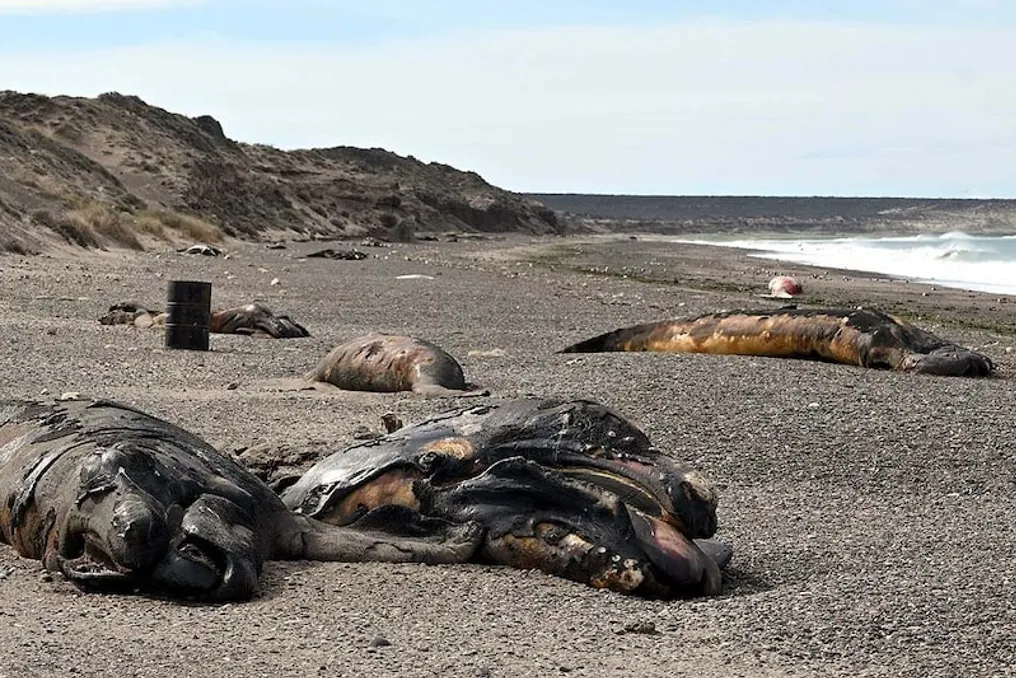
Mass death of young whales in Argentina: Scientists suspect bacterial infection
Read more
Aaj Tak
www.aajtak.in

Mass death of young whales in Argentina: Scientists suspect bacterial infection

In the southern part of Argentina, Patagonia, a significant number of deaths among young Southern Right Whales have been observed. Since June, the corpses of these whales have been regularly found on the coast of the Chubut province. Scientists hypothesize that a bacterial infection may be the cause of these deaths, although final confirmation has not been obtained, and the investigation is ongoing.

This year, approximately 1375 Southern Right Whales were registered in the region, about 400 of which were calves. According to scientists, the mortality rate among young whales is elevated this season. The Chubut government is cooperating with scientific and research groups to determine the causes of these deaths. Preliminary studies point to common marine bacteria as a possible cause.

The appearance of dead young whales on the coast of Chubut has continued since June. Dead Southern Right Whale calves were also found this week. Local scientists are keeping track of all these cases and, where possible, taking samples from the deceased whales for analysis.

According to researcher Mariano Coscarella from the Marine Mammal Laboratory, the mortality rate among young whales is particularly high this season. Scientists suspect a disease called Erispiles, which is a serious bacterial ailment caused by bacteria that can be found in the bodies of marine animals and in the environment.

According to information from the Chubut government, initial data links the possible cause to a common marine bacterium. However, it has not yet been proven that this specific bacterium caused the death of all the whales. Scientists are also trying to establish how the infection could have entered the young whales' bodies and what its connection to their death is. To do this, samples from the dead whales, as well as environmental and seawater conditions, are being studied.

Currently, scientists tend to consider this situation natural, but the role of human activity has not been completely ruled out. Nevertheless, the Chubut administration reports that there is currently no information directly linking these deaths to human activity.

Scientists emphasize that understanding this phenomenon requires more than just counting the number of dead whales; it is also necessary to consider the number of births, the number of fatalities, and mortality statistics from different years.

Puerto Madryn and the adjacent Valdés Peninsula are part of a vast breeding area for Southern Right Whales. These whales can reach lengths of up to 17 meters, and their average weight is about 40 tons. In 2025, a record number of 2110 Southern Right Whales was registered in the area, about 800 of which were calves. This year, 1375 whales were counted, including about 400 calves.

An increase in the death rate of young whales has also been recorded in the Valdés Peninsula previously. In 2012, 113 dead calves were registered there, which was one of the highest mortality rates for this species. The current calf mortality rate continues to worry scientists, although further research is required for a full understanding of the situation.

In the opinion of scientists, the current cases are alarming but are not yet considered a major long-term threat to the entire Southern Right Whale population. Local authorities note that the average age of these whales is about 60 years.

Scientists are currently analyzing samples from the dead whales and the marine environment. It will only become clear after these studies are completed how responsible the bacterial infection is for the death of young whales and whether there is any other cause.


Similar stories

Archer Daniels Midland created textured soy protein in the 1960s
Read more
super.abril.com.br

Archer Daniels Midland created textured soy protein in the 1960s

The first version of textured soy protein (TSP) was developed by the American company Archer Daniels Midland during the 1960s. The success of this product came years later when it began to be incorporated into school lunch programs in the United States.

TSP is a byproduct generated in the process of extracting soybean oil. After the oil is removed using a solvent, a soybean flour remains, half of which constitutes protein. This flour can be transformed into concentrated soy protein, enriching its protein content to about 70%.

Both the flour and the concentrated protein serve as a base for manufacturing TSP. When mixed with water, they form a solid mass. This mass is then heated and subjected to high pressure through a small orifice, a method known as extrusion, similar to using a tube of toothpaste or a gnocchi machine.

When the mass passes through the orifice, the sudden change in pressure causes rapid expansion. Through a chemical reaction called denaturation, it acquires the characteristic airy texture. It is at this moment that the shape of the soy 'meat' is defined, whether ground, in large steaks, minced, or nuggets. Subsequently, the TSP undergoes a dehydration process, which significantly improves its durability and simplifies storage.

This same extrusion procedure can be applied to produce textured proteins from other grains, including wheat, oats, lentils, corn, and peanuts. To use TSP, it is essential to pre-hydrate it with other ingredients, or allow it to absorb the liquids in the recipe. This ingredient is very yielding, absorbing between two and three times its own weight in water or other fluids, and is frequently used to complement industrialized meat products, such as hamburgers and nuggets.

Besides soy, one of the planet's most important crops, there are other food derivatives that function as meat substitutes, such as tofu and tempeh, the latter being a type of fermented soybean grain paste traditional to Indonesia. Jackfruit meat, on the other hand, is made with the fruit still green; although it closely mimics the texture of shredded chicken or pork, it is not considered an excellent source of protein.

Tofu is produced from coagulated soy milk, following a process analogous to cheese making. It has various textures and applications and has a consumption history exceeding two millennia. Seitan is made using wheat protein, also known as gluten, whose oldest record dates back to the 6th century in China.

Rice left over after cooking can become a nutritious medium for seven types of plants
Read more
www.aajtak.in

Rice left over after cooking can become a nutritious medium for seven types of plants

When rice is cooked at home, water often remains, which is used during washing or cooking. Most people consider this water useless and pour it down the drain, however, this rice water that is thrown away can be useful for houseplants.

Simple rice water contains starch and a small amount of minerals. When used in the correct and limited quantity, it is capable of supporting beneficial microorganisms in the soil. If you have potted plants, instead of immediately discarding the water left over from rinsing or boiling rice, you can use it for plant care.

It is important to remember that this water must not contain salt, spices, oil, or any other food additives. It is best to water plants with clean, cooled water. Nevertheless, this does not mean that rice water should be applied to every plant daily; its use requires adherence to a proper regimen and moderation.

Rice water for plants:

Let's look at seven plants that rice water can help, as well as mistakes to avoid when using it.

1. Peace Lily: The Peace Lily needs periodic light feeding. In such cases, adding cold and clean rice water to the soil can be beneficial. It should be applied directly to the soil, not to the leaves, and used every few weeks.

2. Snake Plant: Although the Snake Plant grows easily with minimal care, the condition of its soil cannot be ignored. Occasionally, a small amount of rice water can be given to this plant. Since this species does not like excess moisture, the soil must be allowed to dry out completely before the next watering.

3. Spider Plant: The Spider Plant prefers its soil to retain slight moisture. Therefore, applying rice water every few weeks can provide additional nutrition to the soil. Always apply it to the soil around the plant's roots, not on the leaves.

4. Monstera (Money Plant): Monstera is one of the most popular houseplants. If your Monstera is growing in soil, you can occasionally use cold rice water. The organic components contained in it can support the activity of beneficial microorganisms in the substrate.

5. Pothos: Pothos grows easily even in low indoor light conditions. Clean rice water can be added to the Pothos soil from time to time. However, you must ensure that the soil is never constantly wet, as excess moisture can cause root problems. Rice water should not replace regular water.

6. Fern: Ferns prefer soil that retains moisture and contains organic matter. Therefore, rice water can be part of their care in limited amounts. It is important only to ensure that water does not accumulate in the pot and to provide good drainage.

7. Tomato Plant: Tomato plants require nutrients during growth, flowering, and fruiting. In such cases, rice water can help with soil care from time to time. Nevertheless, relying solely on rice water is insufficient; tomatoes also require quality fertilizers and balanced nutrients.

How to use rice water

The water left over from washing or boiling rice must first be completely cooled. After that, it can be slightly mixed with clean water and applied to the soil around the plant's roots. The most important condition is that the water must not contain salt, oil, ghee, or any spices.

Eldor Aripov stated that geopolitical disagreements should not hinder climate cooperation
Read more
uzdaily.uz

Eldor Aripov stated that geopolitical disagreements should not hinder climate cooperation

At the 37th high-level meeting of the Nizami Ganjavi International Center, held on September 23–24 at the Harvard Club in New York parallel to the 81st session of the UN General Assembly, issues of rebuilding trust, cooperation, and global stability for a common future were discussed.

Eldor Aripov, Director of the Institute of Strategic and Regional Studies under the President of Uzbekistan (ISRS), participated in this event. The meeting served as a platform for exchanging views on international cooperation, sustainable development, energy and climate security, as well as the role of digital technologies in world governance.

Speaking at the session on climate cooperation amidst global fragmentation, Aripov noted that despite growing political disagreements, climate change, conversely, enhances the interdependence of states. In his opinion, climate problems are becoming not only a source of new risks but also an impetus for strengthening regional partnership.

This is particularly evident in Central Asia, where issues of water, food, and energy security are closely interconnected. The Director of ISRS emphasized that the temperature in Central Asia is rising twice as fast as the global average, and the area of glaciers has decreased by approximately 30% over the last six decades. Glaciers play a critical role in the region's water resources, feeding the Amu Darya and Syr Darya rivers, upon which agriculture, energy, and the lives of millions of people depend.

Demographic and economic growth create additional pressure on resources. According to forecasts mentioned by Aripov, the population of Central Asia could reach 100 million by 2050. Simultaneously, the demand for water, food, and energy is increasing, and climate change makes the availability of these resources less predictable.

Discussing ways to solve these problems, Aripov highlighted the importance of regional cooperation. He noted that while the UN sets global climate goals, their implementation requires taking into account the specific characteristics of individual regions. This is especially relevant for Central Asia, where river basins and glacial systems span several countries and require coordinated action.

The Director of ISRS stressed the importance of regional interaction mechanisms, especially when global dialogue faces difficulties. In his conviction, such mechanisms allow for maintaining practical cooperation and jointly addressing issues of common interest.

Special attention was paid to climate finance. Aripov observed that international support is often directed towards individual countries and projects, whereas climate risks affect many states simultaneously. Therefore, he called for the development of financial instruments for implementing joint projects aimed at preserving natural resources and adapting to climate change. According to him, such an approach would take into account the interests of all countries dependent on the state of shared river basins.

The Director of ISRS defined climate change adaptation as one of the key priorities for the region's countries. He insisted that for developing countries, in addition to long-term energy transition goals, practical issues directly affecting the population must be addressed: ensuring farmers' access to water, increasing preparedness for floods and droughts, and preserving people's sources of income.

Concluding his speech, Aripov emphasized that geopolitical disagreements should not become an obstacle to international cooperation on climate and environmental issues. In his view, water resource management, environmental monitoring, and climate change adaptation must remain areas of constant and constructive dialogue between states.

The high-level meeting gathered current and former heads of state and government, representatives of the UN and international organizations, as well as members of parliaments and representatives of the expert and business communities. Among the distinguished participants were the current presidents of Latvia and Montenegro, as well as former presidents and prime ministers of Bulgaria, Croatia, Serbia, Slovenia, Finland, Bosnia and Herzegovina, Austria, the United Kingdom, Belgium, Czechia, Romania, Greece, and other countries.

Welcome remarks were delivered by Tedros Adhanom Ghebreyesus, Director-General of the World Health Organization; Miguel Ángel Moratinos, Deputy Secretary-General of the United Nations World Alliance of Civilizations; Tatiana Molchan, Executive Secretary of the UN Economic Commission for Europe; and U Hongbo, former Special Representative of the Chinese Government for European Affairs.

Popular