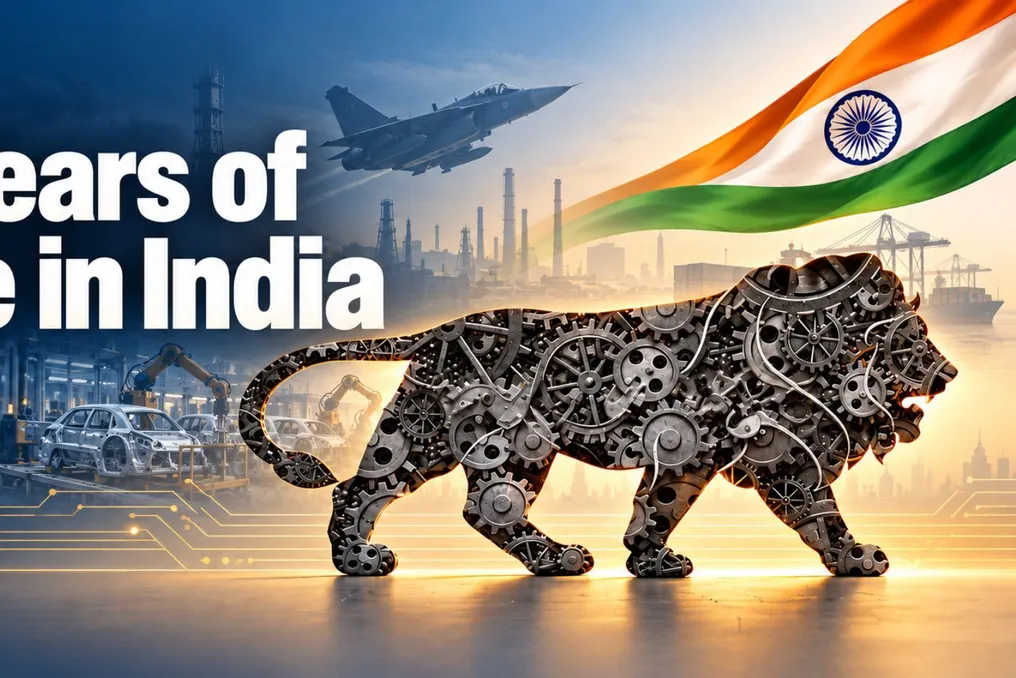
Celebrating the 12th Anniversary of the 'Make in India' Initiative: Growth from Phone Manufacturing to Defence Industry
Read more
YourStory [india, en]
yourstory.com

Celebrating the 12th Anniversary of the 'Make in India' Initiative: Growth from Phone Manufacturing to Defence Industry

Narendra Modi marked the 12th anniversary of the 'Make in India' initiative, emphasizing that the program aims to build the infrastructure, enterprises, and innovations necessary for India's growth and prosperity.

In his post on X, the Prime Minister shared a video and wrote that 'Make in India' contributes to creating the infrastructure, enterprises, and innovations that allow India to develop and prosper, noting this with the hashtag #12YearsOfMakeInIndia. He also pointed to the increase in production volumes, investments, and exports as signs of transformation visible across all sectors.

The 'Make in India' initiative was launched on September 25, 2014, with the goal of transforming India into a global hub for manufacturing, design, and innovation. Currently, it covers 27 sectors: 15 manufacturing and 12 service sectors.

A key mechanism of the program has been the Production Linked Incentive (PLI) schemes. According to government data, these schemes have facilitated production and sales worth approximately 23.8 lakh rupees, exports exceeding 15.5 lakh rupees, and attracted investments of about 2.58 lakh rupees.

The electronics sector has shown the most noticeable success. Electronics production has increased nearly sevenfold: from 1.9 lakh rupees in 2014–15 to 13.11 lakh rupees in 2025–26. Mobile phone production has grown by approximately 33 times, reaching 6.27 lakh rupees, making India the world's second-largest mobile phone producer by volume. Government data indicates that currently, 99.2% of mobile phones used in India are manufactured domestically.

India's defence sector has demonstrated one of the sharpest turns. Defence exports have grown by approximately 55 times—from almost 690 crore rupees in 2014 to over 38,400 crore rupees. Domestic production in the defence industry also reached a record 1.78 lakh crore rupees in the fiscal year 2025–26, compared to 46,429 crore rupees in 2014–15.

In the automotive industry, production volume reached 31.03 million units in 2024–25, which is 33% more than in 2014–15.

Union Minister of Commerce and Industry Piyush Goyal stated that India has transitioned from producing mainly for the domestic market to producing goods for global markets. He cited the change in confidence among founders, manufacturers, innovators, and exporters as the most significant outcome of the initiative: 'India can manufacture, India can innovate, and India can compete with the world.'

Although achievements in phones, defence, and PLI-related exports are substantial, the main goal—increasing the share of manufacturing in India's economy—is still in progress. The initial target was to raise the manufacturing share to about a quarter of GDP, which the sector has not yet achieved. As the initiative enters its thirteenth year, the focus will likely shift to deepening domestic value addition in semiconductors, components, and advanced manufacturing, so that assembly-based growth transforms into overall supply chain capability.

Similar stories

S&P Global raises India's economic growth forecast to 7% for 2026-27
Read more
www.aajtak.in

S&P Global raises India's economic growth forecast to 7% for 2026-27

The confidence of major global agencies in the pace of India's economic growth continues to rise. The rating agency Standard & Poor's Global (S&P Global) has raised its forecast for India's growth, despite the complex global situation, high oil prices, and geopolitical tensions.

The agency increased the forecast for India's real GDP for the fiscal year 2026-27 from 6.6% to 7%. This increase came after economic indicators in the June quarter were better than expected. According to S&P, strong industrial activity, domestic consumption, goods exports, and government investments helped the economy, with consumption growth in India proving particularly resilient.

Investment activity in India also remains the strongest among leading economies in the Asia-Pacific region, allowing India to be considered one of the main growth drivers in the region.

Nevertheless, S&P warns of some future challenges. The agency forecasts a slight slowdown in growth rates in the second half of the current fiscal year. The additional momentum given to the economy through GST rationalization and income tax reduction is gradually weakening. Furthermore, weather will play an important role; up to September 9, the total rainfall in the country was about 15% below normal, which could significantly affect agriculture and rural consumer demand.

S&P forecasts that average consumer inflation in India in the current fiscal year will be around 5.1%. Consequently, attention will be paid to inflation and food prices. The agency expects the Reserve Bank of India (RBI) may raise its policy rate by 25 basis points during the current fiscal year. Thus, despite strong growth, there is pressure from the need to tighten policy due to rising inflation.

The most serious external challenges for India are the cost of crude oil and the dynamics of the rupee. If oil prices remain high amid Middle East conflicts, this could affect import bills, inflation, and the Indian rupee exchange rate. India imports over 80% of its required fuel. According to S&P, by mid-September, the Indian rupee had weakened by more than 5% against the US dollar. Despite this external pressure, the resilience of domestic consumption and investment remains, making the domestic economy India's main strength.

The rating agency adjusted the forecast for India's real GDP for 2026 by 0.4 percentage points, while the forecast for 2027 remained unchanged. According to S&P estimates, the next three fiscal years may look like this: 2025 – 7.8%; 2026 – 7.0%; 2027 – 7.2%; 2028 – 7.0%; 2029 – 6.8%.

India surpasses China and Japan in GDP growth rates according to S&P forecasts. China is projected to grow at 5.0% in 2025, 4.3% in 2026, 4.3% in 2027, 4.4% in 2028, and 4.2% in 2029. Forecasts for Japan are 1.2% in 2025, 0.8% in 2026, 0.9% in 2027, 0.9% in 2028, and 0.7% in 2029. South Korea is projected to show figures of 1.1%, 3.5%, 2.7%, 2.4%, and 1.9%. Although Taiwan's forecast for 2026 is 10.9%, higher than India's, this is attributed to strong activity in technology and artificial intelligence.

S&P is not the only one positive about India's growth. On September 18, Moody's Ratings also raised India's GDP forecast for the fiscal year 2026-27 from 6% to 7%. The agency attributed this to strong private consumption, investment, public infrastructure spending, and the strengthening of the services sector. Thus, there has recently been an improvement in growth forecasts for India from global rating agencies.

India's strong growth means that the foundation of demand and investment in the domestic economy currently remains solid. However, another side of the coin is important for investors: the inflation forecast of 5.1%, a possible 25 basis point rate hike, expensive oil prices, pressure on the rupee, and the risk of growth slowdown in the second half of the year cannot be ignored. In the coming months, key indicators for India's growth rate will be agricultural production, food inflation, crude oil prices, and the next RBI decision.

Ashwini Vaishnaw stated that India is rapidly becoming a semiconductor manufacturing hub
Read more
www.aajtak.in

Ashwini Vaishnaw stated that India is rapidly becoming a semiconductor manufacturing hub

Union Minister Ashwini Vaishnaw noted that the history of the semiconductor industry's development in India has been quite fascinating. Initially, there were significant doubts regarding this sector, but the government's clear vision and honesty allowed these concerns to turn into reality.

During a meeting with CEOs of global semiconductor companies, the Union Minister presented them with the current state of affairs in the country with great respect.

India's Next Industrial Revolution: From Market Opening to Nation Building
Read more
www.aajtak.in

India's Next Industrial Revolution: From Market Opening to Nation Building

Some economic reforms yield immediate results, while others transform the very structure of the economy, creating opportunities that bear fruit over decades. The government of Narendra Modi's decision to open strategic and technological sectors to private companies falls into the latter category.

For many years, areas such as aerospace, space industry, and advanced electronics were entirely state-dependent. The private sector had limited scope for building its strength, making large-scale investments, or competing globally. The Modi government recognized that for India to become a developed economy, it could not remain the primary player in all strategic industries; instead, it needed to become a supporting element, developing policies, incentives, and infrastructure that allow private capital and business to significantly advance India's potential.

These changes have begun to shape a new industrial landscape in fields such as space, semiconductors, data centers, electronics, solar panel manufacturing, and aerospace.

The scale of this opportunity is enormous. According to a recent Jefferies assessment, India's growing industrial revolution could boost the country's space economy to approximately $45 billion by 2030. The data center sector has investment potential of around $45 billion. About $20 billion has already been invested in semiconductors, with an additional incentive program amounting to $13 billion. Furthermore, by the end of this decade, it is expected that 90% of the solar panel manufacturing supply chain will be established in India. As India deepens its involvement in manufacturing and global supply chains, the electronics and aerospace industries are also opening up vast prospects.

These figures should not be viewed in isolation, as they pertain to different sectors and different timeframes. However, they clearly demonstrate that India is simultaneously creating numerous new, multi-billion dollar industrial systems.

The space sector is the best example of what happens when government policy and private enterprise converge. The decision to open the space sector to private participation in 2020 completely transformed the industry. Startups like Skyroot, Agnikul, Pixel, and Digantara are now manufacturing rockets, satellites, earth observation technologies, and other items previously restricted to the public sector. The Indian space economy is projected to grow from approximately $8.4 billion to $44 billion by 2033, including about $11 billion in exports.

The significance of this extends far beyond statistics. India is creating its own commercial space sector, where the technical might of the public sector can be combined with private capital, new ideas, and speed. This model is now being applied in other strategic domains.

Semiconductors are critically important as they form the foundation of modern industries: automotive, smartphones, telecommunications, artificial intelligence (AI), defense systems, and industrial machinery. Therefore, India's mission in semiconductors is not limited to chip production. It aims to create an ecosystem encompassing chip manufacturing, packaging, and testing, chip design, necessary components, equipment, and the entire related industry. The investment of about $20 billion already poured into this sector, along with the $13 billion incentive package, marks the beginning of a process toward self-sufficiency in an area where excessive dependence on foreign nations was a serious weakness.

Electronics demonstrates how successful this approach can be. Electronics manufacturing in India has grown from approximately ₹1.9 lakh crore in 2014–2015 to ₹13.11 lakh crore in 2025–2026. Electronics exports have increased from approximately ₹38,000 crore to ₹4.24 lakh crore. Mobile phone exports have risen from about ₹1,500 crore to approximately ₹2.59 lakh crore. India has transitioned from a country that primarily imported mobile phones to an exporting nation, and nearly all phones sold in the country are now manufactured domestically.

This is the crucial path: manufacturing goods domestically, strengthening the entire component ecosystem, scaling up production, and then competing in global markets.

Data centers represent another emerging area. Data center capacity in India is growing very rapidly and could increase from 2 gigawatts to 5–10 gigawatts in the coming years. This could generate investment opportunities worth around $45 billion in power, cooling, construction, network technology, and digital infrastructure. As AI, cloud computing, and digital services grow, India's engineering talent, digital adoption, and low cost could establish it as a major digital infrastructure hub in this sector.

Solar panel manufacturing adds another vital strategic link. Establishing the entire solar energy supply chain domestically reduces reliance on imported components and fosters an industry that is rapidly evolving in global markets.

Popular