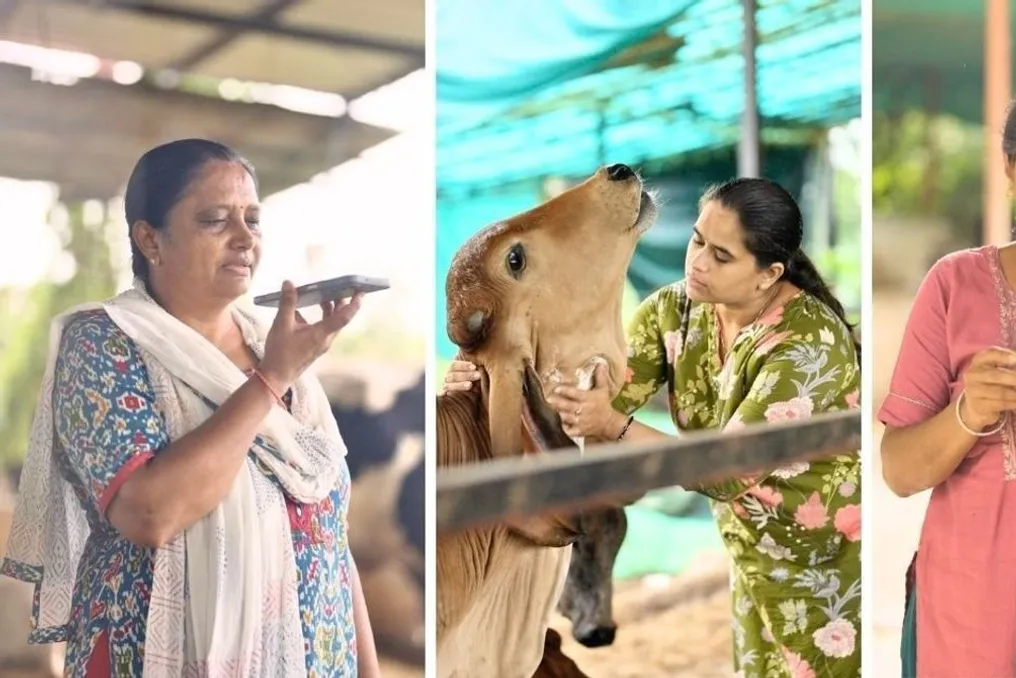
In the village of Adjarpura in Gujarat, Gayatriben noticed a problem when one of her buffaloes started headbutting a tree. In another settlement, Ishnav (Palaj), Charmiben tried to understand the reason for a cow's abnormal growth despite deworming. For farmers, such questions often require prompt answers, and now both women can turn to an artificial intelligence system and ask the question in their local language.
Across India, AI is finding new ways to support farmers by providing advice on sowing and weather, as well as assisting with livestock care and access to agricultural services. A study conducted by The Better India based on the Gates Foundation 2026 Goalkeepers Report included interviews with farmers and technology leaders, as well as an analysis of initiatives like MahaVISTAAR from Maharashtra and Sarlaben from Amul, to understand how AI adapts to the daily needs of farmers and how this can improve the accessibility of useful, personalized information locally.
Dipali Kalbhor, a small farmer and entrepreneur from Maharashtra, has gone through a long journey full of failures and new opportunities. After failing in poultry farming, she recovered her income by engaging in beekeeping, increasing the number of hives from 30 to over 1000.
Kalbhor notes to The Better India that one of the main lessons for farmers is the need for a strong team and access to the right information. She learned about MahaVISTAAR during an agricultural training and now uses it to get data on crop prices, weather forecasts, pest control, and government schemes. The fertilizer calculator proved particularly useful, helping her reduce fertilizer use by approximately 15%. Furthermore, the platform allows checking local product prices and contacting agricultural officials, which she calls a tool she uses 'at least two or three times a day.'
She also used the platform to get recommendations for growing 10,000 mulberry saplings in a nursery, information on vermicompost schemes, and contacts with government officials.
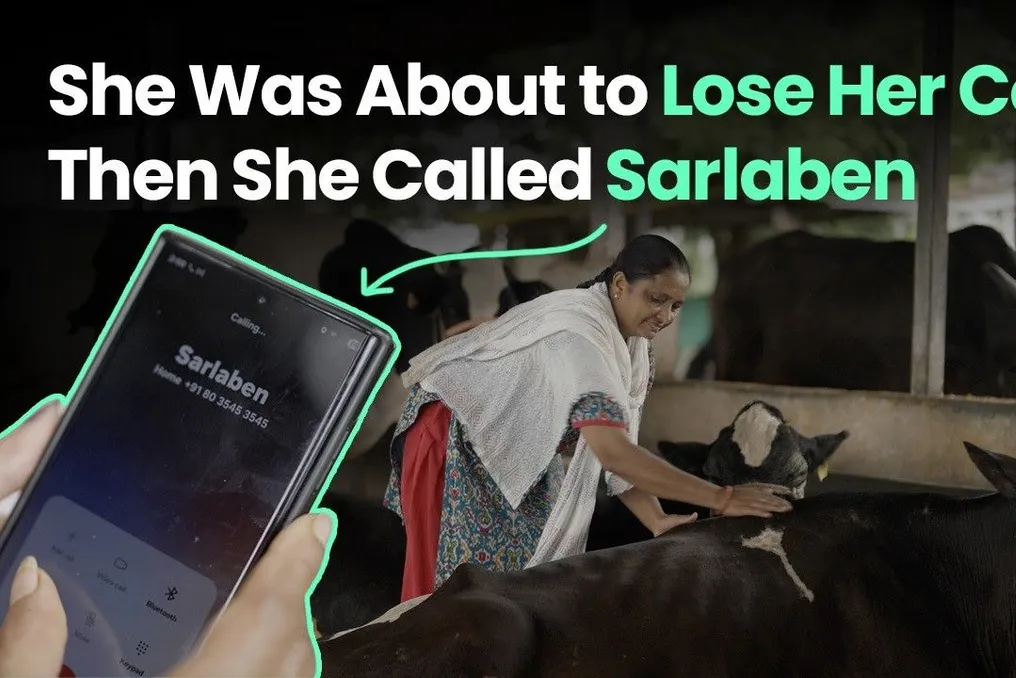
In Gujarat, Amul implemented Sarlaben—an AI-based assistant that provides dairy farmers with recommendations on livestock health, feeding, breeding, vaccination, and government programs in Gujarati. Gayatriben shares her experience: 'One of our buffaloes would not stop headbutting a tree. Previously, I had to contact the cooperative, pay 150 rupees for a vet visit, and then wait for a solution. Now I just call Sarlaben.'
Sarlaben suggested that the cause might have been itching around the animal's horns and advised cleaning the area with oil, followed by applying turmeric and oil. Gayatriben confirmed: 'And it worked!'
Minnaben faced a more serious situation when a cow was about to give birth, but no calf appeared. 'We thought we would lose her. She was about to give birth, but the calf wouldn't come out. In a panic, we called Sarlaben.' The system helped them realize the seriousness of the situation and connect with a specialist. Although the calf did not survive, the cow remained alive. SarlabenAI helped the farmer understand when specialist intervention was required.
For Charmiben, the problem is simple: animals cannot communicate pain. 'My cows are my family,' she says. 'But at home, my children can say, 'Mom, my stomach hurts.' My cows cannot tell me when something is wrong, right?' Therefore, when she is unsure, she says, 'Now I just ask Sarlaben.'
According to Ajay Seth, Head of IT at Amul, Sarlaben uses information that Amul already possesses about farmers and their livestock. He explains: 'Sarlaben identifies farmers by their mobile phone number. The system links their questions to the data that Amul already has about their animals.' He emphasizes: 'Thus, it will never be general advice; instead, it can be 'specific to your cow, backed by years of Amul's research in dairy farming.'
Language also shapes this experience. Gayatriben recalls: 'When I first spoke to Sarlaben, I thought it was a real person. Her Gujarati was better than mine. I couldn't believe I was talking to AI!' Minnaben adds: 'Previously, when the cow came into heat, we had to call the cooperative. Now Sarlaben tracks the heat cycle, shows me technicians, and helps instantly book experts.'
When one of Charmiben's cows grew abnormally despite deworming, she provided its name and identification number and received recommendations on what to feed it. 'And it worked!' she says.
The Gates Foundation 2026 Goalkeepers Report, Make This Matter: AI, Equity, and the Choice We Can’t Delay, identifies linguistic nuances, local context, and accessibility as central issues for ensuring AI equity. The report points out that over 90% of the data used to train early large language models came from English-language sources. India has 22 recognized languages, as well as hundreds of other languages and dialects.
In agriculture, misunderstanding can affect what a farmer sprays, feeds, plants, or harvests. The report argues that AI tools must work in the languages people speak and be developed in collaboration with those who rely on them. Professor Ganesh Ramakrishnan, one of the Goalkeepers 2026 Champions, a professor at IIT Bombay and lead researcher and board member of BharatGen, an Indian multilingual AI initiative, believes that AI cannot simply be created elsewhere and then translated. He asks: 'Does the model think like an Indian, or more precisely, an Assamese, or someone in a remote part of South India?' He describes a woman in a kitchen in Tamil Nadu trying to get information against the background of a whistling rice cooker, demonstrating that the technology must function within real life.
He insists: 'It is very important for us to implement innovations together with people, not just for people.' He refers to the end-user as a 'co-inventor.'
Debjani Ghosh, a Goalkeepers 2026 Champion recognized for her work on human-centered AI, envisions a scenario where farmers wake up and receive information about the weather, what it means for their crops, and whether any action is required. Ghosh advocates for India's 490 million informal workers—from street vendors to farmers—who are often overlooked in global AI discussions and risk being left behind.
'You open your phone, and you have all the information regarding the weather, rain, lack of rain, what it means for your crop, whether you should take any steps,' she says. 'It will be a voice message; you don't even have to read, you can listen and understand.'
For Ghosh, this means that technology becomes 'invisible.' 'We must make people's lives easier,' she states. 'We must make people's livelihoods easier. We must make people's lives better.'
For farmers, this promise depends on AI's ability to understand their questions, recognize their local context, and respond in the language they actually speak. As the Gates Foundation Goalkeepers Report emphasizes, timely actions to create inclusive and accessible AI can help ensure that this technology becomes a force for greater equality, and that those who benefit most are not left behind.