The Mid-Autumn Festival, also known as the Reunion Festival, is approaching. For people in China, the moon holds deep symbolic meaning, representing reunion, longing, and unique Chinese romanticism.
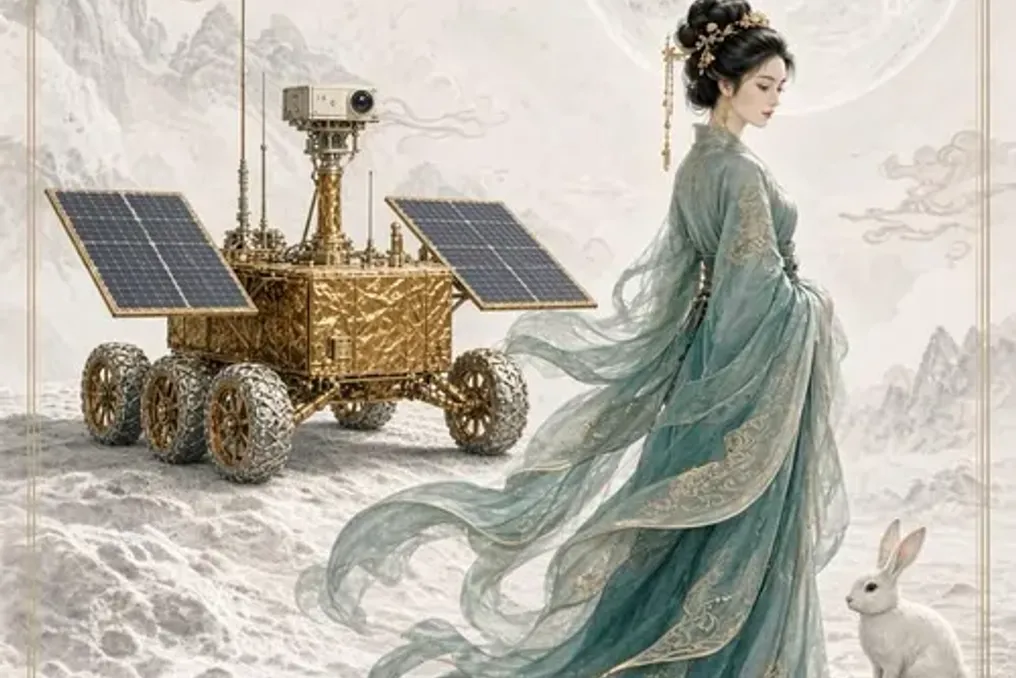
Although many know the legend of Chang'e flying to the Moon and Yu Tu (the Jade Rabbit) preparing medicine, few visitors are aware that Chang'e and Yu Tu are also the names of spacecraft. What ancient China envisioned during the full moon is now traveling in space.
This festival ranks second in importance after the Spring Festival. For centuries, the full moon has symbolized family togetherness, a meaning that remains unchanged.
Reunion Under the Moon
Mid-Autumn Festival falls on the 15th day of the eighth lunar month according to the Chinese lunisolar calendar, in the heart of autumn. The classic setting includes a round table, a box of mooncakes, several plates of fruit, often pomelo, and sometimes lanterns.
Mooncakes are cut according to the number of people at the table, with each person receiving one piece. If someone could not return home, that piece is set aside until their return, so the circle is complete. Traditions vary depending on the city. In Xiamen, Fujian province in southeastern China, they practice the Bo Bin game, which was previously a comfort for soldiers missing home and has now been listed as intangible cultural heritage. In Beijing, one can find clay rabbits Tu'er Ye in parks or along the old moat. In Shanghai, it is easy to find Cantonese, Suzhou, and New Style mooncakes in parks or along the riverfront. In Hong Kong, people cut mooncakes in tea houses and stroll with lanterns.
Mid-Autumn Festival follows the Chinese calendar, so the Gregorian date changes annually, usually falling in September or October. For example, in 2026, the festival will take place on September 25th.
Mooncakes were originally offerings to the Moon, and later the round pastries became a symbol of family unity. Eating a mooncake is only half the ritual; the second half is cutting it and passing it to everyone.
The Taste of Mooncakes
The filling and crust vary across different regions, with five styles being the most common. Cantonese is a thin shell with a large amount of filling, found everywhere. The Beijing style features moderate amounts of sugar and oil, giving it a richer taste. The Suzhou style is characterized by a flaky texture that crumbles when bitten. The Tiehuei style has a shorter crust and thinner filling, being rich but not heavy. The Yunnan style is known for its ham mooncakes—they are savory first, then sweet. It is important to remember that this is not a dessert, and clarification should be sought before consumption.
The safest choice for a first introduction is lotus seed paste with salted egg yolk, as well as red bean and coconut. Five-nut varieties can be too complex for young Chinese eaters. Classic Cantonese mooncakes are rich in oil and sugar, so they should not be perceived as an ordinary slice of cake. In southern China, mooncakes are cut into small pieces and eaten with hot tea or pomelo.
The heart of Chinese moon myths lies not in the goddess's biography, but in the longing and the desire to reunite. Three figures constantly appear on the Moon.
Chang'e Flies to the Moon
Chang'e swallowed the elixir of immortality and flew to the Moon Palace. Since then, she and her husband Hou Yi have been watching each other from a great distance. When people honor the Moon during the Mid-Autumn Festival, they are largely paying tribute to her.
Yu Tu, the Jade Rabbit, grinds medicine on the Moon. In Beijing, this rabbit transforms into the Tu'er Ye—a clay amulet and toy for children. Wu Gang eternally chops the laurel tree beneath him, which regenerates as quickly as he cuts it. This work never ends, just like the longing.
China is rich in moon poetry. A famous line by Su Shi states: 'May we live long and share this moonlight for thousands of miles.' Even if you cannot sit at one table, you can still look at the same full moon. In this poetry, the moon itself is the beauty.
China's Journey to the Moon
In the last decade, China's lunar exploration program has achieved numerous successes. The program was approved in 2004, and the first probe was launched in 2007. Romance is preserved in the names: the probes are named Chang'e, and the rover is named Yu Tu. The relay satellite transmitting signals from the far side of the Moon is called Qiuquan—the Sparrow Bridge, named after the legend of the Shepherd and the Weaver, a bridge allowing separated sides to meet again.
China's lunar exploration program has made significant achievements: Chang'e-4 achieved the world's first soft landing on the far side of the Moon. Chang'e-5 completed the collection and return of lunar samples, and Chang'e-6 achieved the first ever return of samples from the far side of the Moon.
The significance of China's program extends beyond a national achievement, as it has made a unique contribution to the study of the Moon for the entire world and provided an open platform for international cooperation.
New Ways to Spend the Evening
Mooncakes no longer consist solely of oil and sugar. Now, shelves can be found with options featuring ice cream, chocolate, and other unusual flavors. Young people share photos of the Moon on social media or visit museums in Hanfu at exhibitions dedicated to the Moon. Some shopping malls even sell mooncakes for pets.
Forms continue to change, but the Moon itself remains the same. To celebrate the evening, you do not need an altar of ancient paintings; a modern style of mooncake and an evening spent under the sky are enough.
} , {