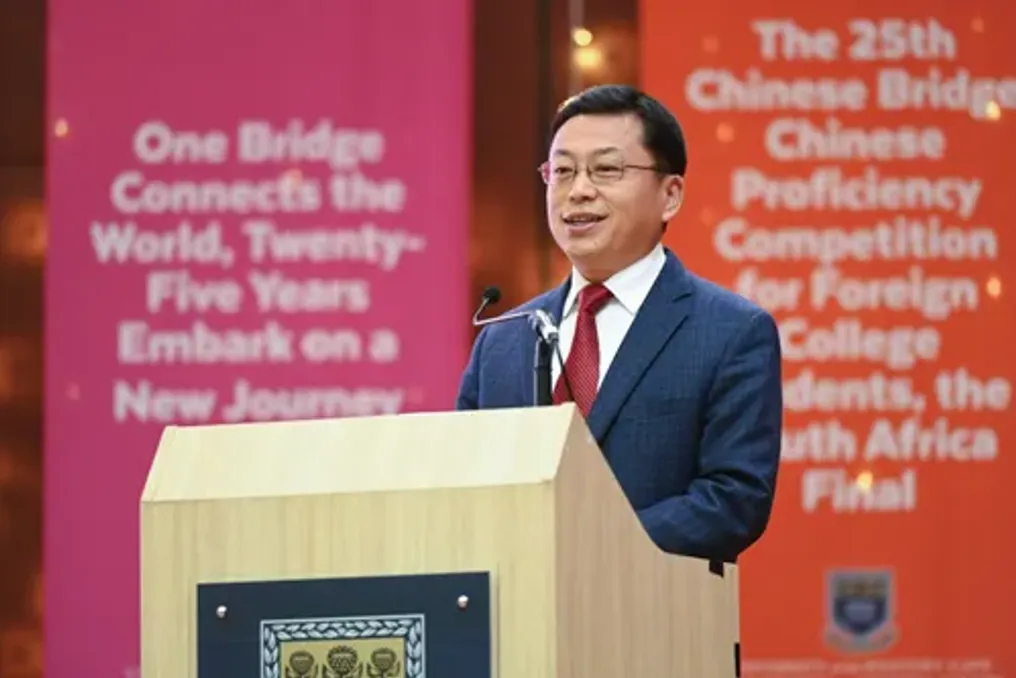
The Consul General of China in Cape Town, Ren Feicang, stated that China will continue to cooperate closely with South Africa to utilize the potential of science, technology, and innovation for mutual development, promoting the modernization of China and Africa, and contributing to building a community with a common future for humanity.
2026 marks the 28th anniversary of the establishment of diplomatic relations between China and South Africa. Bilateral ties have been elevated to a comprehensive strategic partnership in the new era, with cooperation in science, technology, and innovation steadily developing and yielding significant results. Three provinces served by the Chinese Consulate General in Cape Town—Western Cape, Northern Cape, and Eastern Cape—serve as prime examples of this deepening interaction.
This month, the 19th Putian Innovation Forum in Shanghai proudly hosted South Africa as its first African guest of honor. Meanwhile, the 18th World Health Assembly, held in Cape Town, brought together China and South Africa to focus on global health governance. These two major international events complemented each other, demonstrating a new chapter in China-South Africa cooperation in science, technology, and innovation, and setting a positive example for south-south cooperation in science and technology.
China-South Africa cooperation in science, technology, and innovation consistently benefits from the strategic guidance of leaders from both countries. In July 2018, a High-Level Dialogue between Chinese and South African scientists took place in Pretoria. Chinese President Xi Jinping and South African President Cyril Ramaphosa jointly attended an exhibition showcasing the achievements of bilateral scientific and technological cooperation. President Xi noted that the breakthroughs achieved by Chinese and South African scientists in science and technology have attracted worldwide attention, and that the scope of cooperation continues to expand.
In March 2026, Chinese Vice President Han Zheng and South African Deputy President Paul Mashatile jointly chaired the ninth plenary session of the China-South Africa Binational Commission in Cape Town, injecting new strategic momentum into science, technology, and innovation cooperation. In June, the Chinese Embassy in South Africa and the Department of Science, Technology and Innovation of South Africa jointly held the China-South Africa Young Scientists Symposium in Pretoria. The event was attended by, among others, the Chinese Ambassador to South Africa Wu Peng, South African Minister of Science, Technology and Innovation Professor Blade Nzimande, and the President and Chairperson of the South African Academy of Sciences Professor Tokozani Majozi.
On July 16 in Shanghai, China, the Artificial Intelligence Cooperation Organization was officially launched, with Minister Nzimande attending the opening ceremony in China. The strategic consensus between the two countries is transforming into an increasingly rich spectrum of practical outcomes. The scientific and technological communities, as well as industries in both countries, continue to support the traditional friendship between China and South Africa, working together to define a path toward mutually beneficial development in science, technology, and innovation.
Diplomatic relations between China and South Africa were established in 1998, and in 1999, the countries signed the Agreement on Scientific and Technical Cooperation, making innovations in science and technology a vital foundation of their long-term friendly partnership. Over nearly three decades, the scope of cooperation has expanded—from joint research to talent development, from advanced technologies to the practical application of research findings.
According to information published by the South African Department of Science, Technology and Innovation in March of this year, more than 150 joint R&D projects have been implemented since the signing of the Science and Technology Agreement in 1999. These projects cover a range of priority areas, including healthcare, space science and astronomy, energy, traditional medicine, mineral development, and agricultural sciences. Joint research, personnel exchange, and capacity building are deepening continuously, transforming strategic consensus into tangible results.
Exchanges among young scientists, joint research centers, and science park initiatives continue to develop, and new areas such as artificial intelligence, quantum technologies, space science, and cybersecurity have also been included in the cooperation agenda. The three provinces within the jurisdiction of the Chinese Consulate General in Cape Town are becoming increasingly integrated into the broader framework of China-South Africa cooperation.
The 19th Putian Innovation Forum successfully took place in Shanghai from September 11 to 14 this year. For the first time, South Africa served as the guest of honor, becoming the first African country to hold this role. Minister Nzimande led the delegation at the forum, presenting achievements in agriculture, traditional medicine, intelligent technologies, smart energy, hydrogen energy, and space science, with participation from representatives of the South African government, research institutions, universities, and enterprises.
This once again highlighted Africa's growing and deeper involvement in global scientific and technological cooperation. China-South Africa cooperation also holds broader multilateral significance. In platforms such as BRICS and the G20, the two countries continue to expand opportunities for cooperation in new technologies. The Square Kilometre Array (SKA) radio telescope project, including the mid-frequency antenna array located in Carnarvon in the Northern Cape, is a prime example of China and South Africa's joint participation in a major international scientific project.
The Putian Innovation Forum and the World Health Assembly serve as two important platforms emphasizing the broad potential for cooperation between China and South Africa in global science and technology governance.
At this new stage of the 28th anniversary of diplomatic relations between China and South Africa, China is ready to work with South Africa to deepen strategic alignment, strengthen traditional areas of cooperation, expand new directions such as digital intelligence, low-carbon development, and life and health, as well as enhance talent exchanges and joint scientific research. From the 1999 Agreement on Scientific and Technical Cooperation to over 150 joint R&D projects today—from youth exchanges to cutting-edge fields like artificial intelligence and quantum technologies—China-South Africa cooperation in science, technology, and innovation has laid a solid foundation and possesses broad prospects for the future.
The Chinese Consulate General in Cape Town will continue to play a role as a bridge and link, facilitating deeper and more substantial cooperation between the three provinces in its consular district and China in the field of science, technology, and innovation. Innovation knows no borders, and cooperation connects our future.
China will continue to cooperate closely with South Africa to utilize the potential of science, technology, and innovation for mutual development, promoting the modernization of China and Africa, and contributing to building a community with a common future for humanity.