Comparing Housing Purchase Strategies: How Using Mortgages and SWP Allowed Earning 20 Million Rubles Over 20 Years
Read more
Aaj Tak
www.aajtak.in

Comparing Housing Purchase Strategies: How Using Mortgages and SWP Allowed Earning 20 Million Rubles Over 20 Years

There is a debate about whether one should purchase an apartment by paying in cash or if a mortgage is a more advantageous option. To illustrate this dilemma, let's look at the example of two friends—Raj and Pankaj—who decided to buy an apartment worth 50 million rubles. Both friends initially had 50 million rubles in their bank accounts, but their decisions led to a huge financial disparity of over 20 million rubles after two decades.

Raj chose the old approach: he paid for the apartment entirely from his available 50 million rubles. As a result, he owned an apartment without any debts, but his entire cash reserve of 50 million rubles was exhausted.

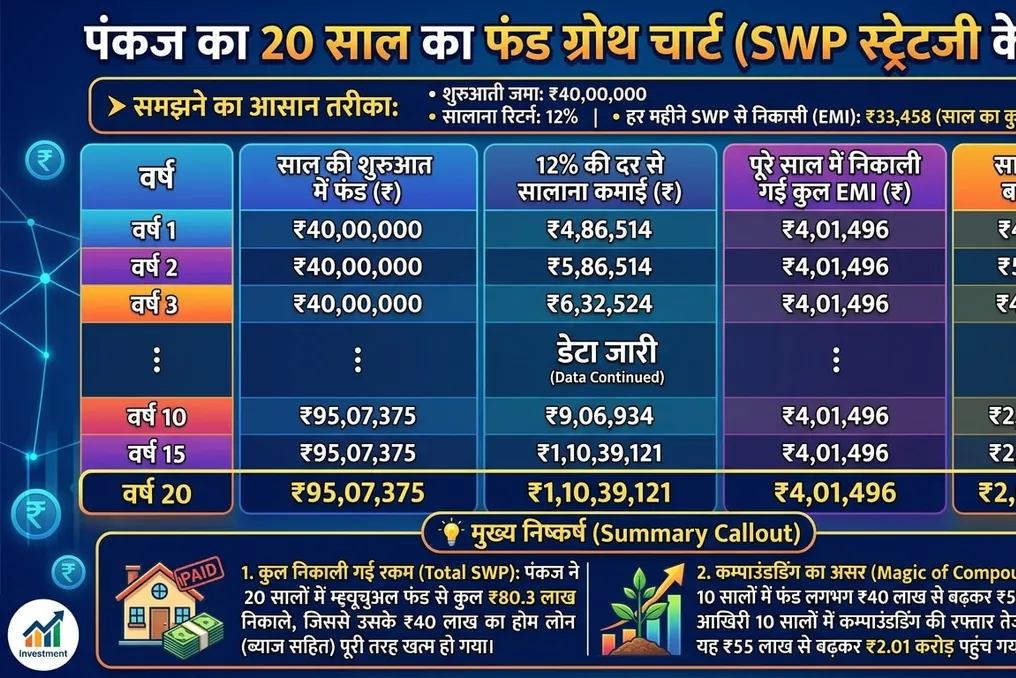
Pankaj approached the issue more rationally. He only paid 10 million rubles as a down payment, taking out a mortgage loan for the remaining 40 million rubles at an annual interest rate of 8%. The monthly payment for this loan was 33,458 rubles. Simultaneously, Pankaj invested the remaining 40 million rubles in mutual funds.

Pankaj used a smart strategy by starting to use the Systematic Withdrawal Plan (SWP) from his investments. These funds were automatically directed to repay the mortgage loan each month in the amount of 33,458 rubles. At the same time, his investments in mutual funds yielded an average annual return of 12%.

Over two decades, Pankaj's investments grew thanks to a 12% return, while the loan interest was 8%. Since the investment return exceeded the cost of servicing the debt by 4%, Pankaj's principal capital did not decrease but continued to grow. Over 20 years, Pankaj withdrew a total of 80.3 million rubles from the mutual fund to repay the mortgage.

By the end of this period, both friends owned apartments whose value had increased by approximately threefold. However, thanks to proper capital allocation, Pankaj accumulated an additional large fund of 20 million rubles, while Raj was left only with real estate. This situation refutes the common belief that one should avoid debt and pay everything in cash; modern financial mathematics shows a different picture.

To understand how Pankaj earned about 2.01 billion rubles over 20 years, it is necessary to examine the mathematics of compound interest and SWP. This calculation depends on his investment's annual return of 12% being higher than the 8% annual mortgage rate. The initial contribution was 40 million rubles, the expected annual return was 12%, and the monthly withdrawal via SWP was 33,458 rubles. Over 240 months, Pankaj withdrew a total of 80,299,200 rubles (about 80.3 million rubles), fully closing his mortgage. Initially, the 40 million rubles grew to 55 million in the first 10 years, but thanks to the acceleration of compound interest in the last 10 years, the amount reached 2.01 billion rubles.
Similar stories

Cost of Living for a Two-Person Family in Gurugram: A Detailed Expense Breakdown from 3 BHK Rent to Food
Read more
www.aajtak.in

Cost of Living for a Two-Person Family in Gurugram: A Detailed Expense Breakdown from 3 BHK Rent to Food

In the expensive city of Gurugram, one married couple shared a detailed breakdown of their monthly expenses, which they posted on social media. According to their data, total monthly spending amounted to about 1.2 lakh rupees. These expenses include rent for a three-bedroom apartment (3 BHK), domestic help services, food, entertainment, and other necessities.

The couple, Mohit and Jotsna, who introduced themselves on Instagram, shared how they manage their budget while living in Gurugram as a family in their early 30s.

Mohit and Jotsna spend 36,000 rupees monthly on the rent and maintenance of their three-bedroom apartment. Additionally, they pay 6,000 rupees for household help, which covers cooking, cleaning, and kitchen work. Their expenses for internet and mobile communication are approximately 3,500 rupees, and for OTT and music subscriptions—about 2,000 rupees.

A significant portion of the budget is dedicated to groceries and daily necessities, for which the couple allocates about 25,000 rupees monthly. They also spend approximately 3,000 rupees on food and supplements for their dog. On weekends, the couple frequently visits cafes and restaurants, costing them around 15,000 rupees per month. Furthermore, about 3,000 rupees is spent on food delivery at home.

Since they do not own a car, they spend about 5,000 rupees on motorcycle fuel and taxis for travel within Delhi and Gurugram, although there are no commuting costs to the office. Monthly grooming expenses amount to about 5,000 rupees, and household goods and wellness items cost approximately 10,000 rupees.

The couple clarified that the stated amount of 1.2 lakh rupees is not the final sum of all their monthly expenditures. They save a portion of their income for investments, and the remaining salary is used for personal expenses.

At the end of their video, Mohit and Jotsna asked viewers: 'The total expense for two people in Gurugram for August is 1.2 lakh rupees. Is this too much or reasonable?'

Following the video's publication on social media, discussions began, particularly regarding the 36,000 rupee rent for a 3 BHK and the 6,000 rupee payment for domestic help. One user noted that the 36,000 rupee rent for a 3 BHK seemed quite reasonable. Another user expressed surprise regarding the 6,000 rupee amount for cooking, cleaning, and kitchen work. Some commentators suggested that finding a 2 BHK apartment in Gurugram within this budget might be difficult. At the same time, some users considered the couple's expenses quite modest, noting that if the figures are accurate, it is indeed an economical budget.

Popular