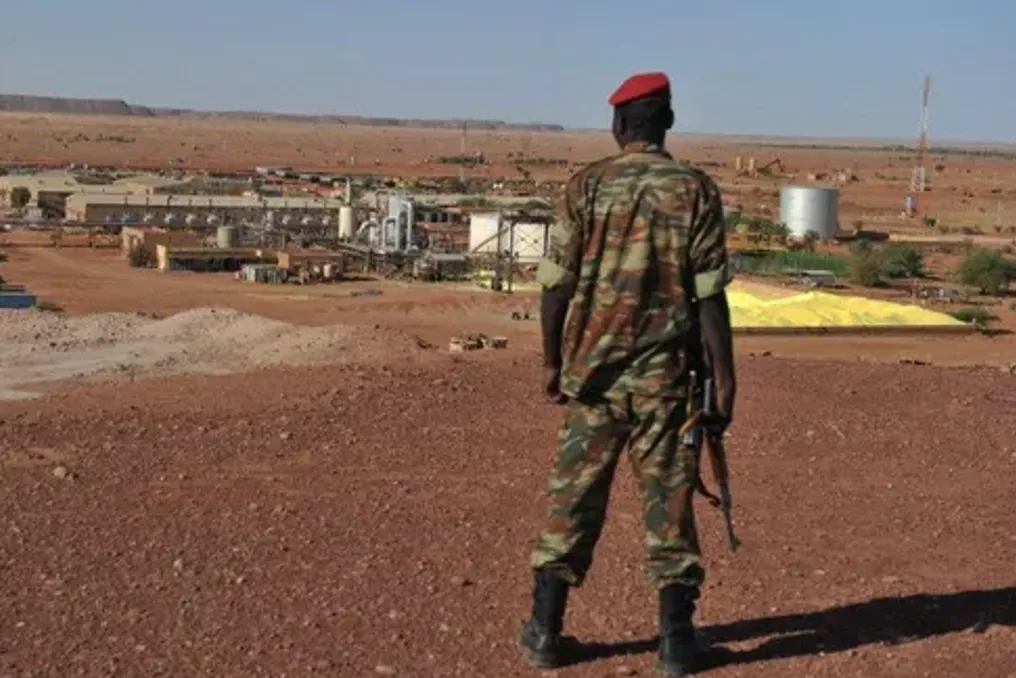
Despite the pursuit of sovereignty and decolonization, Niger faces a dilemma regarding a potential uranium deal involving the US. The author notes that the quest for independence does not always equate to a complete withdrawal from the global economy.
After Washington was forced to withdraw its troops from Niger just two years ago, there is a possibility of a return of American influence. The US International Development Finance Corporation has approved a credit line of up to $414.2 million for the Dasa uranium mining project, which is operated by the Canadian company Global Atomic. However, the US is not acquiring the mine itself; the financing through the DFC is intended for Global Atomic.
It is important to emphasize that this is not a grant for Niger. Global Atomic owns 80% of the Nigerien company SOMIDA, which manages Dasa, while the remaining 20% belongs to the Government of Niger. For Washington, this project holds significant strategic value in the context of seeking new sources of nuclear fuel.
At first glance, this deal contradicts the firm stance taken by Niger and the Alliance of Sahel States (AES) regarding sovereignty and decolonization. Over the past three years, Niger has gained greater control over its natural resources and security, pushing out the influence of both France and America.
Now, however, a US government institution is prepared to finance a Canadian uranium mine in Niger. A cynical interpretation of this event might suggest a return to the former world order. However, the author argues that decolonization cannot be measured solely by the number of foreign soldiers or the number of commercial agreements with companies or governments.
A more accurate criterion is a thorough examination of who determines the terms of extraction, who benefits, and how much of this economic value is transformed into sustainable development and sovereignty.
Niger's break with France is significant, as uranium was central to the country's relationship with its former colonizer. The Nigerien government took control of the Somaïr uranium mining operation after clashes with the French company Orano. Orano dominated this sector for decades but is now challenging Niger's actions through international arbitration. For Niger, replacing the French company with a Canadian one is not inherently an act of decolonization.
Nevertheless, accepting American funding does not automatically mean a return to colonialism. The pursuit of sovereignty does not require a complete disconnection from the global economy. This lesson was demonstrated in 1966 when Charles de Gaulle ordered the withdrawal of NATO headquarters and foreign troops from France so that the country could 'fully realize its sovereignty across its entire territory.'
Even after building its own nuclear power, France continued to trade in Western markets. This serves as an important example. Africa currently needs capital, technology, infrastructure, and markets to ensure significant and long-term national and regional development.
Interestingly, Botswana did not expel the company De Beers from its diamond industry. Instead, it opted for a 50:50 partnership with De Beers in Debswana, which led to significantly stronger local processing. Similar to Botswana, Ghana also leveraged its strategic influence to determine cooperation terms. In 2025, the Ghanaian Gold Council insisted that major mining companies sell twenty percent of exported gold locally. While these are small steps toward resource sovereignty, they represent a huge departure from historically exploitative partnerships with foreign powers.
Any country lacking adequate capital investment, national infrastructure, production and processing capabilities, technological knowledge, and reliable trade routes and markets will remain structurally dependent. Although Niger has sovereign control over its resources, this has not translated into economic power or sustainable prosperity.
The Dasa project has highlighted serious limitations currently facing Niger. Firstly, Niger is a landlocked country. Secondly, instability and threats of insurgent activity make its transport corridors increasingly vulnerable. Global Atomic is studying alternative export routes, and a potential corridor through Algeria is being considered. The financing itself is contingent upon the existence of a viable export route and agreements still under discussion with the Government of Niger.
The immediate task for Niger and the AES is to create an economic system where African states receive a substantially larger share of the value generated by their resources. Building optimal domestic capital, top-tier technical expertise, durable and scalable production and processing facilities, as well as alternative, future-oriented trade routes and markets—this is work spanning decades.
In many ways, achieving political sovereignty is simpler. It can even be as simple as withdrawing foreign troops abroad. Economic sovereignty, conversely, requires slow, methodical capacity building.
At present, the Dasa deal cannot be viewed as proof of success for Niger's sovereignty project, nor can it be prematurely seen as evidence of its failure. If Dasa turns into another enclave where raw materials leave Niger, but profits, technology, and strategic decision-making remain elsewhere, then the language of AES sovereignty will become nothing more than a hollow slogan.
However, if Niger can transform this deal into state revenue, qualified jobs, local procurement, infrastructure development, technical capacity, and enhanced negotiating power, then foreign financing can become a tool for transformation.
Decolonization is a matter of sovereignty. It is not a single event or a linear process. Its realization must be practical and pragmatic, not theoretical. The essence lies in defining the terms of interaction and changing the 'master-slave' relationship. Until now, African countries have been in a position where conditions were dictated to them. This must change.
Niger expelled foreign soldiers. It resisted France's historical control over its uranium. Now, it is negotiating the terms under which American financing can support a Canadian mine. General Abdourahmane Tiani stated that Niger 'has the legal right to dispose of its natural wealth and sell it to whomever wants to buy it, according to market rules, in complete independence.'
The main thing that will happen next is whether Niger uses its influence to ensure that this major uranium project benefits the people of Niger. If this is achieved, this uranium deal will be a reconfiguration, not a retreat from its agenda of decolonization and sovereignty.