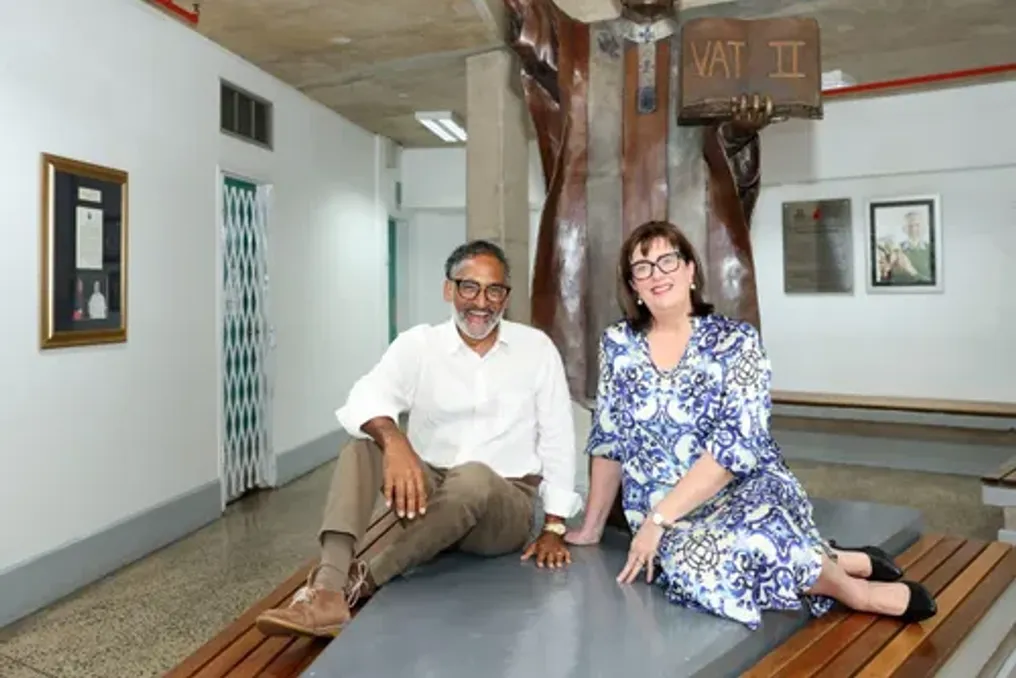
Raymond Perry, who became the first director of the Dennis Hurley Centre, is preparing to leave the organization he helped create. He is handing over the leadership of the centre to Bridget Ward.
Making a Difference
Perry worked with refugees fleeing war, taught children in some of Britain's poorest areas, and helped people living on the streets both abroad and locally. After twelve years as the director of the Dennis Hurley Centre in Durban, the 60-year-old North Beach resident stated that his life path was shaped by faith, music, theatre, human rights, and a desire to make things better.
Childhood
Perry was born in Chelmsford, UK. His parents, Winston Perry (deceased) and Phil, came from Catholic families and were born in India. His father was from Delhi, and his mother was from Bombay (now Mumbai). Perry recounted that they met in college, and after his father found work in Britain, he invited his mother to join him and his mother, Winnie, which she agreed to. If she had stayed in India, she would have joined her four nun sisters.
After their marriage, they had their first child, Gordon (also deceased), and Perry was born a year later. Perry's mother and grandmother were primary school teachers, while his father, an education engineer, worked in market research. Perry noted that his father loved to analyze things, was an analyst and a thinker, traits he inherited.
He mentioned that his grandmother was deeply religious, and at the age of five, he could read Latin prayers that she taught him. The family never missed church attendance, and this was part of their cultural identity. At an early age, Perry became interested in performances, and together with his brother, he started ballroom dancing. His mother was a seamstress, and the parents of the girls attending the ballroom lessons asked her to sew them dresses. Perry took this seriously and received the highest award in ballroom dancing at age 11—the Alex Moore Award from the Imperial Society of Dance Teachers.
Education
He attended two Catholic primary schools from first to fourth grade, and then, after passing the British 'eleven-plus' exam at age 11, entered the elite King Edward VI Grammar School. Perry noticed that when applying to the school, he was drawn to the list of students who would later attend Oxford or Cambridge universities. Despite high academic achievements, his attention was captured by music and drama, and he participated in the school's drama club.
He shared an unforgettable experience when the drama teacher took them on a trip to London to see a play. At ages 11 and 12, he watched Shakespeare productions and a seven-hour Greek tragedy, and also attended the opera, calling it an exceptional experience.
Further Studies
In 1984, Perry enrolled at Oxford University, initially studying French and Italian, but later switched to theology and philosophy. His initial dream was to become either a theatre director or a bishop. He recalled writing an essay at the age of seven about becoming the Pope someday, which demonstrated his ambition. He also knew he could study theology later if he wanted to become a priest, so he decided to focus on his other interest—languages.
In his first year, he realized it required a great deal of reading in different languages, and he couldn't pursue what he loved—music and drama, so he switched to theology and philosophy the following year. Furthermore, he realized he no longer wanted to become a priest as he became more consciously aware of his homosexuality and did not want to be one of those who hid in the church. Nevertheless, he continued his studies in theology.
In 1987, he earned a Bachelor of Arts degree in Theology and Philosophy, which was later upgraded to a Master's degree by the university. He subsequently obtained a Master of Philosophy from the University of London, a Master of Science in Human Rights from the London School of Economics, and a Doctorate in Christian History from the University of KwaZulu-Natal.
Career
During his studies, he got his first part-time job at Interbrand, a branding and marketing company, starting in administrative work. After graduating, Perry remained in business until he decided what to do next. What was supposed to be temporary turned into 14 years, and before leaving, he managed an office in New York where 160 people worked.
His corporate career eventually led him to South Africa in the 1990s. At that time, Interbrand had an office in Johannesburg. Famous businessman John Rupert read his book on branding and contacted their office to meet him. After much persuasion, Perry traveled to South Africa. During this time, he visited places such as Garden Route and Drakensberg, which captivated him about the country.
Perry noted that despite his successful corporate career, his priorities began to change. At 33, a friend who wished to become a mother approached Perry and his male partner with a proposal to have a child. He had to think about it, and he decided to go on a retreat to a monastery in London. Upon arrival, a voice echoed in his head: 'If you become a father (parent), you can never become a priest.' He added that he hadn't thought about priesthood since he was twenty, but over these 13 years, a seed had sprouted within him that had not died.
Perry then began volunteering for a homeless charity. He lived in the same city but was unaware of a completely different aspect of life. He felt that weekly volunteer work and monetary donations were not enough. He wanted to bring about change, and since he was a religious person, he wanted to do it in this context and become a priest. He also realized that becoming a parent would prevent him from doing this, so he had to decline the offer.
After this, he was transferred to manage the New York office, where he met Jesuit Catholic priests (Society of Jesus)—a revolutionary part of the Catholic Church—and realized he wanted to join them. As a Jesuit, he takes three vows—poverty, chastity, and obedience. This was radically different from the life he had been leading. He then decided to return to Great Britain, which meant giving up his job, money, and partner, and began training with the Jesuits.
This experience introduced him to communities facing poverty and hardship. He was assigned to work in a primary school in the city center. He found himself there, possessing 14 years of international business experience, sitting on a small plastic chair teaching eight-year-olds mathematics or playing with them. He also visited prisons, worked in homeless charities, and in a refugee camp known as Rhino Camp in Uganda, which changed his life.
He recounted spending two years in an area without running water, electricity, or roads, among about 60,000 Sudanese refugees who fled their homes due to the war at the time. Five of them lived in the camp, and they conducted educational programs and adult literacy courses, as well as skills training at the school. He had never seen such extreme poverty, but the refugees were happy because they had survived seeing their loved ones shot near them.
Ultimately, Perry left the Jesuits but remained committed to working in a faith-based environment. In 2010, he received a call from the Jesuits in Johannesburg that they were establishing an institute and needed his help. Memories of his time in South Africa in the 1990s flooded back to him. He agreed, but said it would only be for two years, after which he would return to Great Britain.
Dennis Hurley Centre
In 2014, Perry was asked to help at the Dennis Hurley Centre. He often visited Durban to give lectures and met the late Paddy Kearney (an anti-apartheid activist). They dined together, and he learned that the centre was being established and they were looking for a director. What interested him was not only what the Catholics were doing but also how the Catholics interacted with other people: Anglicans, Methodists, Indians, Muslims, and Jews. He thought, 'Wow, this is interesting,' and agreed. He said he would help establish the centre, but only for two years. Twelve years later, he is finally handing it over.
Helping the Most Vulnerable in Durban
The Centre provides food, medical care, and skills training to help people change their lives. Perry recalled a man who used drugs and lived on the street who once entered his office, looking fresh and dressed in new clothes. He told him about the rehabilitation program and subsequent employment. Perry thought, 'We are truly changing situations.' However, he admitted that much more needs to be done.
Key Highlights
In 2020, Perry participated in Durban's emergency response to homelessness during the Covid-19 lockdown. As chairman of the eThekwini Homelessness Task Team, he helped unite government, business, and civil society. He recounted that within three hours of the lockdown announcement, they met with key government institutions and businesses to understand how to ensure the safety of 15,000 homeless people in Durban. They managed to organize shelters and ensure the safety and sustenance of the people within four days. He noted that this response demonstrated the strength of cooperation between religious communities.
The Centre also runs the Street Lit project, which helps homeless and formerly homeless people earn a basic income by selling donated second-hand books. Perry stated that this initiative changed people's perception of the opportunities available to the homeless. He is also one of the founders and former chairman of the National Network Against Homelessness.
New Chapter
Perry said it was time to pass the organization to a new director. He informed the board of directors two years ago that his decision to step down was due to concern for the organization's health. Bridget Ward will take over as director at the end of the year. Perry, a researcher at the Faith and Community Centre at Pretoria University, plans to write his fourth book. Since November marks 20 years since the legalization of same-sex marriage in South Africa, the book will focus on the reaction of religious institutions to this phenomenon.
Leisure
He and his husband, Eckert Fury, a dentist, enjoy theatre and art galleries. Perry still loves the opera. However, he said he is not ready to retire and intends to continue fighting against injustice.