Exploring the Rich Heritage of KwaZulu-Natal: Potential for Tourism Development
Read more
IOL
iol.co.za

Exploring the Rich Heritage of KwaZulu-Natal: Potential for Tourism Development

As Heritage and Tourism Month concludes, Sibusiso Ndebele, Chairman of Tourism KZN and Film, emphasizes the need for South Africans to discover and engage with the rich cultural heritage of KwaZulu-Natal, thereby unlocking the province's tourism potential while preserving its unique legacy.

The question that arises during this period is how deeply South Africans are familiar with the heritage of KwaZulu-Natal. Many know places like Isandlwana, Rorke's Drift, and Spionkop, as well as the names of Zulu kings, Nelson Mandela, and Mahatma Gandhi. However, there is a difference between knowing history and visiting the places where these events occurred, standing in those landscapes, and hearing the relevant stories.

KwaZulu-Natal offers exceptional opportunities for historical tourism: from battlefields and San rock art in the Drakensberg to sites associated with eMakhosi, Inanda, and Nelson Mandela's prison. As noted during Heritage Month in Appleboshe, there are important stories in rural communities that have not yet realized their full potential as visitor experiences.

The task is not to find a new story for KwaZulu-Natal, as they already exist; the problem is to turn more of them into journeys that people want to undertake.

Experience working as High Commissioner of South Africa in India and Ambassador to Australia has shown how powerfully heritage can stimulate tourism. For example, the Taj Mahal is an iconic Indian landmark, but the story of its heritage is much broader than one monument, including the complex in Agra with the Agra Fort.

Delhi demonstrates layers of history through sites such as the Red Fort, Humayun's Tomb, Qutub Minar, and monuments related to modern India. In Amritsar, the Golden Temple shows a different aspect—how faith, living religious practice, history, and place can become a strong reason for travel.

England provides another example: visitors move between very different eras, from prehistoric Stonehenge and Roman baths to the Tower of London, historic cathedrals, castles, old towns, and industrial heritage. These elements are presented not as competing narratives, but as different ways to experience the country.

Australia shows that heritage does not necessarily have to focus on buildings and monuments. In Uluru and Kakadu, Aboriginal culture, ancient rock art, storytelling, and the connection between people and land are integral parts of the visitor experience. Australia also interprets complex chapters of its colonial history through detention sites like Port Arthur and Fremantle Prison.

These examples also prove that heritage is not just about preserving the past, but is an important part of the hospitality economy. Attractions draw visitors to cities, villages, and communities, encourage them to stay longer, and create demand for accommodation, restaurants, guides, transport, crafts, and other local businesses. Thus, the economic value of an attraction extends far beyond the site itself.

Despite the differences in the history of these countries, there is a common lesson for KwaZulu-Natal: successful heritage destinations recognize the various layers of their history, interpret them skillfully, and use them to create reasons for travel, longer stays, and greater visitor spending.

KwaZulu-Natal possesses similar depth. Its San heritage, Zulu culture, battlefields, liberation struggle, missionary, and religious heritage represent different chapters of KwaZulu-Natal's history, and with effective development and linkage, they can become an even stronger part of the tourism economy.

Battlefields Demonstrate Opportunities

There is compelling evidence that people are willing to travel for these stories. Visitors from South Africa and abroad come to Isandlwana to learn how the Zulu army defeated British forces on January 22, 1879, in one of the defining battles of the Anglo-Zulu War. The nearby Rorke's Drift tells another chapter of the same conflict.

In Spionkop, visitors immerse themselves in the history of the South African War and encounter a battlefield associated with figures like Winston Churchill, Mahatma Gandhi, and Louis Botha. However, the battlefield itself is just a landscape. What changes the experience is the interpretation. A knowledgeable guide allows the visitor to understand who was there, what happened, why it happened, and why these events are still important.

History turns a place into an experience. And when these places are connected, we begin to create a journey. A person who stops at one place for an hour has a limited impact on the local tourism economy. A person who follows a route can stay overnight, eat locally, hire a guide, use transport, and visit other attractions.

Therefore, a heritage route cannot simply be a collection of points on a map; it must give the visitor a reason to continue the journey.

Appleboshe: Seeking Another Story for KwaZulu-Natal

This is why our experience in Appleboshe during Heritage and Tourism Month was significant. We joined the community as Appleboshe Hospital celebrated its centenary. But the hospital is only one chapter of a much larger story.

The presence of the Swedish mission in Appleboshe dates back to the nineteenth century. By 1886, the building in the area served as both a church and a classroom. Over time, this story of faith and education expanded to healthcare, and Appleboshe Hospital was founded in 1926. There is a natural connection between this history: faith, education, and healing.

As part of our Heritage Month program, we went beyond the hospital into the surrounding community and its religious heritage, including the parishes of Zwatini and Nhlankazhi. We also listened to the people who hold this history, including 95-year-old alumnus Caleb Chaman.

This raises a practical tourism question: why do these stories remain known mainly to the people who live there? The history of the Swedish mission gives Appleboshe an international connection. The churches provide the religious heritage. The hospital brings a century of healthcare history. Former students and elders hold the living memory. Separately, these are distinct stories. Connected and properly interpreted, they can begin to form a journey.

The opportunity is not to create a tourist attraction, but to take what is authentic to Appleboshe and explore how it can develop into a meaningful religious and cultural tourism experience that can also attract visitors and economic activity to the area.

Our Opportunity is Much Greater

Similar thinking applies to other parts of KwaZulu-Natal. Ukhahlamba-Drakensberg contains incredible San rock art dating back thousands of years. In eMakhosi, the Valley of the Zulu Kings, the landscape carries the history of the Zulu people. In Inanda, the heritage of John Langalibalele Dube and the Olange Institute is in the same broad historical landscape as Mahatma Gandhi's Phoenix Settlement. Outside Howick, Nelson Mandela's prison demonstrates how a defining moment in our liberation history can become a contemporary experience for visitors.

Our advantage is the diversity of these stories. However, having heritage assets is not enough. It is necessary to determine whether visitors can easily find them, if there is a convincing interpretation upon arrival, what else they can experience nearby, and what will convince them to spend another day or night in the area.

This is the difference between having heritage and developing heritage for tourism. There is also an important economic argument, especially when we aim to expand tourism beyond the established tourist centers of the province. Heritage-based tourism can bring visitors to rural towns and communities without the need to build large new attractions. Their strongest tourism asset may already exist in their history, culture, landscape, and people.

But communities must participate in creating value. Who guides the visitor? Where do they eat and sleep? Who provides transport? Can local storytellers, artisans, and small businesses benefit? If tourists pass through a community, but very little of their spending remains there, we have not realized the full potential of heritage in tourism.

This is why routes are important. They encourage visitors to travel further and stay longer, creating opportunities for accommodation, dining, guides, transport, and other local enterprises along the way.

A Challenge Beyond September

As Heritage and Tourism Month draws to a close, perhaps the question to carry forward after September is whether we are doing enough to engage with our own heritage. Millions of people travel around the world to see the Taj Mahal, explore the layers of Delhi's history, visit the Golden Temple in Amritsar, walk through England's historic landscapes, or experience Aboriginal culture in Australia. We must treat what is in KwaZulu-Natal with the same confidence.

We must stand at Isandlwana and Rorke's Drift. We must walk the landscape of Spionkop. We must experience the San rock art in the Drakensberg and the history of eMakhosi. We must visit Inanda and Nelson Mandela's prison. And we must continue to find stories that are not yet included in established tourist routes, as we are beginning to do in Appleboshe.

KwaZulu-Natal does not need to invent its heritage. It needs to be experienced, preserved, better told, and connected. This is how Heritage Month goes beyond commemorating the past. It can prompt South Africans to travel through their own history while inviting visitors from all over the world to discover the extraordinary stories that have shaped this province. And importantly, it can transform this interest in our past into today's economic activity, creating opportunities for communities that have preserved these stories for generations. Our heritage is already here. The journey is ours.


Similar stories

South Africa's Heritage as a Bridge Between the Continent and the World
Read more
iol.co.za

South Africa's Heritage as a Bridge Between the Continent and the World

Heritage is often perceived as what we inherit from our predecessors, found in monuments, museums, archives, languages, traditions, and places of memory. However, heritage extends beyond a mere reference to the past; it is also connected to understanding one's own identity, interacting with others, and shaping a desired future.

For South Africa, heritage plays a particularly significant role, as its history is closely linked to the history of the African continent and the global struggle for dignity, human rights, and freedom. The experience of liberation, transition to democracy, and constitutional settlement has generated lessons that extend beyond national borders.

The Constitution itself reflects this forward-looking goal. Its Preamble speaks to the necessity of healing past disagreements and building a unified, democratic South Africa capable of occupying its rightful place among the nations of the world. It is here that heritage can transform from a simple remembrance into a form of cultural diplomacy.

Although diplomacy is usually associated with governments, ambassadors, and formal negotiations, nations also communicate through their culture, history, people, and institutions. The realm of heritage can create a different diplomatic context where people meet not only as representatives of governments but also as individuals striving to understand one another. South Africa possesses a compelling history that can be shared.

Furthermore, it should be remembered that heritage should not be presented as a collection of isolated national stories, as African histories have always intersected. Movements, languages, ideas, cultures, and struggles crossed borders long before the emergence of modern nation-states. Therefore, South Africa has the opportunity to use its heritage to strengthen connections on the continent. Institutions such as Freedom Park serve as platforms for studying, documenting, and embodying these connections. Their mandate includes presenting African history from an African perspective and collaborating with African and international organizations in this field.

Such work can take many forms: joint research, exhibitions, conferences, educational programs, cultural exchange, memorial events, academic partnerships, and heritage tourism. These activities may seem diverse, but they share a common goal—creating opportunities for people and institutions to meet through history and culture. There is also an important opportunity to enhance the production of African knowledge.

For a long time, African history was interpreted through external frameworks. While international scholarship is important, African institutions must also have the capacity to research, preserve, and interpret their own historical systems of knowledge. Recognizing this, UNESCO highlights the importance of Africa's living heritage for strengthening cultural identity and shared values, and UNESCO's current work on African World Heritage involves capacity building and collaboration among heritage specialists. Thus, heritage institutions can become centers of knowledge, rather than just repositories of objects and memories.

This is especially relevant for youth. A young South African should have the opportunity to visit a heritage institution and learn not only about the origins of their country but also about how its history connects to the rest of Africa and the world. Similarly, a young person from another African country should have the opportunity to see aspects of their own history reflected in South Africa's heritage spaces. In this way, heritage can contribute to developing a stronger sense of African identity without diminishing the diversity of individual nations and communities.

There is also an economic aspect. Heritage-based tourism can create opportunities for local communities, cultural practitioners, researchers, entrepreneurs, and youth. International partnerships can expand these opportunities by linking heritage institutions with tourism networks, universities, museums, and cultural organizations worldwide. Recent initiatives supported by UNESCO in South Africa demonstrate the potential of partnerships that unite culture, heritage tourism, sustainable development, and community benefit.

However, perhaps the greatest diplomatic value of heritage lies in its ability to create spaces for complex conversations. South Africa's reconciliation experience does not offer a simple formula that can be exported to other countries, as every society has its own history and circumstances. Nevertheless, our experience demonstrates the importance of confronting complex historical events, rather than erasing them. The constitutional project was explicitly aimed at healing divisions, establishing democratic values, and creating a society based on human rights and social justice. These discussions remain relevant far beyond South Africa.

Shared histories between countries serve as a powerful reminder of humanity's interconnectedness. For example, our own Truth and Reconciliation Commission (TRC) drew inspiration from Chile's National Commission for Truth and Reconciliation, established by President Patricio Aylwin to investigate serious human rights violations resulting in death and disappearance during the military dictatorship from 1973 to 1990. Parallels also exist between our Freedom Park and Chile's Museum of Memory and Human Rights.

Our heritage is not just a record of where we have been. It is a resource for understanding where we are and a bridge to where we can move together. For South Africa, this bridge must extend beyond its borders, into Africa and the wider international community. If we invest in heritage as a platform for research, education, cultural exchange, tourism, and dialogue, we can ensure that our places of memory do more than just preserve yesterday. The vision of Freedom Park becoming a leading national and international icon of humanity and freedom directly points to this possibility. Consequently, we have a responsibility not only to remember the past but to make that memory useful, using it to deepen understanding, strengthen relationships, and promote a more connected Africa and a more understanding world.

Dr. Hilton Fischer is the Executive Director of the Freedom Park heritage site, located in Pretoria. He previously served as an ambassador to Chile and Indonesia, respectively.

Iconic South African Dishes Reflecting the Country's Cultural Heritage
Read more
iol.co.za

Iconic South African Dishes Reflecting the Country's Cultural Heritage

The culinary heritage of South Africa reflects the diversity of its peoples, cultures, and regions. Regardless of the region, malva pudding is one of the dishes that can be found on menus. These iconic dishes tell the stories of the people who shaped the country, whether served at family celebrations, cooked over a fire, sold on the streets, or passed down through generations.

From aromatic Cape Malay style dishes to classic Durban recipes and township fare—all this food demonstrates the richness of culinary traditions. As part of Heritage Month, nine South African dishes are featured that deserve attention in understanding the uniqueness of local cuisine.

Bunny Chow

Bunny Chow is closely associated with the city of Durban. This dish consists of a hollowed-out loaf of bread filled with curry. It originated in the Indian community of Durban and has become one of the city's most famous culinary exports. When consumed, the bread absorbs the curry, becoming an integral part of the meal rather than just a side dish.

Tomato Bredie

Tomato Bredie is a hearty stew traditionally linked to Cape cuisine and the Cape Malay style. The word 'bredie' means slow-cooked stew. It is known for its rich tomato base and warming spices, while the meat is simmered until tender. Bredies have become an important part of Cape culinary tradition; among the known variations are versions with tomatoes, cabbage, and green peas. This dish is perfect for the category of South African comfort food: it is generous, deeply flavorful, and meant for sharing.

Chakalaka

Chakalaka is a spicy vegetable relish that has become closely associated with township food in South Africa and is now found on tables across the country. Although recipes may vary, this side dish usually includes vegetables such as onion, tomatoes, peppers, carrots, and beans, mixed with spices and chili. It is often served with pap, bread, meat, or other favorite grilled items. The history of chakalaka is less clearly defined than some of the country's older dishes, but its place in South African food culture is firmly established.

Potjiekos

Potjiekos is defined not only by its ingredients but also by its method of preparation. Traditionally, it is cooked in a three-legged cast iron pot over an open fire, layering meat and vegetables and allowing them to simmer slowly. Although this dish is particularly associated with Afrikaans cuisine, today it has long gone beyond any single community. It is a dish loved by people from different cultures, reflecting the country's love for cooking over an open flame.

Vetkoek or Magwinya

Whether called vetkoek, magwinya, or amagwinya, this fried dough is very popular at markets, gatherings, and roadside stalls across South Africa. A crispy exterior hides a soft, airy center. It can be eaten plain, stuffed with mince curry, or paired with sweet toppings like jam. The different names reflect the linguistic and cultural diversity of the country, while the dish itself has become widespread.

Bobotie

Bobotie is one of the dishes most often used to represent South African cuisine abroad, yet its roots lie in Cape Town and the influence of Cape Malay culinary art. It is made from seasoned minced meat, traditionally topped with a custard made from eggs and baked until cooked through. Sweet and savory flavors combine with aromatic spices, often complemented by raisins. Cape Malay cooks have made a significant contribution to South Africa's culinary culture, and bobotie is among the dishes associated with this heritage. Today, bobotie can be found both on home tables and in restaurants far beyond Cape Town.

Malva Pudding

Malva pudding is a dessert that requires no introduction in South Africa. The pudding is drenched in a rich sweet sauce while still warm, allowing it to absorb the liquid. It is usually served with custard or ice cream. The exact history of this dish is debated, but it is widely considered a South African dessert with associations to Cape Dutch cuisine. It has become a familiar element in restaurant menus and family celebrations.

Milk Tart

Milk tart, or melktert, is another dessert deeply rooted in South African culinary culture. It has a base of shortcrust pastry or sponge cake, filled with a creamy milk-egg custard, and sprinkled with cinnamon. This dessert has roots in Dutch culinary influence in Cape Town and has evolved into countless family versions over time. Today, it can be found on restaurant menus, is available in most bakeries, and is popular at family gatherings. Its appeal is simple: the combination of creamy custard, cinnamon, and shortcrust base is time-tested. From restaurants to bakeries, milk tart is a dessert that frequently appears on the tea table.

Koeksisters

Perhaps there is no better example of how South African food can tell several cultural stories than koeksisters. The traditional Afrikaans koeksister is made from braided dough, deep-fried, and then soaked in cold syrup. The result is a crunchy, sticky, and sweet texture with syrup permeating the pastry. There is also the Cape Malay koeksister, which is a different confection made from fried dough, syrup, and coconut, often using spices such as cinnamon and cardamom. Although both hold a place in South African culinary culture, they should not be confused. This distinction is what makes the heritage of South African food so fascinating.

Our dishes do not always fit into separate categories. They have traveled, changed, and been adopted by different communities. Perhaps this is how these dishes should be viewed during Heritage Month. They are not merely products of the past; they are part of a living culinary culture that continues to evolve while remaining recognizably South African.

Five KwaZulu-Natal Heritage Sites: From Rock Art to Zulu History
Read more
iol.co.za

Five KwaZulu-Natal Heritage Sites: From Rock Art to Zulu History

KwaZulu-Natal is often associated with its beaches, mountains, and warm subtropical climate; however, beyond the popular tourist destinations lies a rich past spanning millennia. The province offers numerous opportunities to study South Africa's history, ranging from the ancient rock art of the San people and some of the earliest evidence of modern human behavior, to the history of the Zulu kingdom, the struggle against apartheid, and the arrival of Indian indentured laborers.

For travelers wishing to see more than standard attractions, these heritage sites provide insight into the people, cultures, and events that have shaped KwaZulu-Natal.

Ukhahlamba-Drakensberg is not only one of KwaZulu-Natal's most impressive landscapes but also an important chronicler of human history. This mountain range contains thousands of examples of San rock art located in caves and rock shelters, offering insight into the life, beliefs, and traditions of communities that lived in the region centuries ago.

Visitors can view this heritage up close in places such as Game Pass Shelter in the Kamberg Reserve and the Main Caves in Giant's Castle. Further north, in Sibhudu Cave near KwaDukuza, lies an even older window into human prehistory. This Middle Stone Age archaeological site holds evidence related to early modern human behavior, including ancient technologies, shell beads, and traces of plant use.

KwaZulu-Natal is closely linked to the history of the Zulu kingdom, and several sites across the province preserve this heritage. In KwaDukuza, visitors can visit King Shaka Memorial, which commemorates King Shaka kaSenzangakhona, one of the most influential figures in Zulu history.

Another perspective on the kingdom is offered by the Ndini Royal Complex and the KwaZulu Cultural Museum in Ulundi. This site is connected to King Cetshwayo kaMpande and includes exhibitions dedicated to royal life, clothing, weaponry, beadwork, and Zulu cultural traditions. Another significant location is the eMakhosi Valley, known as the Valley of Kings, which is closely tied to early Zulu monarchy and provides understanding of the kingdom's political and cultural history.

For a deeper immersion, cultural villages in the Eshowe area offer the opportunity to learn about traditional customs, crafts, food, and forms of Zulu cultural expression.

KwaZulu-Natal also played a vital role in South Africa's long struggle for democracy. The Inanda Heritage Route in Durban connects several important sites related to the country's political and social history.

At the Olange Institute, founded by John Langalibalele Dube, visitors can learn about the institution's role in South African education and politics. This place is also known as where Nelson Mandela voted in South Africa's first democratic elections in 1994. Nearby, Phoenix Settlement is associated with Mahatma Gandhi, who founded this community in 1904 while developing Satyagraha ideas.

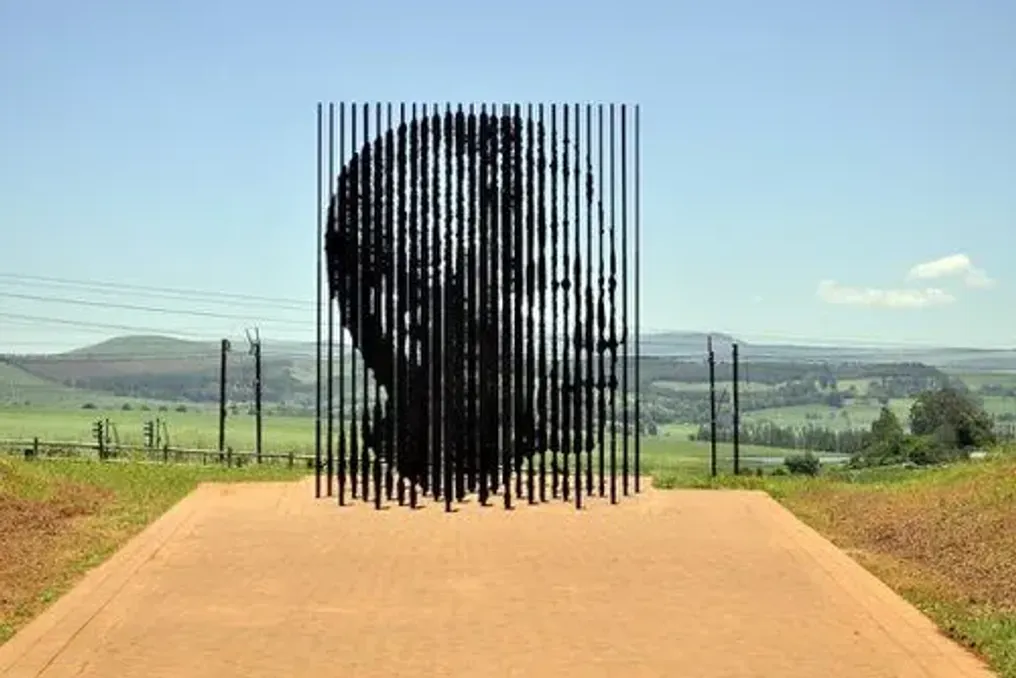
The route also includes Inanda Seminary, one of the country's historic institutions for girls. Further inland, Nelson Mandela's arrest site near Howick commemorates the moment of Mandela's arrest on August 5, 1962. Today, visitors can tour the museum and see the striking steel sculpture that forms the centerpiece of this site. The Tutu Falls Museum in Grutwall offers another important chapter in the province's liberation history. The museum is located in the former home of Chief Albert Luthuli, who became the first African to receive the Nobel Peace Prize in 1960.

The KwaZulu-Natal battlefields route takes visitors through landscapes where some of South Africa's most significant military conflicts took place. Isandlwana is remembered for the dramatic defeat of the British during the Anglo-Zulu War in 1879, while nearby Rorke's Drift became famous for defending the British mission during the same conflict.

The province's military history extends beyond the Anglo-Zulu War. In Spioenkop, visitors can study the site of a major battle during the Anglo-Boer War. This area is also linked to several prominent historical figures, including Winston Churchill and Mahatma Gandhi. The Dundee Tala Museum combines military history with exhibitions covering the region's development in mining, agriculture, and culture.

For those interested in history, the Battlefield Route offers an opportunity to experience these events in the landscapes where they unfolded. In the Chatsworth area of Durban, the Sri Sri Radha Radhanath Temple is one of the province's most recognizable cultural and religious landmarks.

The heritage of KwaZulu-Natal is also closely linked to the history of people of Indian descent in South Africa. In the Chatsworth area of Durban, the Sri Sri Radha Radhanath Temple is one of the province's most recognizable cultural and religious landmarks. Its distinctive architecture, richly decorated interiors, and Hindu traditions make it a notable stop for visitors exploring the diverse heritage of the area.

The Durban 1860 Heritage Centre offers another important link to the province's Indian history, documenting the arrival of Indian indentured laborers in Natal in the 19th century. Visitors can also visit the Victoria Street Market, where Indian and African influences merge through food, spices, clothing, crafts, and other goods. Together, these places tell a broader story of migration, identity, and the communities that helped shape modern KwaZulu-Natal.

More Than Just a Tourist Destination

The heritage of KwaZulu-Natal spans thousands of years and encompasses numerous diverse communities, cultures, and historical periods. Whether you are exploring ancient rock paintings in Drakensberg, learning about the Zulu monarchy, visiting sites related to the fight for democracy, walking through historic battlefields, or discovering the province's Indian heritage, travelers can uncover the side of KwaZulu-Natal that extends far beyond its beaches.

For those ready to step outside the typical tourist trail, the province offers something even more valuable: the opportunity to understand the stories that have shaped South Africa.

Popular