Scientists Receive First Radio Signal from Planet Outside Solar System
Read more
Aaj Tak
www.aajtak.in

Scientists Receive First Radio Signal from Planet Outside Solar System

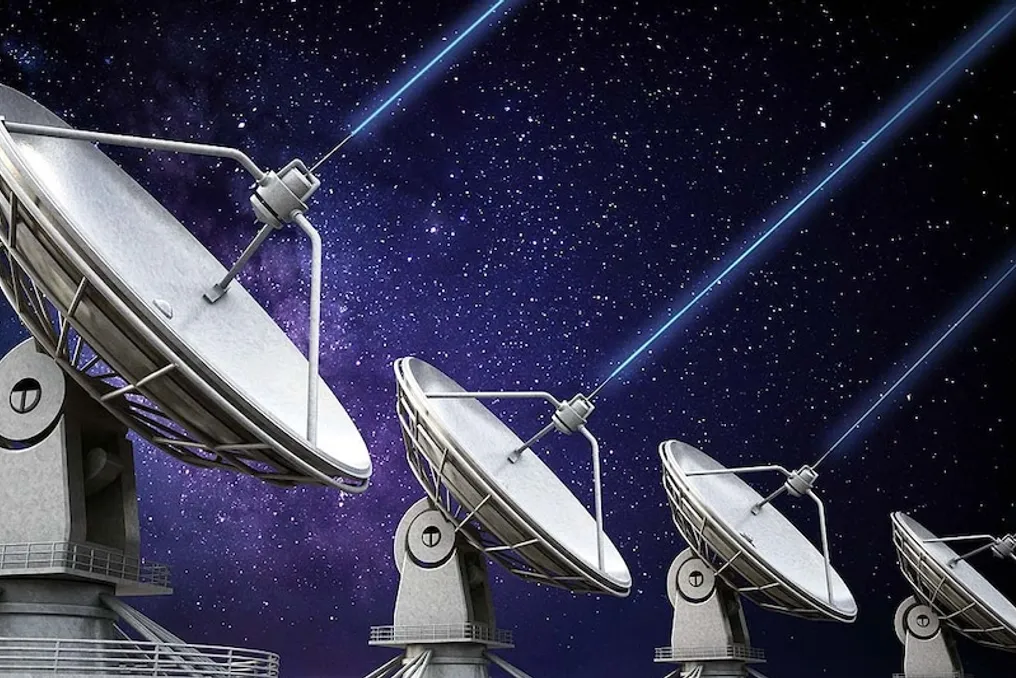
A mysterious radio signal from space is attracting the attention of scientists. This signal originated from a massive planet, Beta Pictoris b, located approximately 63.4 light-years away from Earth. Researchers have successfully linked a radio signal coming from an exoplanet—a planet outside the solar system—directly to that planet for the first time. This significant discovery was made by the MeerKAT Radio Telescope Array established in South Africa.

The team of scientists observed the stellar system Beta Pictoris four times during 2025 and 2026. During this period, they repeatedly received small radio signals at frequencies ranging from 0.85 to 3.5 GHz. The most notable aspect was that these signals were coming from the planet Beta Pictoris b, not its star. Scientists believe these signals are generated by the planet's aurora.

Although radio signals from stellar systems containing planets have been received before, it was not previously certain whether the signal originated from the planet or its star. This time, scientists investigated the location of the signal with extreme precision. To do this, the team used a distant quasar in space as a reference point, which made it possible to pinpoint the actual location of the signal. The investigation determined the signal's location to be Beta Pictoris b, leading scientists to consider it the first direct radio signal received from an exoplanet.

According to the scientists, the radio signal received from Beta Pictoris b is related to its aurora. Auroras are also visible on Earth, known as the Northern and Southern Lights. This phenomenon occurs when charged particles collide with the planet's magnetic field.

Circular polarization was also observed in the signal received from Beta Pictoris b. Scientists estimate that this may be associated with a process called Electron Cyclotron Maser Instability, or ECMI. This same process generates radio signals associated with the auroras of Earth and Jupiter.

This signal also provided important information about the planet's magnetic field. According to the research, the magnetic field strength in the region emitting the radio signal was recorded to be at least 1.25 kilo-gauss, equivalent to about 1,250 gauss. This is thousands of times stronger than Earth's magnetic field.

Beta Pictoris b is a young and massive gas giant, with a mass of approximately 10 times that of Jupiter. It also rotates very rapidly on its axis, completing one rotation in only 8 to 9 hours. Scientists suggest that the planet's rapid rotation and strong magnetic field may play a significant role in the radio signals associated with its aurora.

However, the research related to this discovery has not yet been published in a peer-reviewed scientific journal; it has currently been released as a preprint on arXiv. This means that examination and review by other scientists are still pending. Scientists now aim to search for such radio signals in other large exoplanets, and more planets can be identified in the future with the help of more sensitive radio telescopes.
Similar stories

Astronomers detect radio signal from giant exoplanet for the first time
Read more
olhardigital.com.br

Astronomers detect radio signal from giant exoplanet for the first time

Astronomers have detected a radio signal originating directly from an exoplanet for the first time. This discovery was made by researchers from the Center for Astrophysics Harvard & Smithsonian and the University of Oregon, opening up the possibility to study the magnetic field characteristics of worlds outside our solar system.

The signal comes from the planet Beta Pictoris b, which is located approximately 63.4 light-years from Earth. This emission is linked to the planet's polar auroras and is not an attempt at extraterrestrial communication.

The planet Beta Pictoris was observed four times between 2025 and 2026 using the MeerKAT radio telescope located in South Africa. The measurements covered frequencies from 0.85 to 3.5 GHz and recorded both constant emissions and fast, recurring bursts.

The team aimed to determine whether the signal originated from the planet itself or from the star it orbits. To do this, they used quasars as reference points on the celestial map. The analysis allowed them to localize the radiation specifically to Beta Pictoris b, rather than its host star.

Researchers noted that while radio bursts associated with polar auroras are observed on planets in our solar system and some ultra-cool dwarfs, there has never been a definitive detection of a radio signal from an exoplanet distinct from its host star.

The radio waves exhibited strong circular polarization, which is characteristic of signals generated by polar auroras. On Earth, this phenomenon manifests as the northern and southern lights, occurring when charged particles interact with the atmosphere and magnetic field.

Scientists linked this emission to the Electron Cyclotron Maser Instability (ECMI) mechanism, which also causes polar auroras on Earth and Jupiter. The analysis showed that Beta Pictoris b possesses an exceptionally strong magnetic field, consistent with previous models regarding the internal processes generating the planet's field.

According to the researchers, this is the first direct measurement of an exoplanet's magnetic field intensity. They emphasized that this achievement aligns with predictions regarding dynamo scales for a young and massive giant planet.

Beta Pictoris b is one of three known planets in this system. The star Beta Pictoris differs from the Sun in that it is hotter, larger, and has a different structure.

This methodology can be applied to other worlds. The researchers identified seven giant exoplanets distributed across five nearby stellar systems that could be analyzed in a similar manner. The team believes that the expected five-to-seven-fold improvement in instrument sensitivity from next-generation radio telescopes will allow these signals to be detected. It should be noted that this study has not yet undergone peer review and is available online on arXiv.

Popular