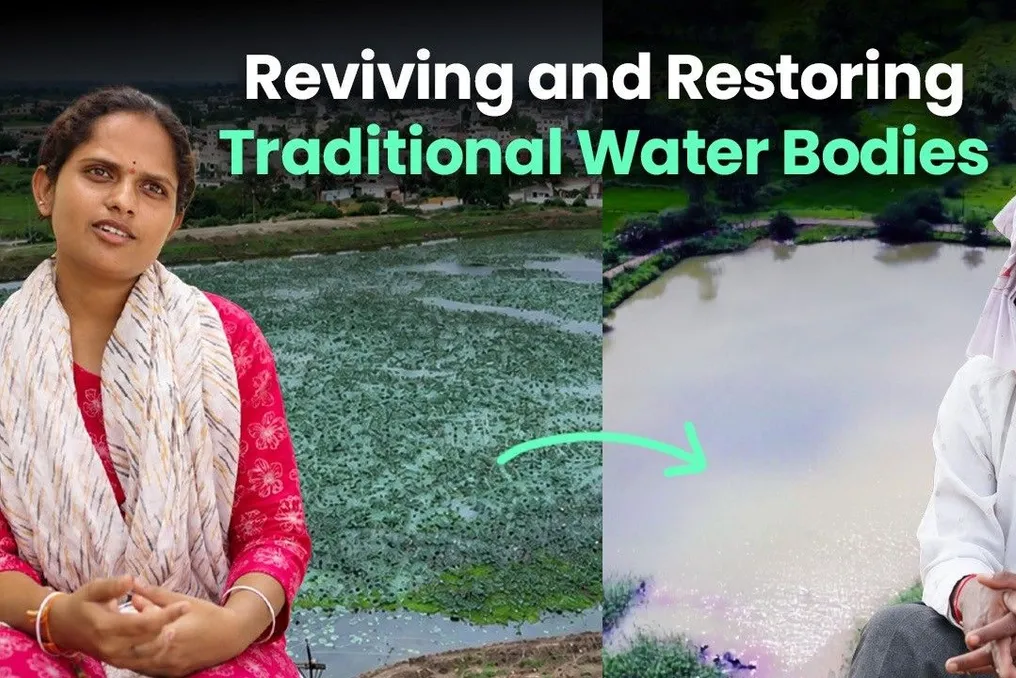
A river can disappear even if its channel remains visible on maps and in the memories of residents. However, the water can run dry, leading to the depletion of wells, loss of irrigation sources for fields, disappearance of fish, and the river turning into a drainage ditch or a dry strip of land.
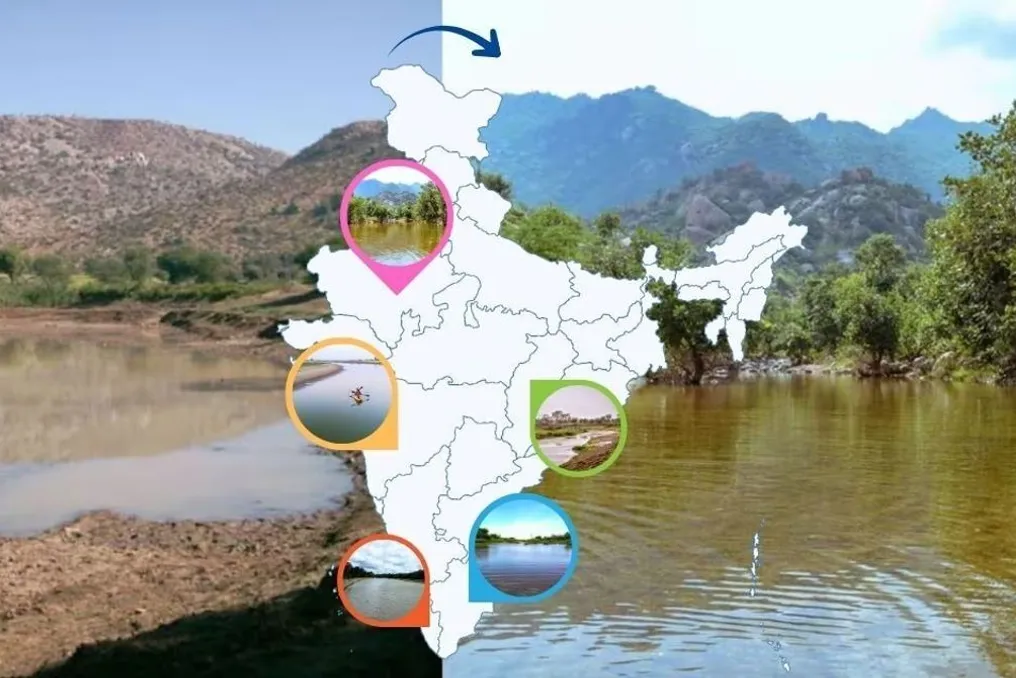
Across India, there are rivers that have reached a critical state and were considered dead or dying. Nevertheless, local communities, administrations, and organizations in different parts of the country have managed to bring some of them back to life.
The restoration methods varied: some focused on rainwater harvesting, others on eliminating sewage and waste, a third required the construction of water retention dams and recharge wells, and some first needed physical clearing of long-standing weeds and silt.
Below are five such rivers, located from Rajasthan to Kerala and from Maharashtra to Tamil Nadu.
1. Aravalli, Rajasthan
In the arid landscape of Alwara, Rajasthan, the Aravalli River had been without flow for decades. Its revival began not with work directly on the river, but with improving the surrounding area.
Starting in the 1980s, the organization Tarun Bharat Sangh collaborated with local residents to create johads—traditional earthen structures for rainwater harvesting that allow water to seep into the soil. Water retention dams and other small structures for conserving water in the catchment area were also built.
The main idea was not to let floodwaters run off, but to hold them in the landscape to replenish groundwater. Positive results gradually became visible: dried-up wells began to fill up, agriculture became possible again, and the Aravalli started flowing. By 2018, Tarun Bharat Sangh recorded the construction of 402 water conservation structures in the Aravalli catchment area.
The restoration also changed the villages' approach to water resource management. In 1998, communities formed the Aravalli Sansad, providing a collective platform for local residents to discuss the river and its resources. The return of the river demonstrated that sometimes the best way to revive a river is to first restore the groundwater beneath it.
2. Kham, Maharashtra
In Chhatrapati Sambhajinagar, the Kham River faced a different problem. This seasonal river had turned into something more like an open drain. Untreated sewage entered it, solid waste was dumped along its banks, and illegal constructions narrowed certain sections of the waterway. A detailed inspection revealed 249 sewage discharge points along the urban area, as well as 16 springs hidden in the degraded river system.
Restoration work, which began in 2019, involved the municipal corporation, cantonment board, Varroc Foundation, and EcoSattva Environmental Solutions. Instead of viewing the river as an isolated channel, the project addressed the sources of pollution. Sewage entering the river was identified and eliminated, solid waste was removed, plastic traps were installed at the river mouths, and parts of the banks were converted into green zones.
The mission to restore the Kham River later received the St. Andrew's Environmental Award in 2024. St. Andrew's University describes this project as a comprehensive effort involving waste management, pollution prevention, flood and drought preparedness, blue-green infrastructure, and citizen participation. It serves as a reminder that an urban river cannot be restored merely by cleaning the water; the drainage systems and the surrounding areas must also change.
3. Sakri, Chhattisgarh
The Sakri River in Chhattisgarh had been dry for almost thirty years. In April 2019, the Bolti Nadi initiative took an unusual first step. Instead of starting with construction, its team traveled the entire 90 km length of the river, visiting 59 villages. They documented water sources, erosion, ecological conditions, existing structures, and the experiences of communities living on the banks.
The data collected was presented to district administrations and helped initiate a broader restoration program. Cleaning and silt removal were carried out under the MGNREGA program. Water retention dams and gabion structures were built to slow the flow and support groundwater replenishment. The riverbanks were planted with trees, and a treatment plant was established in Kawardha to prevent untreated sewage from entering the river. From 2019 to 2023, the Sakri flowed continuously for four years from source to mouth.
This story also carries a warning: the river's restoration was not consistently maintained everywhere. Subsequent interventions, including non-scientific actions such as sand mining, created new problems. A river can be brought back to life, but constant care is required to maintain its viability.
4. Naganadi, Tamil Nadu
In Vellore, Tamil Nadu, the Naganadi River had not had a normal flow for about 15 years due to declining groundwater levels and increasing water scarcity in the surrounding landscape. The restoration strategy was heavily focused on women and groundwater.
Starting in 2014, women working under MGNREGA helped build recharge wells. Stone check dams were also constructed across the landscape to slow down rainwater and give it more time to penetrate the soil. The initial work was done in Salanamatham, where five recharge wells and three stone check dams were built. When the monsoon arrived, these structures helped retain water instead of rapid surface runoff. Wells that had been dry for a long time began to refill with water.
In subsequent years, thousands of recharge structures were built across the entire catchment area, with about 20,000 women participating in the work. By 2018, the Naganadi began to flow again. Here, the river's revival started underground: restoring the aquifers gave the river a better chance to emerge to the surface.
5. Kuttampurur, Kerala
In Alappuzha, Kerala, the Kuttampurur River once represented a waterway of 12 km in length and sometimes over 100 feet wide. However, years of illegal sand mining, garbage dumping, and weed growth gradually choked it. By 2005, some sections of the river had turned into a narrow, stagnant channel.
In 2016, the Grama Panchayat Budhanur finally launched large-scale restoration efforts. About 700 local men and women were employed through MGNREGA and worked for 70 days cleaning the river. First, weeds were removed, then plastic waste was extracted from the riverbed. Workers eventually reached layers of accumulated silt and solid waste that had built up over the years. Within weeks, the water, which had been mostly stagnant, began to move again. The river returned to its former functions for irrigation, livestock, and other domestic needs. Well levels within a radius of approximately 5 km from the river also improved after the flow resumed. Unlike the Aravalli, which required holding water in the landscape, Kuttampurur first needed its own channel to be reopened.
Five Rivers—Five Different Solutions
These five rivers tell five different stories. The revival of the Aravalli in Rajasthan was achieved through rainwater harvesting. The restoration of Kham in Maharashtra required solving issues with urban sewage and waste. For Sakri in Chhattisgarh, it was necessary to understand its entire river course.
Tamil Nadu:
The revival of Naganadi depended on groundwater recharge. In Kerala, the restoration of Kuttampurur required physically clearing decades of accumulated waste and silt.
Together, they demonstrate that there is no single formula for reviving a river. A river is connected to everything around it: forests affect runoff, soil determines how much rainwater penetrates the ground, wells depend on aquifers, farms depend on irrigation, and cities determine the amount of sewage and waste entering the water. Therefore, when a river disappears, its revival means repairing much more than just the river itself. Perhaps this is the most important part of these stories: water may return to the channel, but true revival begins much earlier, in the landscape that feeds it.