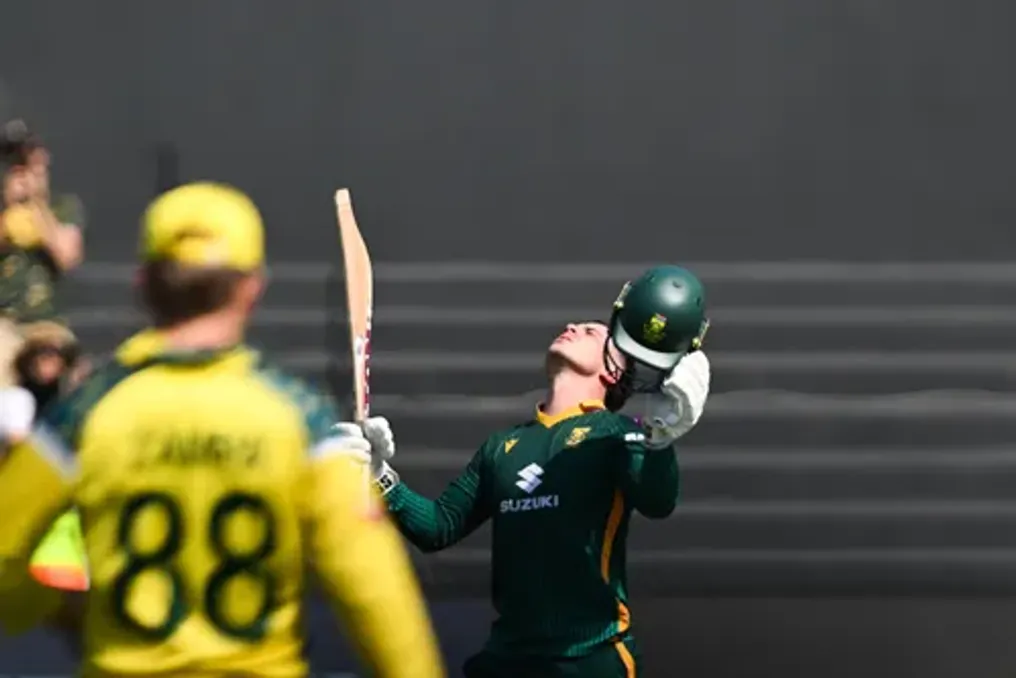
Mathew Britzke, the Proteas team's centurion, highlighted the necessity of deep inner effort to manage pressure during the match against Australia in the South Africa tour.
On Thursday at Kingsmead in Durban, Mathew Britzke celebrated his second ODI century during the first match against Australia. While any international century is a significant achievement, some moments become more special. For instance, coming onto the field when the team was in a critical position of 29/2 in the eighth over against the world champions, under conditions favorable to bowlers like Josh Hazlewood and Mitchell Starc.
The task was complicated by the fact that teammates, including the captain, continued to make errors. Nevertheless, he kept going, meeting every new challenge and taking on all the pressure until he reached his well-deserved second century after exactly 100 balls.
After his decisive performance in the first ODI match against Australia at Kingsmead, Mathew Britzke explained: 'When the first two wickets fell against a world-class attacking team, I really had to dig very deep, and it drained me a lot, but I am just grateful that I could get through it and score those 100 runs for everyone.'
He added that it was a moment of pride for him and his family, but in his opinion, the main difficulty lay in the initial phase and the need to overcome it mentally. He mentioned there were moments when he wanted to take risks, but the team kept losing batsmen, so reaching the hundred-run mark was a relief, and he is very grateful.
When other players' methods faltered, Britzke explained his approach at the crease: 'The talk was simply about playing straight. I think as soon as you start looking too square, you see a couple of balls that lead to the leading edges and so on. So you just had to play straight, have good body language, and get through it.'
During the game, Britzke showed strong competitive spirit. After Australian wicketkeeper Josh Inglis attempted a run-out, Britzke and his partner Marco Jansen managed to run one extra run at the end of the overs—an action that goes against the spirit of the game but does not violate the rules. Australian fast bowler Nathan Ellis was clearly upset and expressed his displeasure at both players, who exacerbated the situation by taking the next two balls for six consecutively.
Britzke stated: 'Honestly, I was in the moment. If this were the World Cup, I probably would have done it again. If I were on the field, I would also heavily punish the batter, so it's just part of the game.'
Following his magnificent 112 runs off 106 balls, which helped Proteas win by 67 runs, he was interviewed. Jansen, positioned on the other side of the field, not only contributed to potential confrontations but also helped relieve the pressure on Britzke. Jansen played a key role in increasing the tempo of the innings, scoring an impressive 75 runs off 59 balls (7 fours and 4 sixes).
Their partnership of 107 runs for the sixth wicket, consisting of only 81 balls, proved decisive for the match, especially considering Britzke did not hit a single four in the first 55 runs of that partnership. Britzke noted: 'It was a special innings from Marco. He helped my innings a lot there.' He continued: 'I think if you look at him when he is in top form, he aims to attack. There was never a plan for him to play aggressively. He connected with the ball, and then just used that momentum. We fuel each other's energy, and I was happy to give him the opportunity to score.'
Thanks to this second century, Britzke's average rose to 63.23, making it the third highest among all players who have played at least 10 matches, and his 822 runs are the highest among all batters who have completed 14 ODI innings. As the home World Cup is approximately 12 months away, the Gqeberha-born batter confidently asserts his right to be the permanent number 4 in the Proteas.