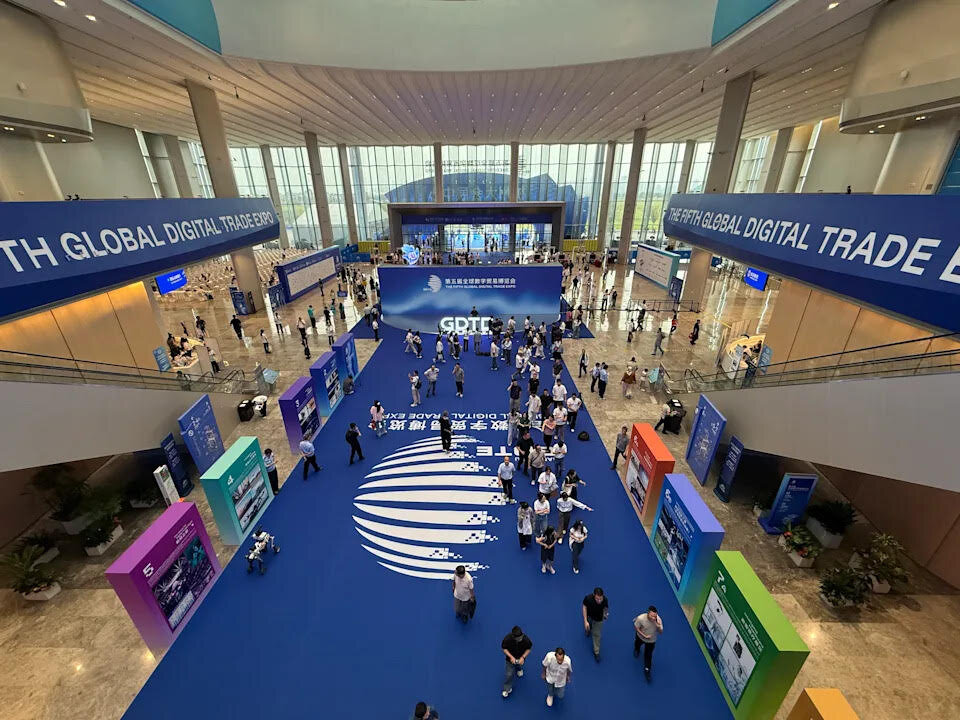
The Fifth Global Digital Trade Exhibition (GDTE) kicked off today in Hangzhou, a city located in eastern China. As the only national-level international professional exhibition in China dedicated to digital trade, the five-day event places artificial intelligence at the center of attention under the slogan 'Meet the Future of AI at GDTE.'
Within the exhibition halls spanning 170,000 square meters, the event brings together technological innovations, business partner sourcing, and international cooperation, reflecting Hangzhou's strong impetus for the global expansion of the AI industry.
Visitors are greeted by a glimpse into the future presented through specially created Token Zones. This zone demonstrates the complete innovation chain, covering computing power infrastructure, large language models, and practical applications across various industries. Over 200 large AI models are collectively showcased at the exhibition. Cutting-edge advancements, such as brain-computer interfaces and embodied intelligence, which were previously confined to scientific papers, are now demonstrated live to the general public.
Attendees can observe how brain-computer devices assist people with disabilities in perceiving the world around them. They can also participate in consultation simulations based on traditional Chinese medicine large model systems or try out service robots and smart wearables in person to see how technology is transforming daily life. The Global Open AI Competition and the Global Digital Trade Innovation Competition, focused on embodied intelligence robots, are running concurrently. Developers from around the world compete and exchange ideas, turning conceptual creativity into practical solutions for the real world.
Openness and interconnectedness are at the core of GDTE. Malaysia and Hungary serve as Honorary Guest Countries for this edition, and the number of foreign exhibiting groups exceeds previous years' figures. Representatives from 121 countries and regions, along with 29 international organizations, have gathered at the event.
Key sessions are being held sequentially, including the Silk Road E-commerce Day, the BRICS Special Economic Zones Dialogue in Hangzhou, and Africa Digital Trade Day. Participants are jointly discussing prospects and promoting practical cooperation in e-commerce along the Silk Road route, cross-border data flow, and green digital trade.
In collaboration with five leading authoritative international institutions, the exhibition is preparing and publishing its flagship report—the 2026 Digital Trade Development Report—as well as a series of important industry publications. These documents provide valuable insights and reflections on the rapidly evolving landscape of global digital trade.
Nearly 40,000 professional buyers and sellers participated in this major gathering, more than 12,000 of whom were foreign delegates. Over 1,300 business matching sessions have been organized, where AI assistants facilitate precise identification of business opportunities.
Beyond the short-term offline exhibition, the updated digital trade platform creates an 'infinite digital trade exhibition.' It connects online cross-border e-commerce platforms with offline specialized markets, extending engagement in trade throughout the entire event cycle—before, during, and after it. Ticket compatibility has been implemented between GDTE, the APSARA Conference, and the West Lake Conference, allowing for mutual reinforcement and expanded reach of the event.
Coinciding with the Mid-Autumn Festival, the exhibition also transforms into a vibrant digital carnival filled with everyday charm. One hundred AI application scenarios, 100 premium digital trade products, and 100 consumer experience spots are placed throughout the venue. An eight-hundred-meter bazaar is abundant with diverse exotic goods from around the world. Additional services, such as simplified entry procedures and tax refund processing for departing visitors, are fully available. Guests can fully immerse themselves in advanced technologies while strolling and enjoying the bright joys of digital consumption.
The vibrancy of the exhibition is rooted in Hangzhou's long-term industrial accumulation. The city is currently home to 938 enterprises in key AI sectors. In the first half of 2026, the revenue of local enterprises in key AI industries reached 270.5 billion yuan, representing an annual growth of 26%. Local tech innovators are entering the global market: agile humanoid robots are being sent worldwide, and rehabilitation exoskeletons are crossing oceans to help patients with muscle weakness stand up again. Cold hardware carries the warmth of human care.
From January to July of this year, exports of AI enterprises from Hangzhou grew by 156% year-on-year. AI-related deals account for half of the letters of intent signed during this exhibition. The headquarters of the Arab Federation for Digital Economy in China will be located in Hangzhou, creating a joint platform for Chinese and foreign enterprises to conduct joint technology research and product development, enabling digital innovations born in the East to benefit broader global markets.
As the mighty currents of the Qiantang River continue their course, digital trade is becoming an undeniable force driving global economic growth. At this exhibition, AI is not just a flashy technology; it serves as a connector, linking businesses, markets, and benefiting ordinary people. By attracting participants from all over the world to Hangzhou, the exhibition promotes technical exchange and business negotiations for jointly exploring an open, inclusive, and mutually beneficial path for the digital age.
At the opening ceremony of the Fifth Global Digital Trade Exhibition
1. Every major technological innovation in history has led to a more open world. Today, with accelerated digitalization, the trend of economic globalization is unstoppable. Against this backdrop, mutual distrust and a 'neighbour-robber' approach will inevitably be rejected by time; only mutual trust, mutual benefit, and open cooperation will help us win in the future.
2. The international community must promote cooperation between the North and South in digital trade and provide greater support to developing countries in terms of technology, infrastructure, and personnel training. Development must be fast, efficient, and human-centered if we are to achieve global prosperity and a better life for all.
3. For many years, China has firmly promoted economic globalization. We are fulfilling our commitments, strengthening cooperation, advocating for equality, and achieving win-win results. Thus, we are achieving domestic development while simultaneously benefiting the whole world. In the digital era, China will continue to embrace the world, deepen economic and trade cooperation with all parties, and jointly contribute to global economic recovery and growth.
4. Companies are a vital force driving digital trade. We warmly welcome more serious investment from companies of all countries and their long-term commitment to the Chinese market. We fully implement the principle of national treatment for foreign enterprises and will address their legitimate concerns, allowing them to confidently conduct and develop their businesses.