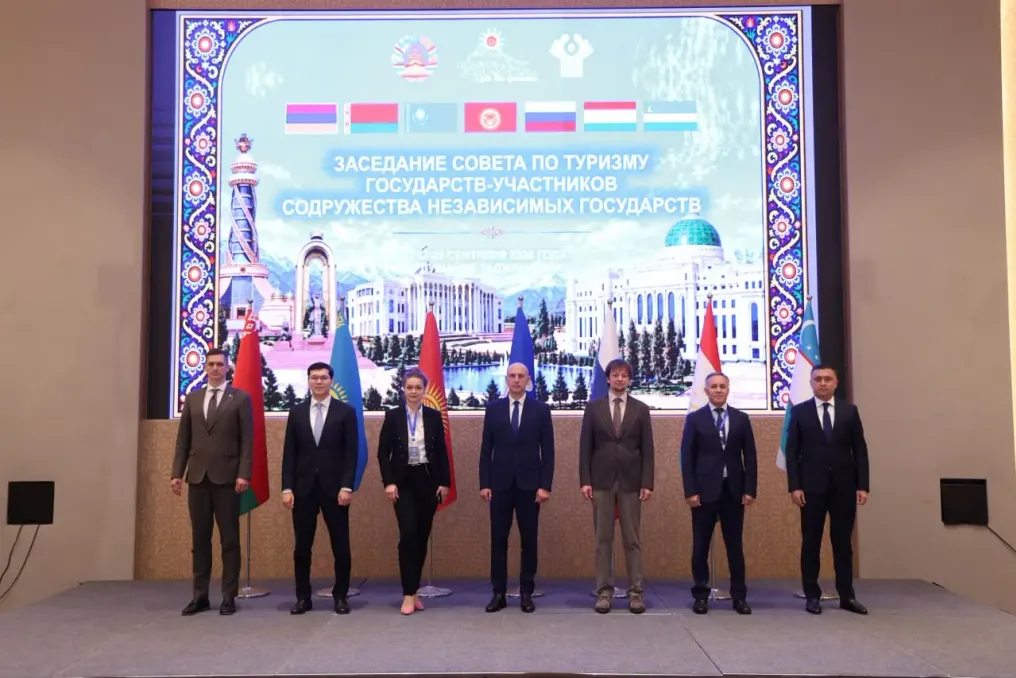
Uzbekistan has taken on the chairmanship of the Commonwealth of Independent States (CIS) Tourism Council for the period from 2026 to 2027. This decision was made following a council meeting held in Dushanbe.
The meeting included an Uzbek delegation led by Sanjar Tajiev, Deputy Chairman of the Tourism Committee. Representatives from state bodies responsible for tourism development in Belarus, Kazakhstan, Kyrgyzstan, Russia, Tajikistan, and Uzbekistan, as well as representatives from the CIS Executive Committee and the Secretariat of the CIS Parliamentary Assembly, participated in the session.
Participants reviewed current trends in the tourism sector and prospective projects. They also discussed the implementation of the Strategy for developing cooperation between CIS member states in the field of tourism for the period 2021–2030, tourism statistics and forecasting, as well as issues of personnel training and further expansion of cooperation.
Particular attention was paid to the exchange of statistical and analytical data on mutual tourist flows. Participants discussed the need for information exchange between authorized bodies of CIS countries and the integration of information resources of national digital platforms.
The activities of the International University of Tourism and Cultural Heritage 'Silk Road' in Samarkand were also considered at the meeting as the CIS base organization in the field of tourism. Tajiev presented information on the university's current work, international cooperation, educational and research programs, and interaction with specialized higher education institutions of CIS countries.
Following the conclusion of the meeting, the chairmanship of the CIS Tourism Council for 2026–2027 was transferred to Uzbekistan in accordance with the rotation principle. Abdulaziz Akkulov, head of the Tourism Committee, was appointed as the Chairman of the Council.
Participants also decided to hold the next council meeting in Uzbekistan in 2027. As part of its chairmanship, Uzbekistan intends to focus on developing cross-border tourism, improving the exchange of statistical and analytical data in the tourism sector, training qualified personnel, strengthening ties between educational institutions, and creating joint tourist routes. It is expected that work in these areas will contribute to expanding practical cooperation in tourism among CIS countries and promoting new joint initiatives.