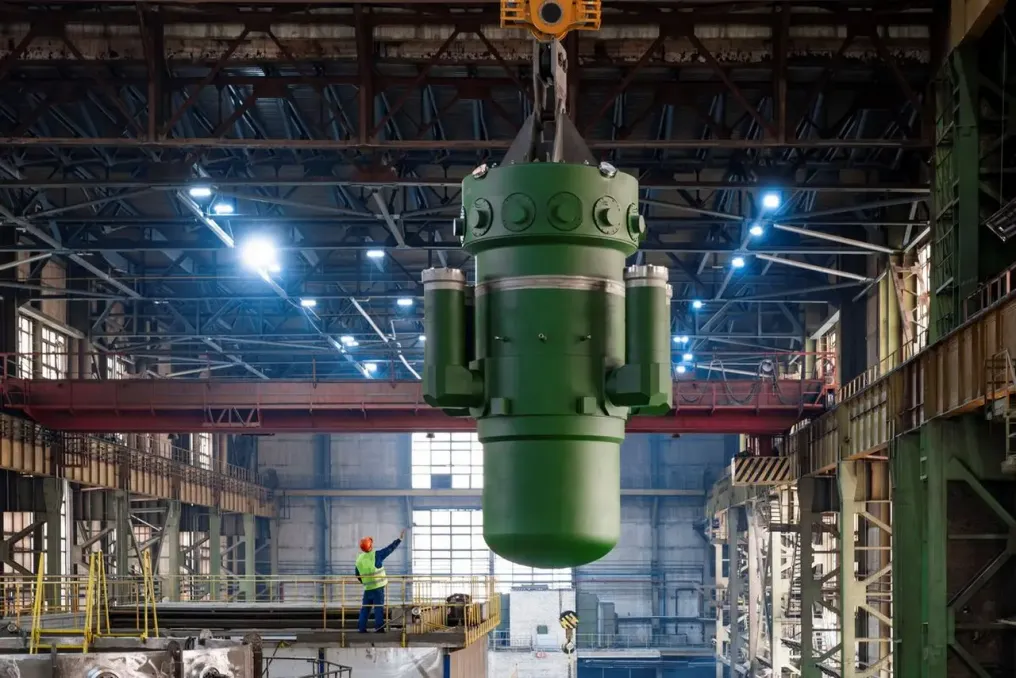
Zio-Podolsk, a division of Rosatom's mechanical engineering division, manufactured the second RITM-200S reactor module intended for the floating nuclear power unit PEB-106. This power unit is designed to supply electricity to an industrial cluster involved in copper mining in Chukotka.
The completed reactor module successfully passed hydraulic tests, which confirmed the reliability of the equipment, and a trial installation was conducted. During the assembly, the compliance of all connections between elements with the design documentation was verified. Thus, the plant has completed the manufacturing of a full set of two RITM-200S reactor modules required by the PEB-106 design.
Anton Lebedev, head of Zio-Podolsk, noted that 2026 marked a turning point for Zio-Podolsk's mechanical engineers. For the first time, they were able to manufacture a complete set of RITM modules for a floating nuclear power unit that will power the industrial cluster in the Russian North. He emphasized that this is an important step in the development of small-scale nuclear energy. Furthermore, this year the plant set a record by producing four RITM family modules in less than a year, with five more currently in production.
The first reactor module for PEB-106 was created in May 2026 and has already been delivered to the shipyard. Both reactors will subsequently be installed in the hull of the floating power unit.
The RITM-200 reactor module was originally developed for Russia's nuclear icebreaker fleet. Its compact design allowed for a reduction in equipment dimensions by approximately 1.5 times compared to previous models while increasing its energy characteristics. The technical solutions applied in RITM-200 and tested in Arctic conditions formed the basis for the development of low-power units, including those intended for remote areas.
To date, a total of 16 RITM family reactor modules have been manufactured: eight are operating on the Arctic, Ural, Siberia, and Yakutia nuclear icebreakers. Another 12 units are at various stages of production.
A number of enterprises within Rosatom's mechanical engineering division participate in the production of this equipment. Afrikanтов OKBM in Nizhny Novgorod is the main designer and comprehensive supplier of the reactor module. AEM-Spetsstal in St. Petersburg produces the metallurgical blanks, while Zio-Podolsk is responsible for manufacturing the reactor vessel, final testing, and trial installation.
Floating power units are considered one option for ensuring stable electricity supply to remote areas with access to the sea. Their use allows for long-term electricity generation regardless of weather conditions and infrastructural limitations typical of hard-to-reach territories.
The world's first floating nuclear power unit, Academician Lomonosov, has been operating in Chukotka since 2020, generating nearly 1.4 billion kWh of electricity during its operation. Currently, an entire line of floating power units equipped with RITM-200 reactors of varying capacities has been developed for operation in different climatic zones.
One of the key projects is the serial production of PEB-106 units to supply electricity to the copper mining industrial cluster in the Chukotka Autonomous Okrug. This project involves using the floating power unit for industrial production needs. The development of such technologies is linked to expanding the capabilities of small-scale nuclear energy, including providing energy to industrial enterprises and remote settlements.
Rosatom's mechanical engineering division is a major Russian energy holding company that supplies equipment for the construction of Russian NPPs. Additionally, it is involved in the development and production of equipment and integrated solutions for the energy and industrial sectors.