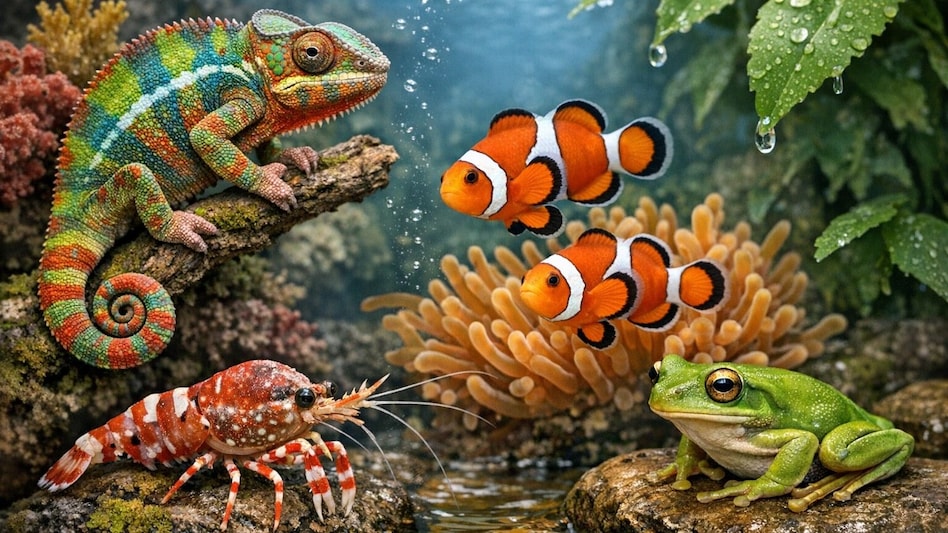
The process of animal reproduction is not only vital but also quite fascinating. Different species have adapted to increase their kind in unique ways: some attract mates with bright coloration, while others compete with other males using horns and teeth. However, there is another group of animals that are born male and then transform into females.
Although this may seem unusual, such changes do occur in nature. For some organisms, this is part of their natural life cycle, while for others, sex change may depend on social or environmental conditions. Let's look at some of these interesting creatures.
The clownfish is one of the most curious examples of this phenomenon. Sex change occurs in the life of these fish. A group of clownfish usually contains one large dominant female, around whom many males live. If the main female dies or leaves the group, the largest male transforms into a female and takes her place.
The need for sex change is driven by direct benefit: if the dominant female is absent, the new female does not need to wait for arrival from another group. The largest male can continue the reproductive process by changing into a female.
The humphead shrimp is also a unique species whose life cycle involves first being male and then becoming female. This process is called protandry. That is, the organism begins its life as a male and later transitions into a female state.
The scientific community links this to the size and benefit model. Since eggs are significantly larger than sperm, having a large body is advantageous for producing a greater number of eggs. This shrimp remains male during its first year of life. In the second year, it becomes female and is capable of laying about 3000 eggs during that same year, after which its life ends. Thus, throughout its life, it goes from male in the first year to female in the second, and then dies after reproduction.
The blue-eyed sea trout, living in the sea, also has the ability to change sex. However, in this case, the sex change occurs in the reverse order compared to the clownfish. A group of this fish usually has a large dominant male, and several females live near him, which can be called a peculiar hermaphrodite group.
If the dominant male dies or leaves the group, the largest female takes his place. Soon, significant transformation begins in her body, and her ovaries convert into testes. This process can happen quite quickly; according to reports, mature ovaries can turn into testes in just 8–10 days. After this, the fish can reproduce as a male along with other females. The purpose of sex change here is also to maintain the reproductive process in the group.
Now consider the bearded dragon. The situation here is somewhat different. Although, like most mammals, biological sex is determined mainly by chromosomes, they also exhibit a specific influence of temperature. If the temperature rises above approximately 32 degrees Celsius during egg development, some embryos that would normally develop as males can form as females.
Thus, in this case, sex is determined not only by chromosomes but also by temperature. Scientists do not yet have a complete understanding of how an increase in the number of females in warm and dry conditions can be beneficial to them. One hypothesis suggests that this may help maintain reproductive capacity in complex ecological conditions.
It is important to note that the bearded dragon does not change sex during its life like the clownfish or humphead shrimp; here, temperature affects sex development during fertilization.
Some green frogs also exhibit sex change, or sexual reversal. They may experience a change in genetic sex and body development during the tadpole stage. Under certain circumstances, they can develop into adults of the opposite sex.
Initially, scientists suggested that such a change might be caused by human pollution, as more female frogs were found in some areas with contaminated water. However, similar changes were later observed in ponds without pollution. This showed that the cause might not only be pollution but also general environmental factors and local conditions.
The question arises as to why nature endowed these creatures with such an ability. One of the main motives may be reproductive advantage. The ability to change sex is very useful if the dominant male or female in the group dies, allowing another creature to take its place.
For some species, it may also be more advantageous to be male or female depending on body size. For some species, it turns out to be more beneficial to be male in a small body and then become female.