Weekly, the program Olhar Espacial displays two notable astronomical images from the previous week. Last week, images related to an occultation event and a newly formed crater on the Moon were presented.
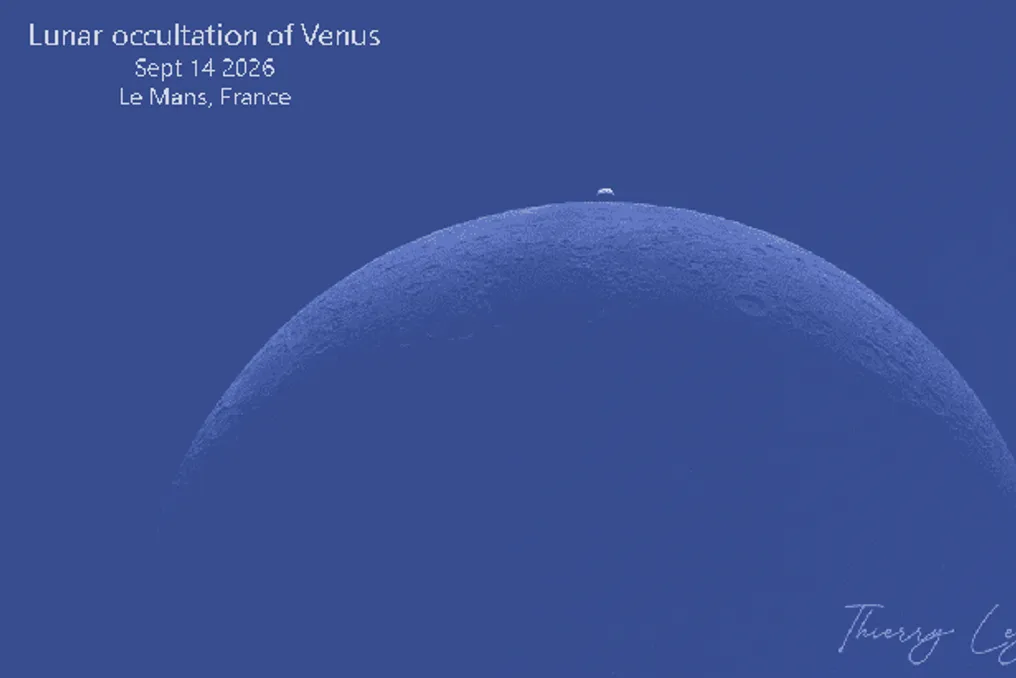
The first image captured the impressive moment when the planet Venus emerged behind the Moon after being hidden by its cosmic neighbor last Tuesday. On that day, both the planet and the Moon displayed similar shapes. The Moon was in a waxing phase, with approximately 7% illumination, while Venus, although with 28% light, showed a waning phase, gradually decreasing its luminosity. Because it has an orbit inside Earth's, Venus exhibits phases comparable to those of our Moon. It was the observation of these phases that allowed Galileo Galilei, more than four centuries ago, to conclude that the planet orbited the Sun and not the Earth, contradicting the prevailing view of the time.
The second image, on the other hand, revealed a remarkable record of a new crater on the lunar surface. This crater is about 220 meters in diameter and is located near the eastern limb of the Moon. It was created by the impact of an asteroid estimated to be between 10 and 20 meters in size, an event that would have occurred between April 11 and May 22, 2024. The discovery of this new crater was made through images obtained by NASA's Lunar Reconnaissance Orbiter (LRO), and it was officially named McGetchin, in tribute to the lunar scientist Tom McGetchin.