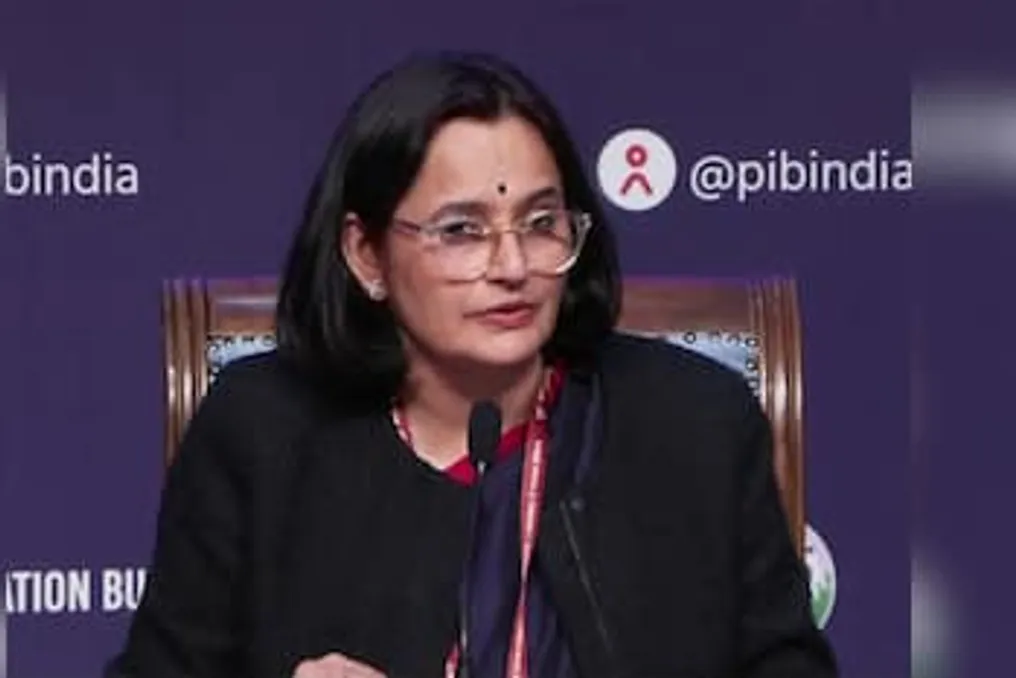
Anuradha Thakur, Secretary of the Department of Economic Affairs (DEA) of India, stated that BRICS discussions are examining issues related to the compatibility of payment and messaging channels, as well as the use of local currencies for trade and investment.
During the SBI Banking and Economy Conclave in 2026, Thakur emphasized that discussions have advanced regarding finding practical solutions for effective cross-border mechanisms among BRICS nations. These discussions included studying the possibility of inter-system compatibility of payment and messenger channels, as well as promoting trade and investment settlements using the national currencies of BRICS countries.
She added that national priorities were taken into account during these negotiations, and the principle of 'one-size-fits-all' is not applicable. Thakur noted that these initiatives are part of India's broader transition from seeking a larger voice for developing markets and economies to actively participating in shaping the global economic order.
A joint statement by the Finance Ministers and Central Bank Governors of BRICS dated September 10 calls on BPTF to continue the dialogue based on current work to ensure practical solutions for cross-border payments between BRICS countries that are fast, inexpensive, more accessible, efficient, transparent, and secure.
Thakur pointed out that India's economic strength has laid the foundation for this expanding global role. She cited examples of the country's GDP growth from $2.5 trillion to $4.3 trillion, as well as disciplined management of inflation and public debt. Furthermore, the World Bank recognized India's progress in reducing poverty: the share of people living in poverty fell from 57.7% to 16.1%, and extreme poverty decreased from 27.1% to 2.6%.
The Secretary also commented that the increase in system liquidity caused by the inflow of funds through FCNR(B) deposits is not a concern for the government. Liquidity peaked at 11.16 trillion rupees in the first week of September but decreased to 4.34 trillion rupees by September 23.
The Secretary also highlighted the growing global significance of India's financial system, noting that the banking sector combines domestic scale with increasing influence in international digital infrastructure. She mentioned that the State Bank of India and HDFC Bank are among the top 100 banks globally by asset size, and Indian stock and derivatives markets meet global standards.
India's trade ties have also diversified: nine free trade agreements covering 38 countries have been signed since 2021. Thakur stated that the country's economic diplomacy extends beyond trade and investment, encompassing financial cooperation, digital payments, energy transition, sustainable supply chains, and development finance.
She also mentioned India's efforts to strengthen strategic resilience in areas such as semiconductors and critical minerals, as well as its role in ensuring food security and global development.
Globally, the BRICS Declaration in New Delhi 2026 affirmed the bloc's commitment to reforming global governance and called for an increased voice and representation for developing markets and economies in international financial institutions.
Thakur concluded that India's trajectory in global economic governance represents a shift from gaining a larger voice to actually shaping global agendas. India increasingly contributes ideas, policy solutions, and institutional reforms to the world economic architecture, working on multilateral development banks, mobilizing private capital, development finance, tax transparency, and digital public infrastructure. She stressed: 'Since we rely on a sound macroeconomic situation and a very disciplined fiscal order, we are heard and respected.'