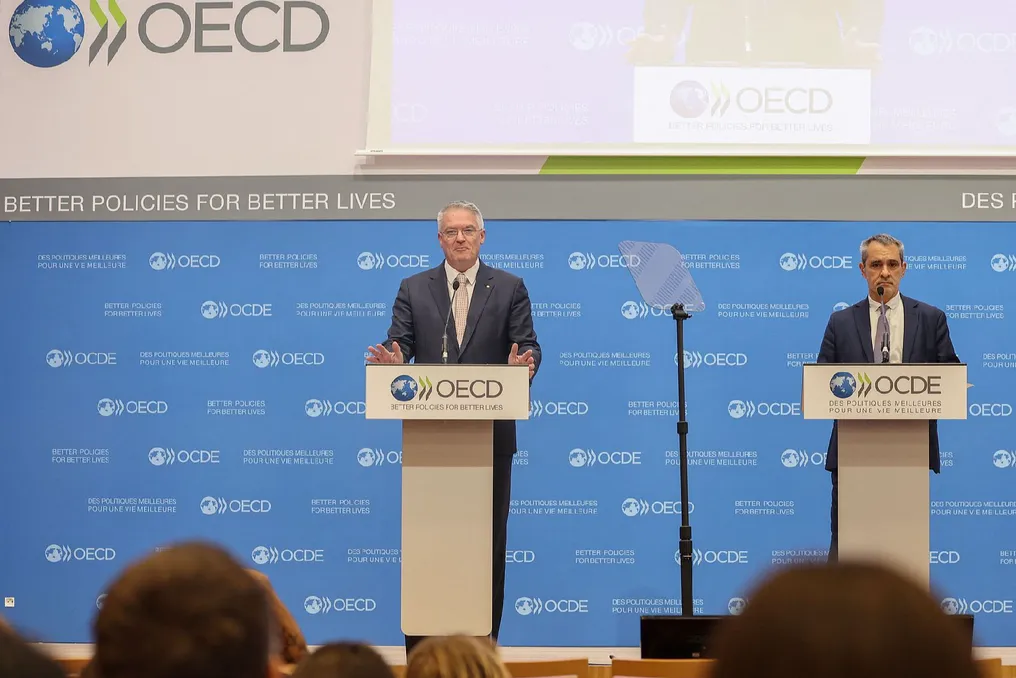
According to the interim economic outlook report published by the Organisation for Economic Co-operation and Development (OECD) on Wednesday, global economic growth is expected to be at 2.9% in 2026 and 3.0% in 2027.
The report notes that growth rates in developed G20 countries, as well as in developing G20 countries, should remain generally stable.
Overall inflation in G20 countries is expected to rise from 3.4% in 2025 to 4.1% in 2026, before falling to 3.6% in 2027.
In developed G20 countries, inflation is projected to increase from 2.5% in 2025 to 3.2% in 2026, followed by a drop to 2.6% in 2027. Meanwhile, in developing G20 countries, inflation is expected to rise from 4.1% to 4.8% before decreasing to 4.3%.
The OECD indicated that these forecasts are based on the technical assumption that Brent crude oil and TTF gas prices will peak in the fourth quarter of 2026 and then steadily decline until the end of 2027. The assumed Brent oil price scenario aligns with the 'short-term disruption' scenario in the OECD's June 2026 economic forecast, but the assumed gas price path is about 60% higher.
The organization warned that ongoing uncertainty regarding the development of the conflict in the Middle East remains a key risk to the baseline forecasts. Furthermore, export restrictions through the Strait of Hormuz, additional disruptions on alternative export routes such as the Bab el-Mandeb Strait, or further significant damage to energy production facilities in the region could trigger further sustained increases in energy prices and potentially lead to shortages of key commodities, especially in net-importing countries.
Supply disruption risks could be exacerbated by low gas reserves in Europe and the uncertain volume of further oil reserve drawdowns in some countries.
The OECD stated that in light of renewed energy price shocks, stronger-than-expected consumer demand, and above-target inflation in many economies, central banks must ensure sustainable containment of inflationary pressures. The organization also called for additional structural policy reforms that will help economies cope with future supply shocks, including diversifying energy sources, improving energy efficiency, enhancing the adaptability of goods and labor markets, and ensuring workers possess adaptable skills.