
Financial documents reveal details of the deal between TVS and Hanno, including a 29-year lease agreement and a custom build model
Read more
YourStory [india, en]
yourstory.com

Financial documents reveal details of the deal between TVS and Hanno, including a 29-year lease agreement and a custom build model

According to documents studied by the publication YourStory, the commercial relationship between TVS Motor Company and Hanno One Warehousing, a company associated with the family of Tata Sons Chairman N Chandrasekaran, turned out to be more extensive than previously assumed.

Hanno One Warehousing was registered in March 2025. Its board of directors includes N Chandrasekaran's wife, Lalita Chandrasekaran, and his son, Pranav Chandrasekaran. According to MCA records, the company's activities are focused on warehousing and storage operations, including the storage of various goods such as automobiles, furniture, chemicals, and textiles.

Hanno's annual report, Ministry of Corporate Affairs (MCA) filings, and approved project plans demonstrate that TVS Motor entered into a 29-year lease agreement with Hanno for a plot of land measuring 17.41 acres in Uddanapalli village, Krishnagiri district, Tamil Nadu state. The documents also contain details of a project worth approximately 106 crore rupees, including planned financing, and indicate that Hanno is considering a similar custom build model in Mysuru.

YourStory has sent queries to Hanno One Warehousing, former TVS Motor Chairman Venugopal Srinivasan, TVS Motor, and Tata Trusts. These queries concern Hanno's selection criteria for the project, the existence of a competitive process, the commercial viability of this arrangement, disclosure of relationships, and consideration of withdrawing from discussions upon Chandrasekaran's reappointment.

These documents add detail to the commercial ties that are under scrutiny amid the corporate governance dispute at Tata Sons. Srinivasan is a director of Tata Sons, Vice Chairman of Tata Trusts, and a member of the Tata Sons Nomination and Remuneration Committee, which assesses the performance of the Tata Sons Chairman. He supported N Chandrasekaran's new five-year term at the board meeting on September 17, while Tata Trusts Chairman, Noel Tata, opposed his reappointment.

Initially, the relationship between TVS and Hanno was reported by the publication Mint, which stated that TVS Motor leased about 17 acres in Krishnagiri from Hanno three months after the company's registration. Tata Sons stated that Hanno's registration was disclosed to companies where Chandrasekaran serves as chairman in April 2025, insisting that this specific deal with TVS did not require separate disclosure because TVS Motor is an independent public company without dealings with Tata group companies.

Tata Trusts reported that Srinivasan made no disclosures to its trustees regarding the TVS-Hanno deal. Under the Krishnagiri project, TVS Motor leased 17.41 acres from Hanno for 29 years. Subsequently, Hanno entered into an agreement with TVS Motor, listed in the annual report as a client, to construct an industrial shed of 330,418 sq ft on the same site. Upon completion, TVS is expected to occupy the facility and pay rent to Hanno. Thus, this arrangement makes TVS simultaneously a lessor of the base land and a client for the facility being developed by Hanno.

Hanno expects rental income from this project to commence in November 2026. Hanno's annual report indicates that Pragati Infra Solutions was appointed as the contractor for design, procurement, and construction for 76.85 crore rupees, excluding GST. MCA mortgage records reviewed by YourStory show the registration of a mortgage of 60 crore rupees in favor of HDFC Bank. The remaining funding is expected to come from a combination of equity, director loans, mandatory convertible bonds issued to shareholders, customer deposits, and bank financing.

Hanno contributed paid-up share capital of 10 lakh rupees for the period covered by its first annual report. The report states that the company borrowed 10.86 crore rupees from one of its directors for partial funding of the Uddanapalli project and financing the acquisition of industrial land in Mysuru. The section describing the loan does not specify which director provided the funds.

Separate approved building plans viewed by YourStory provide a more detailed picture of the development in Uddanapalli. The plans cover cadastral numbers 475, 476, 477, 478, 834, 835/2B, 839/1, 840/1, 841/1, 842/1A, 918/1A, and 918/2B2. They include a factory building of 28,072 sq m, a mezzanine office and dining area of 2,952 sq m, a warehouse building of 4,229 sq m, and auxiliary infrastructure. The total built-up area indicated in the plans is approximately 35,647 sq m, or about 3.84 lakh sq ft. The development is classified as light engineering industry category Orange, excluding manufacturing and forging.

The site plan also includes a substation, wastewater treatment plant, fire reservoir, kindergarten, internal roads, and parking for 44 trucks and 430 two-wheelers. The required equipment capacity is 1,500 kW. The total built-up area of 3.84 lakh sq ft shown in the approved plans exceeds the 330,418 sq ft industrial shed area mentioned in Hanno's annual report. The reason for this discrepancy is unclear from the presented documents; it may reflect office, warehouse, or utility areas not included in the industrial shed metric. YourStory has requested clarification from Hanno.

The annual report also hints that Hanno plans to expand beyond its first project in Krishnagiri. The Karnataka Industrial Area Development Board has allocated industrial land in Immavu, Mysuru, valued at approximately 27 crore rupees to the company. As of the report date, Hanno has invested 7.91 crore rupees for this land and stated that it is negotiating with potential clients for the development of industrial sheds and leasing facilities using the same custom build model.

The document states that the company intends to grow its operations and asset base in the coming years. The allocation of land in Mysuru indicates Hanno's ambition to replicate this model outside the Krishnagiri project. The scale of the proposed development in Mysuru and the identities of potential clients were not disclosed in the report.

The TVS-Hanno relationship attracted attention because Srinivasan was involved in the Tata Sons board decision-making process regarding Chandrasekaran's reappointment. The issue of disclosure remains contentious. Tata Sons' position is that Hanno's registration was disclosed, and the specific deal with TVS did not require disclosure to Tata Sons. Tata Trusts stated that Srinivasan made no disclosure of this deal to its trustees. Tata Trusts also told Mint that it cannot definitively state whether disclosure was made to the Tata Sons board, as it lacks independent access to board meetings.

Tata Trusts added that if the allegations prove true, it will assess its institutional response and take appropriate action. A broader disagreement between Tata Sons and Tata Trusts extends beyond Hanno and includes Chandrasekaran's reappointment, the proposed listing of Tata Sons shares, and wider corporate governance, listing, and shareholder rights disputes.

Similar stories

Rising mobile phone prices lead to increased cost of protective screens
Read more
www.aajtak.in

Rising mobile phone prices lead to increased cost of protective screens

Most users install cases and protective films on smartphone displays to prevent damage from accidental drops. A quality screen protector can save from expensive repairs.

However, the market offers numerous inexpensive protective glasses, costing between 50 and 100 rupees, which lack proper certification or quality testing results. Although people install them for savings, such cheap screen protectors can subsequently cause problems with the phone's screen, sensor, and fingerprint reader.

The quality of cheap screen protectors is often insufficiently high, which can lead to several difficulties for smartphone owners. The potential drawbacks of cheap screen protectors and the reasons for the government introducing new regulations for them are discussed next.

Sometimes, installing a low-quality screen protector leads to incorrect operation of the smartphone sensor. This can happen because the glass is too thick or made of poor-quality material. Such a defect can create a gap between the user's finger and the sensor, causing many users to believe that the phone's sensor is malfunctioning.

Furthermore, difficulties may arise when unlocking the device using the built-in fingerprint sensor. Since many protective glasses on the market do not undergo any quality checks, the thickness and quality of the glass can interfere with the correct operation of the under-display fingerprint sensor, forcing the user to attempt unlocking the phone multiple times.

The greatest danger lies in the reduction of the original screen quality. Many cheap protective glasses are made from low-grade plastic or other substandard materials. As a result, the user does not receive the benefits of the original display quality, and the screen brightness may appear lower.

Modern smartphone screens are often equipped with an anti-glare coating that facilitates viewing the screen even in bright sunlight. However, using a low-quality protective glass can reduce screen visibility, creating difficulties when using the phone in the sun.

If a cheap glass cracks slightly at the edge, small glass shards may break off. These particles can get stuck in fingers and cause injury. Therefore, one should not always decide to install a screen protector solely based on its low price.

Considering all the above issues, the government has introduced a new rule regarding the quality of smartphone screen protectors. The Ministry of Electronics and Information Technology has included screen protectors in the BIS registration scope. This means that screen protectors sold on the market must now comply with established quality standards. Otherwise, they may be banned from sale.

This new rule will come into effect on April 1, 2027. The government has currently published the relevant guidelines. In the future, low-quality screen protectors priced between 30 and 50 rupees should not appear on the market.

It is crucial for consumers to check the quality and required standards of the protective glass when purchasing. After all, saving small amounts can turn into significant expenses if the screen, sensor, or user's fingers are damaged.

OECD forecasts global economy growth of 2.9% in 2026
Read more
cgtn.com

OECD forecasts global economy growth of 2.9% in 2026

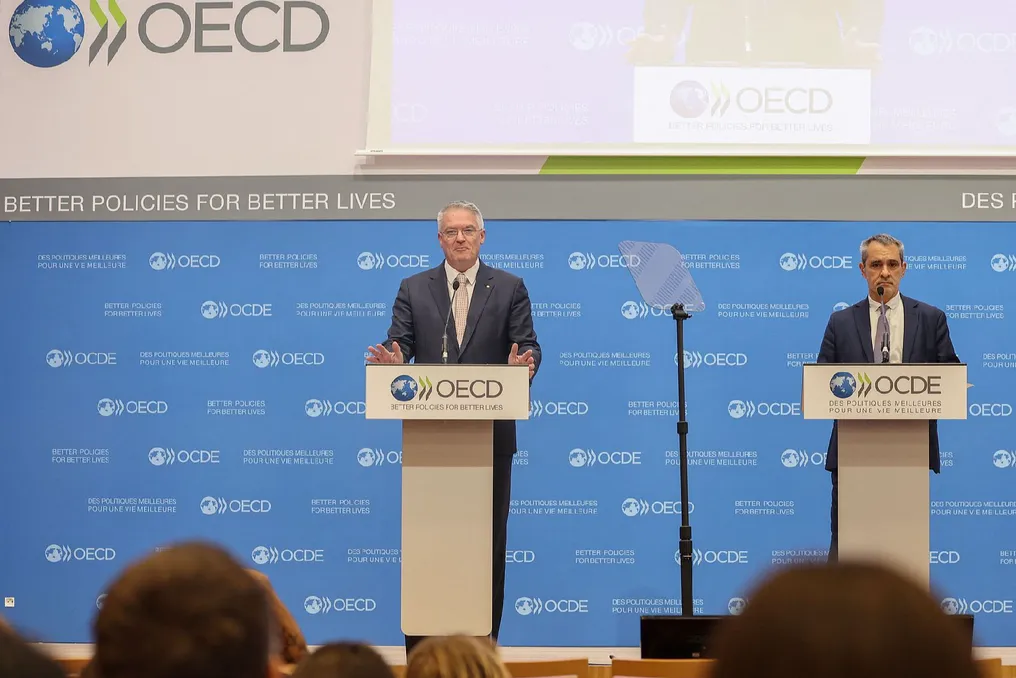
According to the interim economic outlook report published by the Organisation for Economic Co-operation and Development (OECD) on Wednesday, global economic growth is expected to be at 2.9% in 2026 and 3.0% in 2027.

The report notes that growth rates in developed G20 countries, as well as in developing G20 countries, should remain generally stable.

Overall inflation in G20 countries is expected to rise from 3.4% in 2025 to 4.1% in 2026, before falling to 3.6% in 2027.

In developed G20 countries, inflation is projected to increase from 2.5% in 2025 to 3.2% in 2026, followed by a drop to 2.6% in 2027. Meanwhile, in developing G20 countries, inflation is expected to rise from 4.1% to 4.8% before decreasing to 4.3%.

The OECD indicated that these forecasts are based on the technical assumption that Brent crude oil and TTF gas prices will peak in the fourth quarter of 2026 and then steadily decline until the end of 2027. The assumed Brent oil price scenario aligns with the 'short-term disruption' scenario in the OECD's June 2026 economic forecast, but the assumed gas price path is about 60% higher.

The organization warned that ongoing uncertainty regarding the development of the conflict in the Middle East remains a key risk to the baseline forecasts. Furthermore, export restrictions through the Strait of Hormuz, additional disruptions on alternative export routes such as the Bab el-Mandeb Strait, or further significant damage to energy production facilities in the region could trigger further sustained increases in energy prices and potentially lead to shortages of key commodities, especially in net-importing countries.

Supply disruption risks could be exacerbated by low gas reserves in Europe and the uncertain volume of further oil reserve drawdowns in some countries.

The OECD stated that in light of renewed energy price shocks, stronger-than-expected consumer demand, and above-target inflation in many economies, central banks must ensure sustainable containment of inflationary pressures. The organization also called for additional structural policy reforms that will help economies cope with future supply shocks, including diversifying energy sources, improving energy efficiency, enhancing the adaptability of goods and labor markets, and ensuring workers possess adaptable skills.

Chinese New Energy Vehicle Market Becomes Key Factor in Global Growth
Read more
cgtn.com

Chinese New Energy Vehicle Market Becomes Key Factor in Global Growth

The global new energy vehicle (NEV) market is demonstrating rapid growth, with official representatives from China's Ministry of Industry and Information Technology stating that NEVs now account for over 25% of global car sales. This information was presented at the World New Energy Vehicle Congress in 2026 on Tuesday.

China's automotive market has entered a phase where NEVs have become a significant driver of growth in the country's automotive sector. Experts note that China has transformed into the main engine for global large-scale NEV development. In the first eight months of 2026 alone, NEV production and sales in China exceeded 10 million units.

Nevertheless, the development of the NEV market is uneven across different regions. The transition to electric mobility in Europe is steady: China Media Group (CMG) reported that in August 2026, registrations of battery electric vehicles in 16 major European markets exceeded 200,000 units, accounting for over 30% of the market. However, in developing regions such as Southeast Asia and the Middle East, NEV penetration remains below 10%, similar to major automotive markets including the US and Japan.

Zhang Xiuming, Secretary-General of the World Organization for New Energy Vehicle Development, pointed out that limited competition, relatively high prices, insufficient charging infrastructure, and policy fluctuations can influence the development of NEV markets and consumer confidence.

As the Chinese NEV industry expands rapidly, cooperation with international markets is deepening. Cooperation between China and Germany in the NEV sector is developing in a direction described by industry experts as 'bilateral strengthening,' moving beyond traditional market and production partnerships to joint research and technology development, as well as industrial chain coordination.

A recent survey by the German Chamber of Commerce in China showed that over the past two years, the share of German automakers conducting R&D in China to serve both Chinese and global markets has increased from 12% to 33%. Furthermore, 81% of German companies operating in China stated that localized R&D accelerated their development process.

Chinese NEV companies are also expanding into foreign markets, including Southeast Asia, bringing their manufacturing capabilities and industrial chains to local markets. CMG reported that seven Chinese automakers invested in factories in Thailand with a total investment exceeding $3 billion, according to information presented at the event.

Chinese companies are also engaging with local suppliers. Changan Automobile's plant in Thailand has established connections with over 40 Thai auto parts suppliers and attracted 10 key suppliers to open operations in Thailand.

According to the International Energy Agency's forecast in its Global EV Outlook 2026 report, global electric vehicle sales will reach 23 million units in 2026, accounting for nearly 30% of global new car sales. By 2035, the share of electric vehicles could approach 50% of global vehicle sales.

Experts believe that over the next decade, China will continue to leverage its strengths in the NEV industry, strengthen international cooperation, and offer more NEV product options to global markets.

Popular