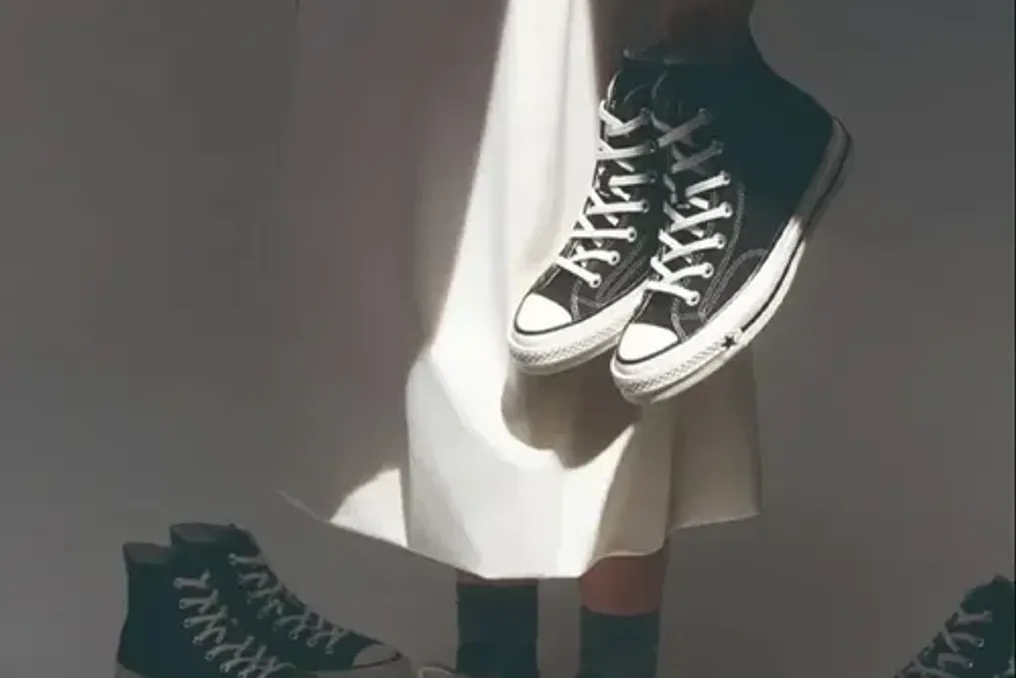
The company Converse was forced to issue a public apology and remove the sneaker advertising campaign in September 2026 after social media users expressed dissatisfaction with an image they perceived as resembling KKK symbolism.
Internet commentators criticized the photograph posted on the company's Instagram account, claiming that the lighting in the shot resembled the white cone characteristic of hoods. Furthermore, social media users compared the figure of the lynching victim and the pair of shoes hanging in the picture.
Doubts about the advertisement
Blair Monique Walker, a renowned branding and marketing expert in America, expressed her disgust on Instagram, stating: 'I am absolutely outraged by the Converse advertisement currently circulating.' She emphasized that as a creative professional, she understands that advertising does not appear online magically; it involves concepts, photographers, creative direction, edits, reviews, brand teams, and yet, an image that so clearly evokes horrifying images of the KKK and the lynching of Black people made it to publication. She called this unacceptable.
Walker's opinions aligned with the growing sentiment that this image should never have appeared. Walker noted that attempts to explain it as 'intentional' or 'just an unfortunate image' miss the main point. She asked: 'When your visual material immediately makes people see one of the most brutal and traumatic symbols in American history, the reaction should not be to explain what people are seeing. The question should be: HOW DID NO ONE STOP THIS?'
Walker condemned Converse's creativity, stating: 'Lynching is not art. The KKK is not creative inspiration. The trauma of Black people is not a toy to be played with for shock value, engagement, or edgy advertising.' She added that simply removing the post after it caused anger does not solve more serious issues with the approval and creative process that allowed it to be published in the first place. In her view, Converse must provide the public with more than just a deleted image; accountability, explanation, and serious reflection on who makes these creative decisions are necessary.
Jacqueline Peterson supported the views, also speaking out sharply. She pointed out that the problem goes beyond bad advertising, noting that Converse recently removed a photo advertising one of its sneakers after people noticed the composition depicted a Ku Klux Klan hood over the dangling feet of a lynching victim. Peterson suggested that it might not have been the photographer's intention, but stressed that once something is seen, it is hard to forget. She argued against the brand being able to dismiss the mass perception of a disturbing image as merely an artistic ambiguity. Peterson discussed several decision points, each revealing something about the brand: the first was the decision to approve the image. She believed that before publishing an ad for a major brand like Converse, it was likely reviewed by many people. Were questions about potential interpretation raised? Was concern voiced and ignored because the creative team assumed the image 'should' mean something?
The second decision concerned audience reaction. Instead of defending the artistic intent or trying to explain the meaning of the image, the company chose to delete it, which Peterson felt was the right move. After receiving significant criticism regarding this image, Converse issued an apology, stating: 'We are sorry. We understand why this image causes deep concern, and we admit we were wrong.'
The article also cites examples of other controversial advertising campaigns. In 2018, H&M displayed a young Black child in a green hoodie with the inscription 'Coolest monkey in the jungle.' When campaigns fail to grasp cultural context, use inappropriate messaging, or accidentally touch upon racist iconography, large brands often face public anger, forcing them to apologize and withdraw marketing materials.
A recent controversial campaign was Starbucks Korea in early 2026. A branch of the coffee chain in South Korea launched a promotion that appeared to reference the brutal military suppression of the Gwangju uprising in 1980. The public reaction led to a significant drop in sales and the dismissal of the head of Starbucks Korea.
Additionally, in 2025, American Eagle released an advertising campaign featuring actress Sydney Sweeney under the slogan 'Great Jeans.' This campaign drew internet criticism for alleged undertones related to genetic traits and eugenics imagery, although the brand later stated it had successfully expanded its customer base.
In the past, in a 2017 commercial for Pepsi, Kendall Jenner participated in a street demonstration and handed a Pepsi can to a police officer. The advertisement was criticized for trivializing significant social justice movements and real confrontations with the police. Also in 2017, a short social media video promoting Dove body wash showed a Black woman removing her outer clothing to reveal a white woman underneath. Due to widespread criticism of this advertisement as overtly racist, Dove was forced to halt the campaign and issue an official apology. In 2018, H&M again used the image of a young Black child in a green hoodie with a racially offensive inscription, which provoked boycotts and widespread public outrage before the retailer removed the image. Critics argue that creative and decision-making teams often lack representation from color in leadership positions who could have identified and flagged offensive or stereotypical concepts before production began.