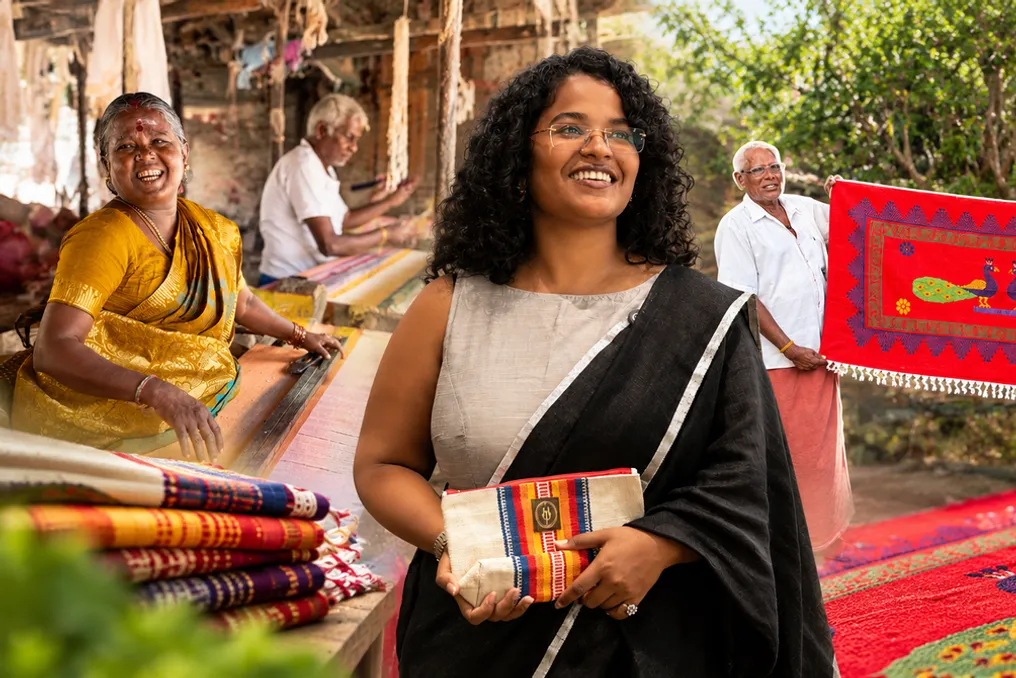
In the town of Bhavani, where Varsha Sivakumar works, and in Chennai, where she conducted online calls, there was an atmosphere of diligence. Twenty-six-year-old Varsha coordinated new orders and managed the weavers while machines clattered around her and sweat dripped from her face.
Amidst this intense work, 56-year-old Agilandam Akka shared her joy, discussing the multicolored carpet being created using a method passed down through centuries. She emphasized that for her, the importance lay not so much in the heat, but in the perfect combination of red, purple, blue, and yellow shades to satisfy herself and Varsha.
Agilandam's loom is one of about thirty in this cluster in Bhavani. They are situated in pits sunken into the floor, resembling wells. Seven looms in a row, with four rows working simultaneously, create a rhythmic noise that speaks of a thriving craft.
Three-century-old craft facing buyer shortage
The towns of Bhavani and neighboring Kumarapalayam, located along the banks of the Kaveri River in Tamil Nadu, have been producing Jamakkalam—a dense striped cotton fabric—for nearly three centuries. Initially, this craft was created by the Jangamar community when local weavers needed something unique to compete with British factory textiles.
In 2005–2006, the craft was granted a Geographical Indication (GI) tag and became part of almost every home in Tamil Nadu, from wedding trousseaus to temple courtyards. According to Varsha herself, in the early 2000s, weaving covered almost all households in the town, and trade flourished as generations passed on skills to each other.
However, that former bustle has quieted. Government cooperative orders, which previously formed the basis of trade, have sharply decreased, leaving looms idle and forcing weavers to seek other sources of income. Weavers note that cooperative warehouses are overflowing with unsold items that were approved and re-approved but never purchased.
Mariamma, one of the weavers in this cluster, returned to weaving after her husband passed away, drawn by the familiar work and faces in Bhavani. She says this work gives her a sense of comfort, and she earns between 2,000 and 6,000 rupees per month, providing for her independence and the ability to pay for her husband's medication.
Agilandam also feels the strain of this labor. Hours spent at the loom negatively affect the body. Despite back pain, she notes that the pain subsides when she interacts with other women, sharing problems and laughing together.
Returning to the roots
Varsha grew up among these looms, and her connection to Jamakkalam has always been with her. However, it was the perspective of an outsider that helped her see the true value of this craft. In 2017, while studying at the National Institute of Fashion Technology, a lecturer unconnected to Bhavani or Kumarapalayam presented a project on hand-weaving Jamakkalam.
This experience made her realize that she, having grown up surrounded by this craft, had never looked at it closely enough. Recognizing the true value of her region's craft and its weavers, she decided to act.
Varsha's decision to stay in the region was unusual, as in recent years, young people have left the weaving sector for higher-paying jobs or education. Industry estimates suggest that the number of active weavers in the Bhavani cluster has dropped from approximately 20,000 two decades ago to about 3,000 today. Varsha, at around twenty-five years old, is the only one of her generation choosing a life connected to this craft and attempting to save it.
During her studies, she began visiting Bhavani and Kumarapalayam, documenting details that the weavers were willing to show, as much of the craft had never been properly recorded. She discovered that about 200–300 weavers survived almost exclusively on government cooperative orders for outdated products, earning between 2,000 and 15,000 rupees per month and going months without work.
Instead of creating individual products, Varsha wanted to build something that could support the entire cluster, not just the weavers she worked with that week. This aspiration defined her subsequent activities.
Journey to the roots
In 2026, the House of Jamakkalam (HOJ) initiative was born, based on the idea of not viewing the craft as something needing external rescue, but as something that must continue internally. Design at HOJ starts from the cluster's own archive, not from a blank slate. Varsha explained that the goal is not to invent a new visual language for Jamakkalam, but to identify existing elements in the old design and present them with minimal changes, such as colors and proportions, to give it a modern look without compromising the recognizability of the pattern.
HOJ's most famous product, the Smiling Pouch, directly borrows elements from Pallu Mutham—a traditional stripe arrangement whose name translates to 'pearl-like teeth,' where the geometry of the stripes always resembled a woven smile. Varsha noted that no one at HOJ invented this smile; it already existed on Bhavani looms long before anyone thought of placing it on a pouch. The task was merely recognizing this element.
A more significant change was the financial aspect. Standard yarn in the cluster costs about 60–70 rupees per kilogram. HOJ purchases and dyes its yarn independently at a price ranging from 206 to 550 rupees per kilogram, absorbing these costs instead of passing them on to the weavers. Traditional Jamakkalam yarn is rough by necessity: cheap, durable, and restrictive, and its thickness has preserved simple geometric patterns for centuries.
HOJ's finer, better-dyed yarn allows for clearer detailing and more precise colors without forcing the weave to abandon what makes it recognizable as Jamakkalam. It is more like a new vocabulary of material layered onto an old technique. HOJ was created to bridge the gap between what was traditionally paid for the craft and the real cost of living.
Weavers in other parts of the cluster usually earn 200–350 rupees per day when working, and this rate has barely changed over the years despite rising costs. HOJ pays upfront, offering bonuses of 30–35 percent for complex orders specifically designed to exceed the minimum level. Even if the item is defective, HOJ buys it at full price.
Ultimately, Varsha argues that one cannot extract all the profit from a product because a sustainable business does not operate that way. HOJ maintains a minimal, reasonable profit distributed across many products, which allows for affordable prices with a stable flow of orders. At the highest level, HOJ executes fully custom pieces made to the client's size, color scheme, or occasion, sometimes with names or motifs embroidered directly into the weave. Such items cost from 10,000 to over 30,000 rupees, and even the smallest custom piece requires four full days of work from two weavers.
Weavers finding support
The greatest relief in adapting to the changes was felt by the senior weavers, disproving the assumption that age makes masters unresponsive to change. Weavers explain that this is due to how the changes were introduced: Varsha sits next to them throughout the entire creation process, offering real-time feedback rather than just giving remote instructions.
For Agilandam, known in the cluster for her mastery of the intricate 'Nimhans' pattern spanning 27 feet, the independence now provided by the work has become as important as the craft itself. For Mariamma, it is even simpler: she speaks of the women around her as family and of a sense of belonging that is hard to replace.
Mariamma notes that this is the only type of work she knows, as her husband also did it. Today, if she is suddenly asked to do something new, she is capable of doing it because Varsha trusts her. She also expresses concern about declining orders and the need for greater support.
Weaving finding a home abroad
Today, HOJ collaborates with approximately 30–35 weavers, depending on the scale of orders, corresponding to the same cluster that gathered around the looms of Agilandam and Mariamma. A significant part of the growth unexpectedly came through Instagram. Varsha believes this platform connected the cluster with buyers far beyond what word-of-mouth alone could provide.
Furthermore, personal events shared in text messages generated similar enthusiasm. Varsha reported recently receiving a weaver's certificate from the central government, making her the only next-generation weaver seen by this collective.
Special attention is paid to the audience of the Tamil diaspora from Sri Lanka, whose textile traditions are closely linked to those of Tamil Nadu. For many of these clients, a Jamakkalam piece is not just decoration, but a substitute for a home they no longer have. A recent piece was made for a wedding in Sri Lanka based on a specific couple's request. Varsha observes that Sri Lankans highly value their roots, even if it is tied not to happy memories, but to deep attachment.
HOJ's goals for the coming year include regular, guaranteed monthly orders for every loom in the cluster and entering markets in two or three countries by the end of 2026. In Bhavani, the loom rhythm continues: seven in a row, only thirty, and the design, passed down for nearly three centuries, is now integrated into new color schemes.