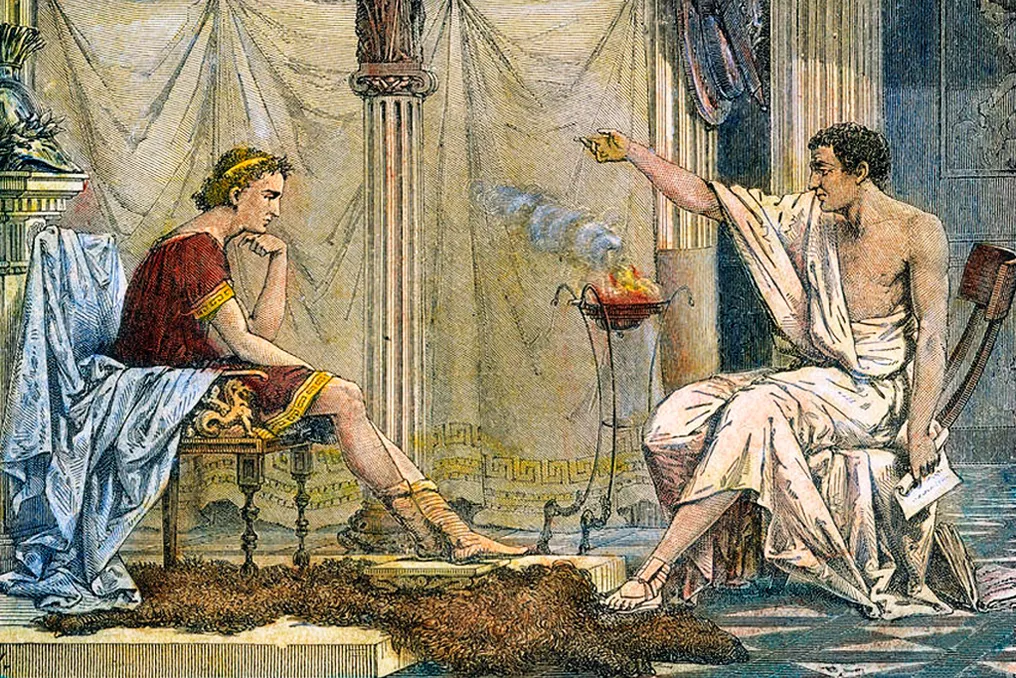
The school where Aristotle taught Alexander the Great over 2,300 years ago was discovered in the ancient Macedonian city of Mieza, located in northern Greece. According to the Greek Ministry of Culture, the excavation work unearthed an architectural complex that included stone desks, two halls, a sports area, a stadium, and a covered veranda.
In addition to the infrastructure, the archaeological site preserved everyday artifacts of the students, such as coins, ceramics, and four styluses used for writing. The ruins of the school, dated to the 4th century BC, featured mosaic floors and columns, as well as rooms equipped with raised pedestals, where originally about a dozen sofas would have been placed.
To specialists, the architecture and decoration of this place resemble the royal palace of Macedon in Aigai (modern Vergina), where Alexander and his father, King Philip II, resided. The opulence of the site suggests that the attendees were sons of the most prominent members of Macedonian society, making it likely that Philip II ordered the construction of the school specifically to receive them.
Educational institutions in ancient Greek world, known as 'gymnasia,' offered a variety of subjects aimed at the comprehensive development of students. However, educating a future monarch represented a responsibility of greater magnitude. Philip II sought out Aristotle, whom he considered 'the wisest and most illustrious of philosophers,' to instruct the young prince Alexander, who was between 13 and 16 years old at the time.
As reported in Plutarch's work 'Life of Alexander' (c. 46 – 120 AD), the king made great efforts to bring the philosopher to Macedonia. Plutarch describes that 'Philip II rebuilt the city of Stagira, Aristotle's homeland, which he himself had destroyed, and repopulated it with exiled or enslaved citizens,' adding that 'he reserved the nymphaeum of Mieza for the master and the student to dedicate themselves to study.'
Aristotle remained responsible for Alexander's education for a period of three years. During these lessons, he covered various topics, including nature, logic, zoology, society, mathematics, politics, poetry, physics, and ethics. During this period, between 343 BC and 336 BC, the Greek philosopher was already over forty years old and had dedicated much of his life as a student of Plato in Athens.
After the assassination of Philip II in 336 BC, Alexander assumed the throne of Macedon at the age of twenty. Even after separating, the king retained some of Aristotle's teachings; notably, his deep appreciation for Homer's Iliad was directly influenced by the philosopher, who introduced him to the work. In his military campaigns, which culminated in the formation of one of the greatest empires of antiquity, Alexander always carried a copy of this work with him.
Plutarch mentions in his biography of Alexander the Great that the prince and Aristotle held their classes in the city of Mieza. For this reason, Angeliki Kottaridi, archaeologist and director of antiquities at the Greek Ministry of Culture, who led the excavations at the site, maintains that the discovered archaeological complex corresponds to the school where Alexander the Great studied.
The location of the site also coincides with Plutarch's records. Mieza is located in northern Greece, approximately 43 kilometers from Pella, the ancient capital of the Kingdom of Macedon. At that time, political assassinations were relatively frequent, and keeping the prince away from the center of power served as a protective measure. Thus, if the king were killed, Alexander would have a greater chance of surviving unharmed, which indeed happened.