Innovation does not always arise from necessity; sometimes the spark is born from a simple realization: what if this works? Finding a solution to an existing problem is one thing. But finding a more efficient way to solve an already solved task can be even harder and bring greater satisfaction. Audi can attest to this with its experience.
In the 2000s, engineers from Ingolstadt decided to radically change their approach without any initial need for it. Although the company already dominated the '24 Hours of Le Mans' races with gasoline prototypes, in 2006 they put two diesel-powered prototypes on the track and continued to win.
A Problem That Didn't Exist
From 2000 to 2005, the Audi R8 LMP was an absolute nightmare in endurance racing. Equipped with a 3.6-liter turbocharged V8 gasoline engine, the R8 won five out of six editions of the '24 Hours of Le Mans' during this period, which was only part of 63 wins in 79 world races. The reliability of this car was legendary: the modular rear section ('Hinterwagen') allowed the team to replace the entire driveshaft in less than three minutes.
The only failure in this Ingolstadt dynasty was in 2003, when the iconic British Racing Green Bentley Speed 8 crossed the finish line first. However, it was a 'home' victory: Bentley belonged to the Volkswagen Group, and the Speed 8 was essentially a prototype based on Audi's own technology, using a four-liter version of the same gasoline turbocharged V8.
Audi effectively controlled the entire situation. The gasoline V8 with FSI direct injection was powerful, flexible, and reliable—the pinnacle of decades of industry development. Essentially, everyone knew how to build a good gasoline race engine. But Audi looked ahead—the Germans knew better than anyone that the first step toward obsolescence is standing still. At the time, this seemed like an exaggeration, but today we see how gasoline engines are gradually but persistently giving way to electric ones.
At that time, Audi was actively investing in more traditional diesel engines for its road cars. One of the main symbols of this phase was the ingenious Audi A2 3L—a compact aluminum-bodied car designed with an almost obsessive focus on aerodynamics and one mechanical goal: to consume only three liters of fuel per 100 kilometers (an impressive 33.3 km/l).
This bridge between extreme road efficiency and the top of the podium at Le Mans began to form quite casually: during an informal conversation in a bar. In January 2002, Ulrich Barrettsky, then head of powertrain technology at Audi Sport, met with Daniel Pussoneo and Daniel Perdrix, both employees of the Automobile Club de l’Ouest (ACO), in Ingolstadt. Discussing the future of motorsport, Barrettsky noted an undeniable fact: 50% of new cars sold in the European market were already running on diesel fuel. If the premise of Le Mans has always been to serve as a technology laboratory, why weren't the prototypes on the track using the same fuel as consumers?
Barrettsky passed this idea to Wolfgang Hatz, head of engine development, who immediately supported it. For Hatz, the logic was clear: advanced track technologies would be transferred to the roads (and vice versa), just as FSI direct injection was done in R8 engines. But the final and most important approval came from Wolfgang Ullrich (yes, these people had similar names), the legendary head of Audi Motorsport.
Ullrich saw a powerful strategic advantage in this. Firstly, Audi could use its American Le Mans Series (ALMS) calendar as a powerful marketing showcase to introduce and stimulate sales of its diesel passenger cars in the US market. Secondly, he wanted to permanently dispel the stereotype that diesel engines are inevitably slow, dirty, noisy, and 'too oil-consuming.' The mission was to prove the sportiness of diesel—and no laboratory was better suited for this than the '24 Hours of Le Mans.'
As Martin Winterkorn, then Chairman of the Board of Management of Audi, summarized at the official car presentation in Paris at the end of 2005: 'The Le Mans project will help our technical specialists extract even more from TDI technology.' The seeds were sown. And historical precedents also existed—no matter how absurd this idea seemed, Audi was not the first to try diesel in endurance racing.
Long before the Audi R10 TDI appeared, the French brothers Jean and Jacques Delestre registered a diesel-powered car for the '24 Hours of Le Mans' in 1949, using a Delage chassis and a six-cylinder inline engine producing only 70 hp. In the US, Cummins achieved a historic event by placing a diesel car on the starting grid at the 'Indianapolis 500' in 1952. In both cases, the cars retired from the race due to mechanical failures.
Decades later, in 1998, the BMW 320d made history by becoming the first diesel car to win a major international endurance race—the '24 Hours of Nürburgring.' And at Le Mans, the private team Taurus Sports Racing entered a Lola B2K/10 in 2004, equipped with a V10 TDI diesel engine (borrowed from the Volkswagen Touareg). The car proved to be slow and left the race early.
Diesel had a reputation for being noisy, dirty, heavy, and having too narrow a operating range for high-performance competition, and this history did not help. But Audi decided to insist because there was a real thermodynamic advantage that they could not ignore. They simply needed to utilize decades of evolution and apply the right materials.
Power Like Iron
If you follow FlatOut, you have probably seen our article explaining why diesel engines have higher torque and are stronger—and consequently heavier. In any case, here is a brief reminder: diesel fuel contains more potential energy per unit volume than gasoline (approximately 10–15% higher energy density). Furthermore, the diesel cycle does not use spark plugs: combustion occurs due to very high compression of the air-fuel mixture. This high compression ratio leads to much more efficient thermal expansion and, consequently, much greater torque at low and mid-revs.
However, this very reason became a real nightmare for Wolfgang Hatz (who was then head of engine development) and Ulrich Barrettsky. Diesel engines experience very high internal pressure, so their block must be made of cast iron (or ductile iron) to withstand detonation in the cylinders without splitting in half or ejecting pistons and connecting rods. When the Audi R10 TDI project began, Richard Bauder, head of road engine development for the brand, naturally proposed making the race engine block out of cast iron, like in road cars. Barrettsky categorically refused this, as it would make the entire engine incredibly heavy, disrupting the prototype's mass distribution and severely worsening handling in corners.
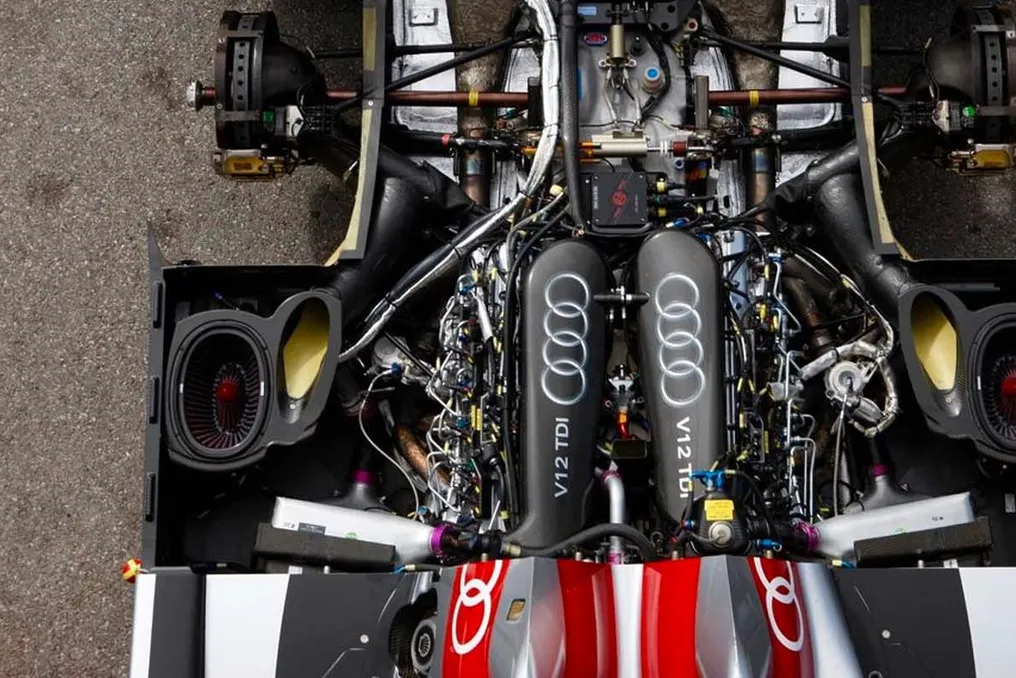
Audi's radical solution was this: they developed a completely unprecedented block from silicon-aluminum alloy—a material that possessed structural properties capable of withstanding the compression of the diesel cycle as well as cast iron, while saving dozens of kilograms. Yes, the final weight of this new aluminum engine still exceeded the weight of the old Audi R8 gasoline engine. Nevertheless, compared to any standard diesel block existing at the time, Audi's aluminum alloy was a marvel of weight reduction, allowing this unit to be used in the rear of the LMP1 chassis.
The result of these colossal efforts was a longitudinally mounted 5.5-liter V12 engine, equipped with two Garrett turbochargers limited to almost 3 bar of pressure, and a Bosch common rail direct injection system operating at an incredible 1600 bar. The power figures were so astonishing that even experienced engineers were shocked: officially the engine produced 'over 650 hp'—in practice, it exceeded 700 hp.
But what was truly impressive (and destroyed transmissions on test benches) was the enormous torque of 111 kgm, delivered almost evenly in the range from 3000 to 5000 rpm, with 80% already available at 2000 rpm. The Xtrac company was forced to design a completely new five-speed sequential gearbox, as no existing transmission could handle such power. Five gears were sufficient because the wide torque range made constant downshifting unnecessary.
There was also another curious point: thanks to the use of ceramic particulate filters (DPF) developed by Dow Automotive and the nature of the combustion itself, the engine did not emit black smoke—and it was simply not loud. The high whine of gasoline V8s slicing through the straight sections of Le Mans was replaced by a low hum, almost like a huge whispering vacuum cleaner.
Former Formula 1 racer and Le Mans legend Allan MacNish recounted that the engine was so quiet that when the car exceeded 160 km/h, all that could be heard was the sound of the wind hitting the helmet and the sounds of the suspension and tires rubbing against the asphalt, which completely drowned out the roar of the V12. Racers could not shift gears by sound, relying solely on the indicators on the steering wheel. Mechanics in the pits had to be much more attentive, as they could not hear the car approaching in the pit lane.
As compensation, the excellent torque mode made driving the car much smoother and more natural than constantly fighting with the gearbox in the gasoline prototype. But Audi's true trump card was not speed, nor even dynamics. In fact, it was not faster in a lap than the best gasoline cars of the time, such as Pescarolo-Judd, or even its predecessor, the Audi R8.
The secret lay in moments when the car was stationary—during refueling. At that time, gasoline prototypes consumed more fuel, showing an average consumption of about 1.3 km/l. With a full tank, this allowed them to complete an average of 12–13 laps on the Le Mans track, which is over 13 kilometers long, before needing to stop in the pits. Audi, armed with the energy density of diesel and the incredible efficiency of its 1600 bar injection, amazed everyone. The R10 TDI showed an average consumption of about 2.4 km/l (about 41 liters per 100 km). With the same regulated 90-liter tank, the Audi diesel prototypes could complete up to 16 laps on a single tank.
This may seem small, but the difference of 3–4 laps per tank is a chasm in endurance racing. Over 24 hours, while the gasoline car required more than 30 pit stops, Audi saved several such visits, saving precious minutes. Gasoline competition could not compensate for the time lost during refueling on the track.
But this was only half the story: to prove this mathematical superiority in practice, Audi had to tame the monster in real-time—this innovative complex brought headaches proportional to its complexity. When the V12 TDI debuted at Le Mans in 2006, the Achilles' heel was not the new aluminum block, but...
3.