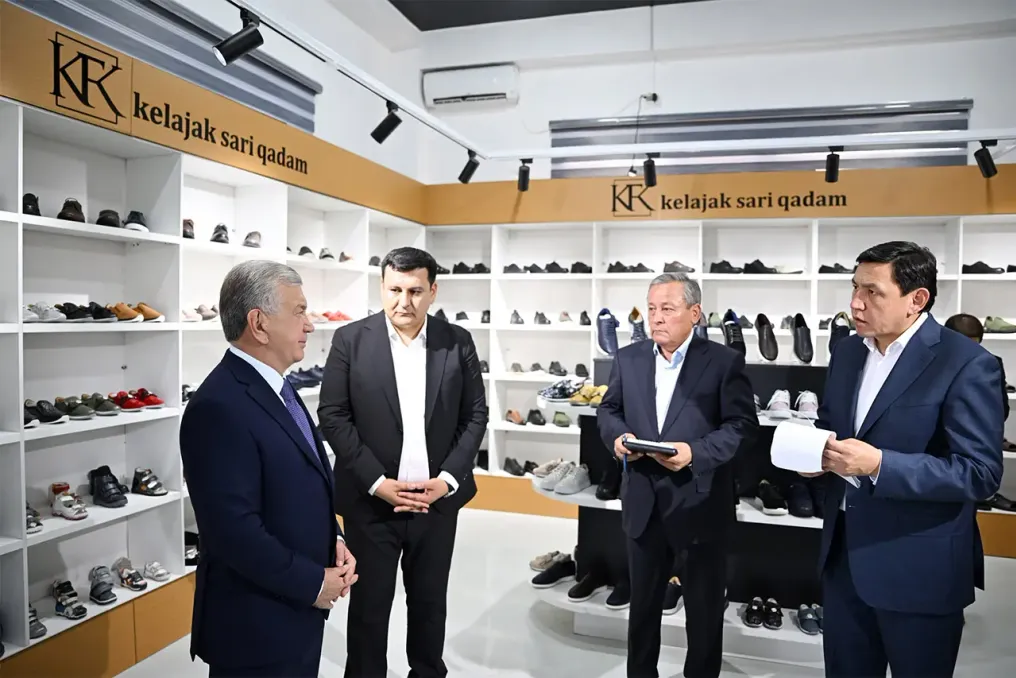
The President of Uzbekistan, Shavkat Mirziyoyev, inspected projects in the small industrial zone for leather and footwear production in the Altynkul area during his visit to the Andzhan region. A unified production complex is being created there, covering raw material processing, production, and sales of finished products.
Priorities for this sector include deep processing of leather raw materials, increasing the production of export-oriented goods, and ensuring the domestic market has access to quality footwear. One of the legal bases for these efforts is a presidential resolution aimed at further stimulating development and enhancing the export potential of the leather, footwear, and fur industries.
The industrial complex covers an area of 10.1 hectares, and the total value of the implemented projects reaches 28 million US dollars. Production buildings, a dual education center, and commercial facilities have already been constructed on 5.5 hectares of the territory.
Seventeen projects are being implemented in the industrial zone with a total production capacity of 150 billion soums. Ten enterprises specialize in the production of footwear and soles, two in artificial leather, and two in shoe adhesives. Other projects include the production of rubber footwear, uppers for special footwear, and leather.
The complex has currently created 2,500 new jobs. The complex's products are supplied to the markets of Russia, Belarus, Kazakhstan, Kyrgyzstan, Tajikistan, Turkmenistan, and Afghanistan.
Specialists who have undergone advanced training in Turkey, China, and Italy participate in the production process, which contributes to improving product quality. Additionally, extra support measures are being taken for sector participants; for example, production buildings and facilities built upon request are sold with installment payments up to seven years.
During the inspection, the President examined product samples, reviewed economic indicators, and assessed the export potential of the projects. While discussing issues with entrepreneurs, he provided recommendations on improving product quality, developing modern designs, and expanding export directions. Furthermore, officials were instructed to integrate local traditions of shoemaking with modern industrial technologies and to continue working on improving labor conditions in the industry.