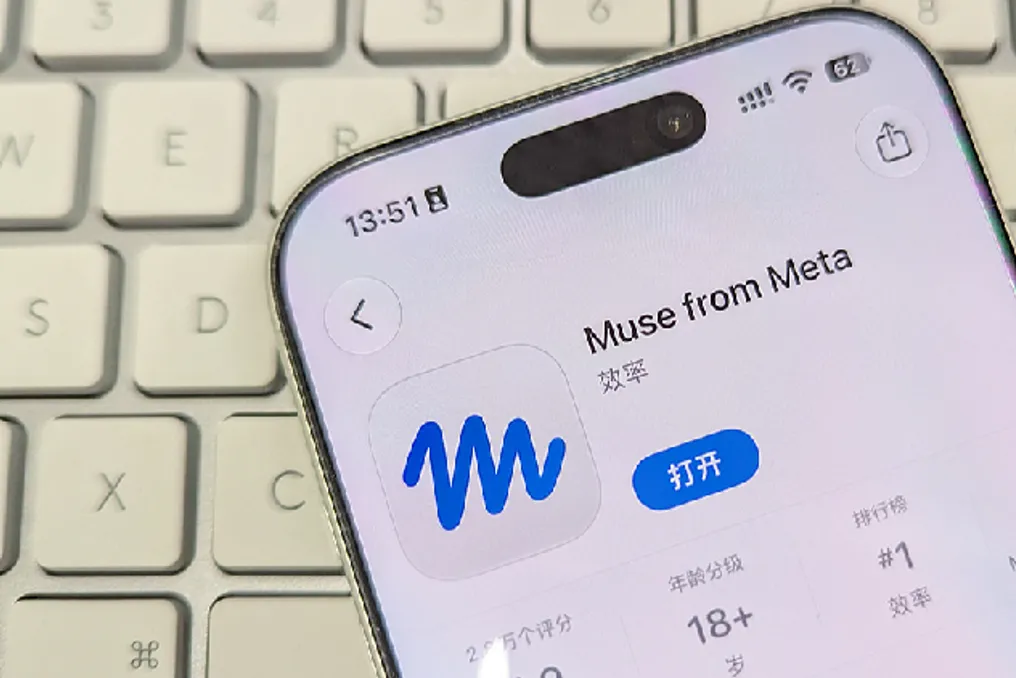
Meta has introduced Muse, a new personal artificial intelligence agent that has gained rapid acceptance in the United States. The application reached the top of the App Store and positively contributed to the company's stock performance, although it is already facing criticism regarding security, privacy, and access to third-party systems.
Within days of its launch in the American market, Muse surpassed 2.5 million installations, according to data provided by Sensor Tower. In response to this success, Meta's shares rose by 11% on Monday. Truist Securities projects that this feature could add US$ 28.5 billion (approximately R$ 146.4 billion) to the company's revenue by 2030.
To optimize its operation, Muse has the ability to access emails, calendars, and messages, implying that the user must deposit a considerable amount of personal data into the agent. A survey conducted by Oppenheimer & Co. illustrates this hesitation, indicating that only 8% of American consumers declared confidence in sharing their passwords with Meta, compared to 30% for Google.
Meta assures that the development of Muse prioritized security, stating that each agent operates on a dedicated and protected computer. Prior to the launch, Alexandr Wang, the company's head of AI, mentioned that the main concern was preventing leaks of personal data or accidental deletion of important emails.
Nevertheless, security concerns persist. Youssef Squali, an analyst at Truist, warned that a large-scale incident compromising credentials or credit card information could undermine trust not only in Muse but in the entire AI agent sector.
The first significant challenge for Muse arose in the e-commerce segment when Amazon blocked the agent on its website, preventing it from browsing or making purchases on behalf of users. Amazon stated that it had not received prior notice of such access nor authorized the action. An Amazon spokesperson emphasized that external applications making purchases for customers must operate transparently and respect the access permission guidelines established by the services.
Behind this block lies also a concern related to the business model. If AI agents start making purchases in place of individuals, users might have less exposure to pages displaying advertisements. For several analysts, this could generate resistance from major internet platforms, especially those whose revenue depends on advertising.
Meta, for its part, signals partnerships with Shopify, Instacart, and Dick’s Sporting Goods. Muse's advancement also generated reactions in other segments: there was a decline in the stocks of asset managers, brokers, and banks, with Charles Schwab registering a drop of over 6%. Booking Holdings and Allstate were also impacted.
Meta holds a crucial advantage, given that Facebook and Instagram offer vast distribution infrastructure, in addition to their services already accumulating data from millions of users. Currently, the only comparable product is the Instinct startup's agent, which is available only by invitation.
However, this landscape is expected to change soon. Analysts predict that OpenAI will announce a consumer-focused AI agent in the coming weeks. Google is also cited as a potential competitor, and Apple may enter this market later.
In this context of fierce competition, being a pioneer can be decisive. According to Ken Gawrelski, an analyst at Wells Fargo, the effectiveness of these assistants improves as consumers become familiar with them and direct their functionalities. Furthermore, Muse demands high computational capacity, as each agent runs on its own virtual computer, which represents a factor in the dispute; however, analysts cited by the Wall Street Journal indicate that Google possesses sufficient infrastructure to develop a similar solution.
So far, the rapid implementation of Muse has positioned Meta at the epicenter of this new dispute. However, the agent's success will not depend solely on the number of users, but also on the willingness of platforms to allow an artificial intelligence to perform tasks on behalf of their customers.