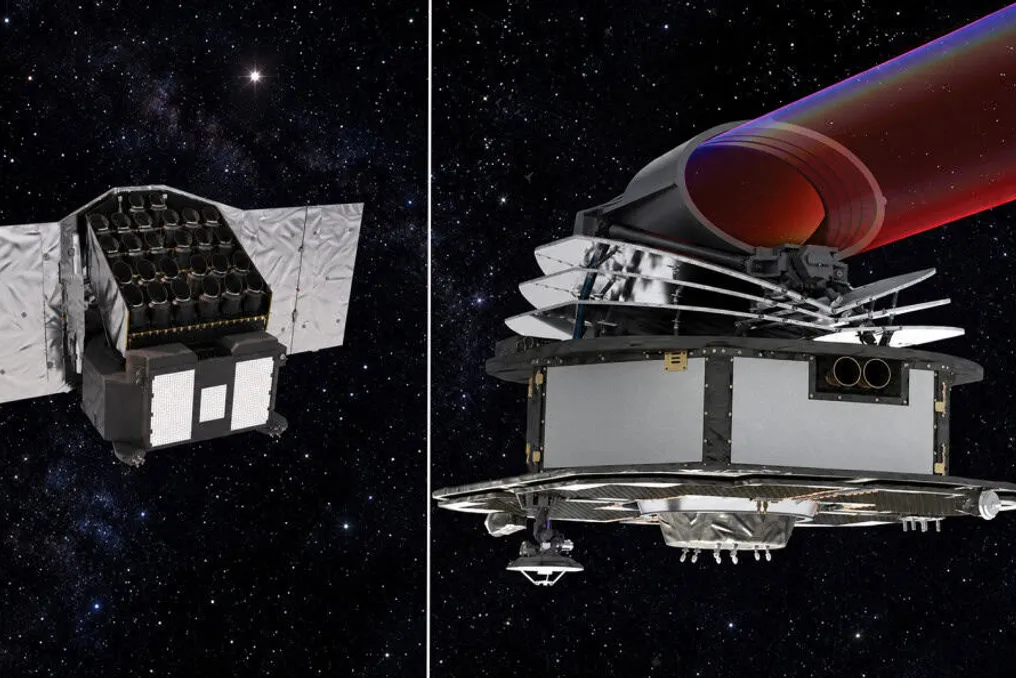
The European Space Agency (ESA) is preparing an unprecedented scientific campaign aimed at answering one of humanity's oldest questions: are we alone in the Universe? Two complementary missions dedicated to studying exoplanets—worlds outside our Solar System—will be launched for this purpose.
The first mission is PLATO (Planetary Transits and Oscillations of Stars). Its launch is scheduled for early 2027, and its objective is to search for planetary systems. Most known exoplanets orbit small, cool red dwarfs or are too close to their host stars. The new observatory will change this picture by focusing its detection on rocky planets orbiting in the habitable zones of yellow stars similar to our Sun, where radiation conditions are more favorable for the existence of liquid water and life.
To achieve this goal, the space telescope is equipped with an innovative set of 26 synchronized miniature cameras. This architecture allows the instrument to monitor tens of thousands of bright stars simultaneously over long periods without interruption, recording the slightest changes in brightness.
Astronomer Marcelo Zurita, President of the Paraíba Astronomy Association (APA), member of the Brazilian Astronomical Society (SAB), technical director of the Brazilian Meteor Observation Network (Bramon), and columnist for Olhar Digital, explains that the key advantage of PLATO lies in using 26 cameras simultaneously, which will allow it to observe tens of thousands of stars in parallel and detect small dips in brightness caused by planetary transits.
In addition to discovering new worlds, the observatory will use an advanced methodology to study the internal structures of the stars themselves. As Zurita clarifies, PLATO will apply asteroseismology—the study of stellar oscillations—to determine the age, mass, and internal structure of a star with high precision. Knowledge of this data is a fundamental step in characterizing entire planetary systems, understanding their similarity to ours, and calculating planet ages to assess the possibility of life's emergence and evolution.
Once initial mapping points to promising targets, astronomy will receive support from the ARIEL space telescope, slated for launch in 2031. Unlike its counterpart, the primary goal of this equipment is not the search and discovery of new celestial bodies in deep space. Its central focus is studying exoplanets whose positions are already known, functioning as a true remote chemical analysis laboratory.
Zurita explains: 'After other telescopes find exoplanets, Ariel investigates whether they have an atmosphere and what it consists of.' The telescope will be able to identify molecules such as water, carbon dioxide, and methane, and also study clouds and chemical characteristics by analyzing starlight passing through atmospheres during transits, and the planets' own emission using the infrared range.
The main advantage of ARIEL is the unprecedented scale of research. Instead of concentrating on a few particularly interesting worlds, the observatory will select a sample of about a thousand cataloged exoplanets—from hot gas giants to rocky worlds called Super-Earths.
Zurita emphasizes: 'Instead of focusing on a few particularly interesting worlds, Ariel intends to study about a thousand exoplanets, allowing for comparisons of their atmospheres and the search for patterns that reveal how different types of planets form and evolve. And who knows, it might even be able to detect some sign of life on one of these planets.'
The central tool for unraveling these mysteries is transit infrared spectroscopy. When an exoplanet passes in front of its star, the starlight passes through the planet's gaseous layer, leaving a distinct chemical 'fingerprint' that allows the components of the alien atmosphere to be deciphered. Identifying these elements will help determine whether the chemistry found on Earth is a common phenomenon in the Milky Way, or if our planet is a rare exception in space.
This coordinated mechanism creates an ideal scientific production line between leading global space observatories. Sky-survey telescopes, such as NASA's Nancy Grace Roman and PLATO, pave the way for discovering entire populations of exoplanets in promising regions of space. Then, spectroscopy-focused instruments, like ARIEL and James Webb, come into play for detailed analysis of the chemical composition of these discoveries, optimizing the use of the most advanced built devices' time.
In the future, the Habitable Worlds Observatory, a landmark NASA project, will use the catalogs created by these preceding European missions to focus the direct search for biosignatures. By analyzing light reflected by rocky planets, the American telescope will look for definitive biological signs, such as oxygen and methane.
More than just searching for a 'second Earth,' this international alliance of observatories is building a bridge between doubt and discovery. Every fact we gather brings us closer to a moment when, looking at the stars, we see not just bright dots in the darkness, but a real promise of other worlds scattered across space.