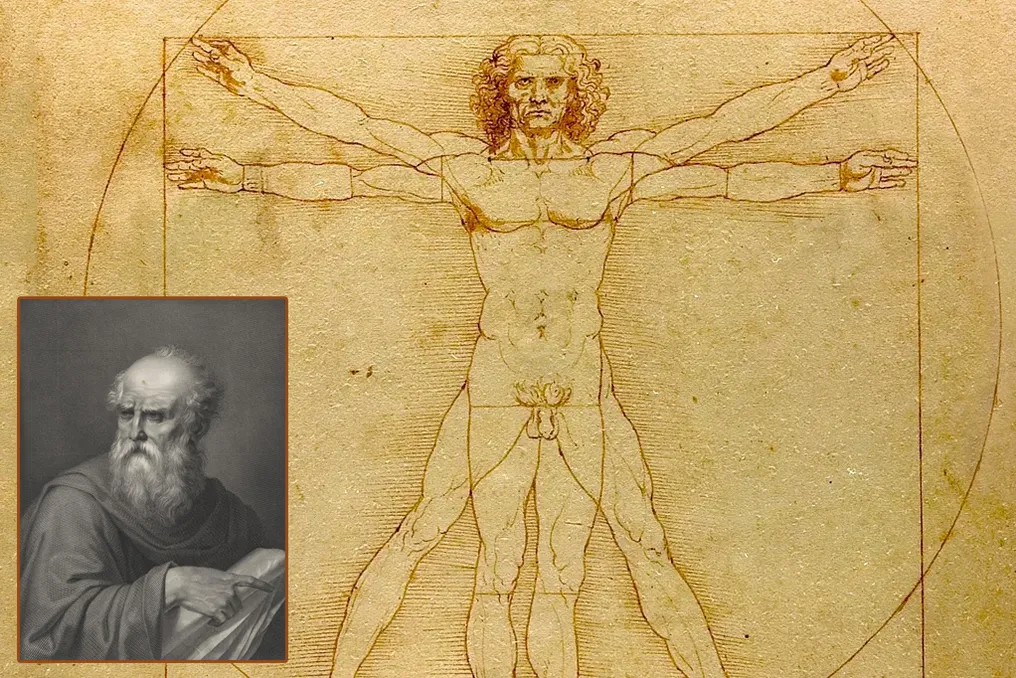
The name of the Vitruvian Man refers to the Roman architect and engineer Vitruvius, who lived in the first century BC. His most notable publication is the book De architectura, where he discusses the profession of an architect.
In this book, Vitruvius postulated that the human body could be perfectly contained within both a circle and a square. He observed that when a person extends their arms and legs, the fingers of the hands and feet touch a circumference whose center coincides with the navel. Furthermore, Vitruvius noted that the total distance between the tips of an individual's outstretched arms is equivalent to their height, allowing anyone with their arms open to fit inside a perfect square with equal sides.
This representation is exactly what the Vitruvian Man, created by Leonardo da Vinci, illustrates. Since Vitruvius's original treatise did not have drawings, other intellectuals sought to recreate the concept presented in the book. It was the architect Fra Giovanni Giocondo who drew the Vitruvian Man in an illustrated edition of De architectura, released in 1511, approximately twenty years after Da Vinci's sketch. Other thinkers, such as Cesare Cesariano and Francesco di Giorgio, also made similar attempts.
Several examples of 'Vitruvian men' were produced during the 15th and 16th centuries, the Renaissance period. Although Vitruvius lived in the 1st century BC, his reflections echo Renaissance concepts linked to humanism, geometry, anatomy, and art. The ideal man proposed by Vitruvius symbolizes the notion of the human body as a microcosm of the Universe.
Leonardo da Vinci's Vitruvian Man is part of the collection at the Gallerie dell'Accademia in Venice, Italy.