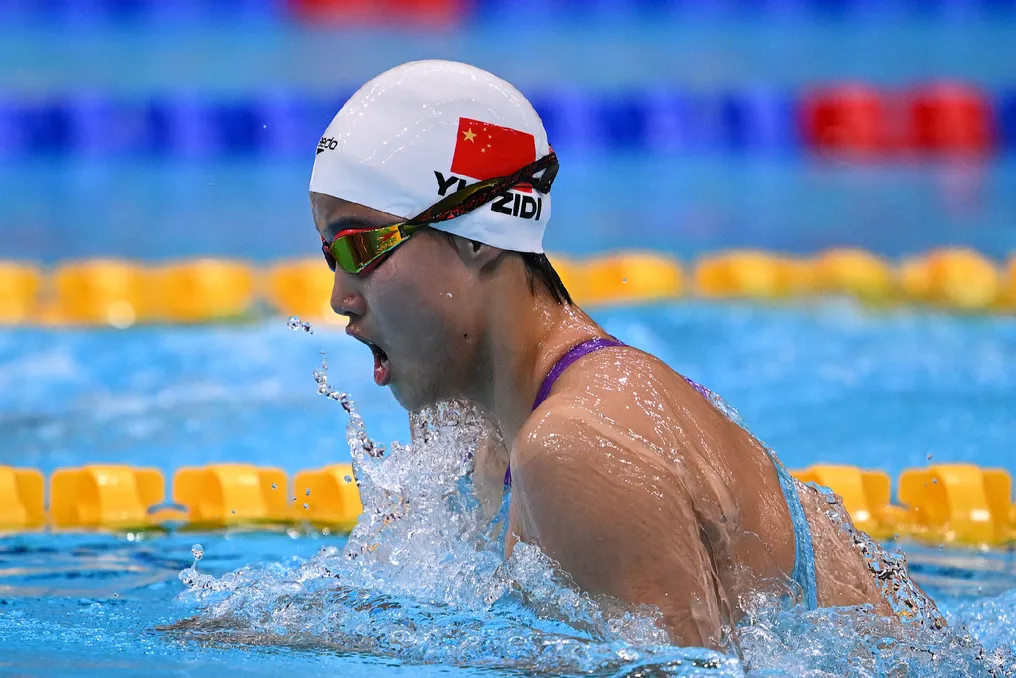
China wins 12 gold medals on the second day of the 2026 Asian Games
Read more
CGTN
cgtn.com

China wins 12 gold medals on the second day of the 2026 Asian Games

At the 2026 Asian Games in Aitih-Nagoa, China secured 12 gold medals on Monday. This day was marked by several sporting achievements, including setting multiple records and successfully defending the title in the men's all-around gymnastics event by Zang Boheng, marking the second consecutive day of strong performances by the delegation.

Swimmers contributed to China's haul of five gold medals, setting two Asian records and one Asian Games record from Tokyo.

The most prominent individual performance was the victory of Yu Jidi in women's swimming in the 200-meter individual medley. The thirteen-year-old athlete won with a time of 2:06.10, improving the previous Asian record held by her compatriot Yu Yiting, who finished second with a time of 2:07.99. Mio Narita from Japan won the bronze medal.

Yu Jidi's winning time was only 0.40 seconds faster than the world record of 2:05.70 set by Summer McIntosh from Canada. This victory was the second gold for the teenager at the Asian Games following her previous triumph in the women's 200-meter butterfly.

China also broke another Asian record in the evening's final race—the men's 4x200-meter freestyle relay. Although Japan led early in the competition, Pan Zhanle closed the gap in the third leg. Then Zhang Zhanshuo delivered a powerful final sprint of 1:42.92, overtaking his Japanese rival in the last 50 meters and securing the win for the Chinese quartet after trailing.

Xu Haibo, Fei Liwei, Pan, and Zhang finished with a time of 7:00.17, thereby lowering the Asian record and beating Japan by 0.88 seconds. Athletes from the Republic of Korea took the bronze medal with a time of 7:06.76.

Swimming veteran Xu Jiayou was also recognized in the record books as he successfully defended his title in the men's 50-meter backstroke. The 31-year-old athlete covered the distance in 24.04 seconds, breaking the Asian Games record, while his compatriot Wang Zhining took second place with a time of 24.49.

Xu's time was slower than his own Asian record of 23.92 set earlier this year, so his achievement is counted as a Games record rather than a continental standard.

China also won gold in the women's 50-meter backstroke thanks to Wang Letian, and Dun Zhixiao shared the title in the men's 100-meter breaststroke with Japan's Shinon Ohashi, as both finished with a time of 58.64 seconds. Chinese swimmers concluded the evening with five gold medals across seven finals.

In Nagoa, Zang Boheng managed to retain his title in the men's all-around gymnastics, defeating two Olympic champions from the host country—Japan. The reigning champion scored 85.065 points across six apparatuses, surpassing Shinnosuke Oku from Paris, the Olympic gold medalist, who finished second with 84.698 points. Tokyo Olympian Daiki Hashimoto placed third with 83.865 points.

Zang climbed in the rankings after starting the pommel horse and took a strong position with 14.700 points on the parallel bars. Knowing he needed to secure the final ring, the 26-year-old athlete reduced the difficulty of his routine and scored 14.033 points to ensure gold. This victory brought China its third consecutive Asian Games championship title in the men's all-around and a total of 12 golds.

Thanks to these 12 victories on Monday, China's overall tally reached 23 gold, 10 silver, and five bronze medals after two full days of competition.
Similar stories

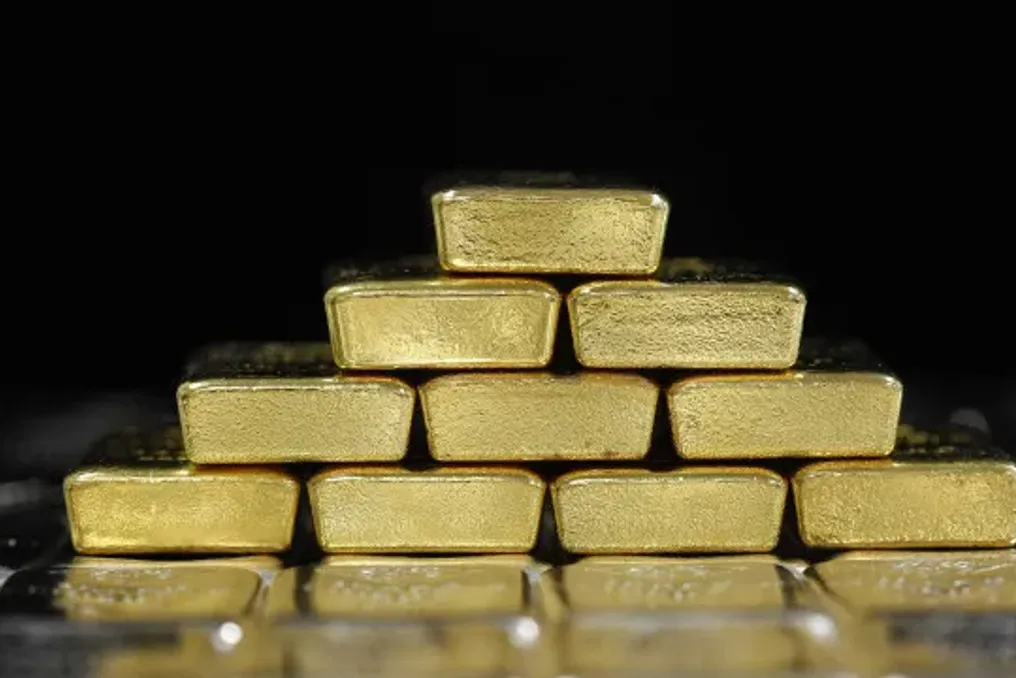
China records record spending of 158.8 billion in gold imports
Read more
noticiasaominuto.com

China records record spending of 158.8 billion in gold imports

According to information released by the Financial Times, China imported more than a thousand tons of gold between January and August. This volume exceeded the 886 tons purchased during the entire year of 2025, totaling 96.5 billion dollars (equivalent to 84.45 billion euros).

This increase in acquisitions comes after China reduced its purchases in the previous year, a period marked by a sharp appreciation of the precious metal. The price of gold rose from approximately 2,625 dollars (2,297 euros) per troy ounce at the beginning of 2025 to a peak of 5,595 dollars (4,896 euros) in January.

Additionally, China is recognized as the world's largest gold producer, having extracted 384 tons last year, according to data provided by the World Gold Council.

The increase in imports is linked to the growing search by Chinese investors for alternatives to diversify their economies. This demand is driven by the persistent crisis in the real estate sector, the poor performance of the stock market, and the low returns offered by public debt.

The CSI 300 index, which groups large companies listed on the Shanghai and Shenzhen stock exchanges, has fallen by 1.8% since the beginning of the year and remains more than 20% below its recorded high at the beginning of 2021. Simultaneously, yields on Chinese sovereign bonds are close to historically low levels.

China's positions in US Treasury bonds fell to 618 billion dollars (540 billion euros) in July, reaching the lowest level since August 2008.

Lisa Liu, CEO of Gold Mountains Asset Management, which is part of the Zijin Mining group—China's largest gold producer—told the FT that both the central bank and private investors are diversifying their reserves and savings towards an asset that does not carry counterparty risk. This is part of a broader strategy focused on long-term wealth preservation.

Liu emphasized that this movement should not be seen as a very short-term action, but rather as a 'multi-year repositioning of family and institutional assets'. She added that 'the scale and persistence of Chinese purchases are now a central factor in global gold prices, and we expect them to remain as long as uncertainty persists regarding growth and geopolitics.'

Gold has also gained relevance in the diversification of portfolios for investors globally, at a time when the traditional relationship between stocks and financial bonds is transforming.

Christopher Hamilton, head of Invesco's asset management for the Asia-Pacific region (excluding Japan), informed the FT that the price of gold has stopped reacting to increases in real interest rates in the same way as before. He stressed that 'we are in an environment where people want to hold real assets', adding that institutional acquisitions continue to be the main support for the precious metal's price.

Analysts at Goldman Sachs, based in the United States, estimate that gold purchases made by the People's Bank of China (central bank) may be higher than officially disclosed. In a note published this month, they calculated that the Chinese central bank bought 35 tons in July, compared to the 20 tons reported in official data.

Chinese acquisitions also occur against a backdrop of growing demand from governments seeking to keep their gold reserves closer to their own territories. The previous month, the Government of the Netherlands transferred part of the gold reserves it held in New York to London.

Popular