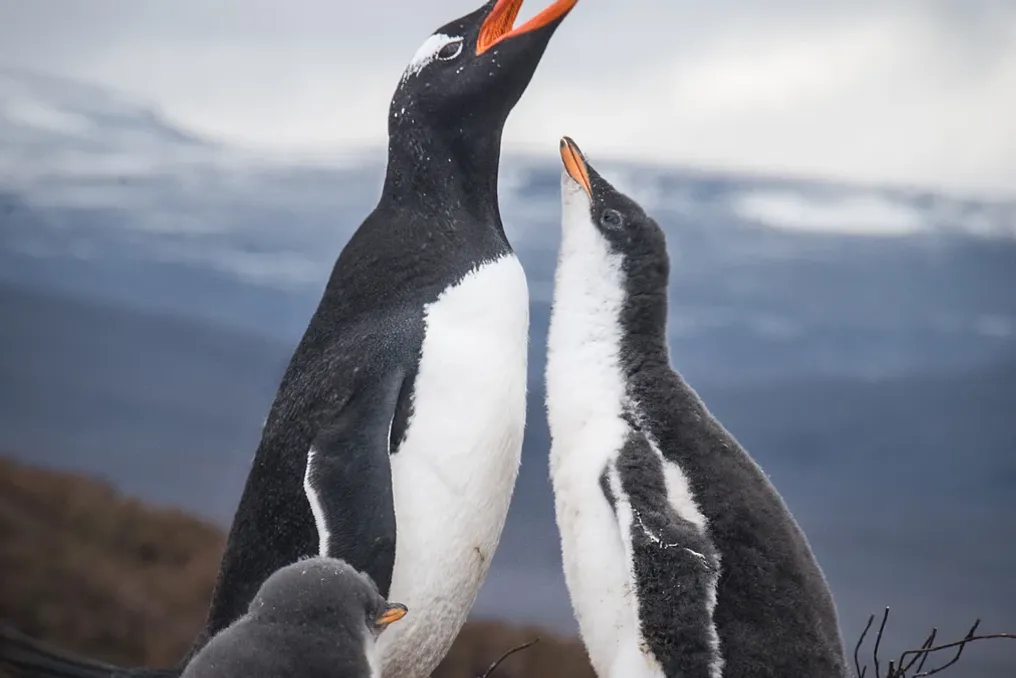
For over a hundred years, penguins inhabiting the Southern Ocean appeared identical due to similar characteristics: black backs, white bellies, and orange-pink flippers. However, among them, scientists discovered a species that had not been officially recognized before.
Researchers concluded that what was long considered one widely distributed species of Gentoo penguin actually represents four separate species, including one new to science.
The newly described species, Pygoscelis kerguelensis, inhabits the remote Kerguelen Islands, also known as the Desolation Islands, located in the southern Indian Ocean. Researchers note that this is the first new penguin species named in over a hundred years.
The reason why an entire species remained hidden for so long turned out to be unexpectedly simple: the birds did not differ externally enough. Besides minor differences in size and call, the newly recognized penguins are very similar to other Gentoo species.
Scientists refer to this as a 'cryptic species'—a species that looks extremely similar to its relatives but is genetically distinct. Furthermore, their remote location made studying these penguins difficult.
To gain a clearer picture, researchers analyzed whole-genome data from 64 penguins across 10 nesting sites, covering almost the entire geographical range of Gentoo penguins. The results showed four distinct evolutionary groups instead of one species.
Laurie Bouey, Professor of Integrative Biology at the University of California, Berkeley, and one of the senior authors of the study, stated upon announcing the work: 'For over 100 years, it has been a contentious issue regarding how many species or subspecies exist.'
The study, published in Communications Biology, combined genetic evidence with data on the physical characteristics, behavior, and habitats of the penguins. Part of the answer lies in the lifestyle of the Gentoo: they can feed on diverse food, including fish, krill, squid, and cuttlefish. This allows them to stay close to nesting sites without traveling far in search of a specific food source.
Over hundreds of thousands of years, isolated populations adapted to their conditions and gradually acquired genetic differences. Researchers suggest that these four groups diverged approximately 300,000–500,000 years ago. The Antarctic polar zone also contributed to the separation of some populations—an oceanic boundary where water conditions change sharply.
The discovery of a new species expands scientific knowledge about penguin diversity, but the study also raises concerns about their future. Climate projections used in the work indicate a serious loss of suitable habitats for three of the four Gentoo groups, while the southern species discovered around Antarctica may expand its range.
This is important because viewing all Gentoo penguins as one widespread species can mask problems affecting small populations. Penguins might thrive in one part of the Southern Ocean, while a genetically distinct population thousands of kilometers away faces entirely different challenges. Scientists believe that recognizing these four groups as separate species will allow for individual assessment of conservation needs for each one.