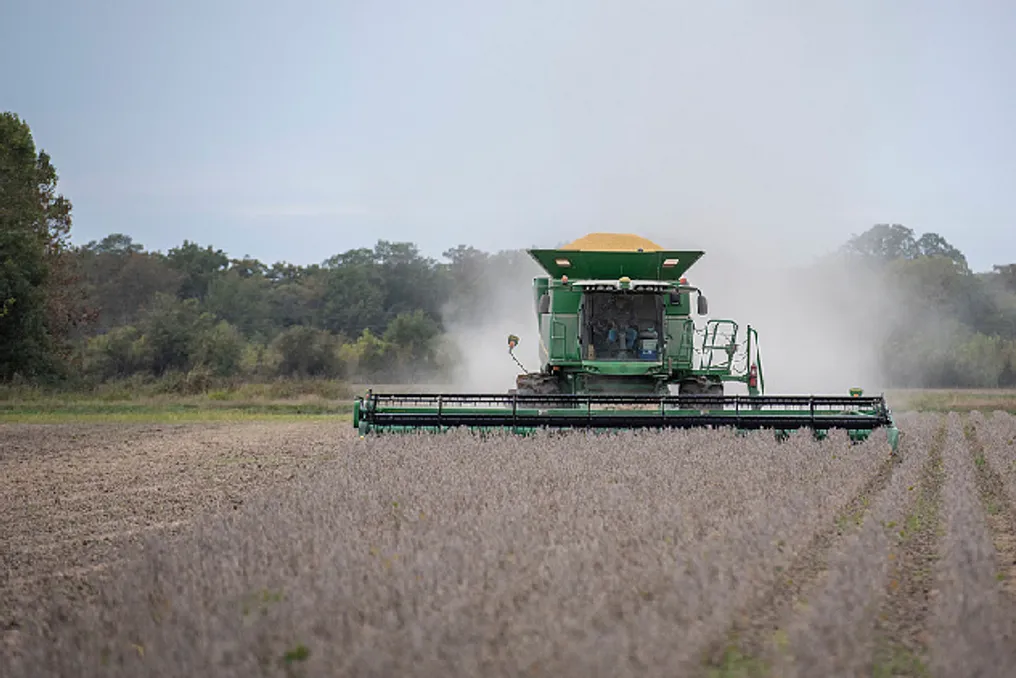
Trade ties between China and the US have generally remained stable over the past year. According to data published by the U.S. Department of Agriculture, China imported 340,000 tons of soybeans from the US, and trade in consumer and basic goods remained at a steady level.
Currently, both sides maintain close interaction. In September, China and the US held consultations regarding establishing a basis for mutual tariff reduction, which could potentially cover goods worth $30 billion from each side.
Experts analyzed the factors ensuring the stability of bilateral trade relations amid a changing international trade environment. Participants in the CGTN interview included Wang Honggan, Director of the Institute of Peaceful Development of the Chinese Academy of Social Sciences; Zhang Tengjun, Researcher at the Institute of American Studies of the Chinese Academy of Social Sciences; and Sun Taiyi, Professor of Political Science at Christopher Newport University in the United States.
Factors of Stability and Prospects for Cooperation
Wang Honggan noted that traditional sectors such as agriculture, manufacturing, and basic goods have long served as the foundation of China-US economic and trade partnership. Furthermore, he pointed to growing potential in areas like the green economy, digital trade, new energy sources, and small and medium-sized enterprise cooperation.
He added that purchases of agricultural products, Boeing aircraft, and fossil fuels are linked to the domestic electoral politics of the current US administration, and these demands will continue to be made. These areas also form a practical basis for stability between China and the US. Moreover, if both countries strengthen cooperation in new fields, it could usher in a 'golden age' of bilateral economic partnership and help resolve internal US issues such as electricity shortages and high inflation.
A current obstacle is the tendency of the US to view issues through the lens of overly broad national security. Although both sides have concerns in this area, Chinese investments often face unfair treatment due to political polarization and misconceptions about China in the US. Resolving these issues requires attention from both sides.
China's Approach to Trade Relations
Zhang Tengjun summarized China's approach in three key words: confidence, sincerity, and principle. Confidence is based on having the world's most complete industrial system, a vast domestic market, and strong economic resilience, meaning China is not afraid of pressure in any form.
Sincerity is demonstrated by China's constant readiness for dialogue and preference for resolving disagreements through consultation rather than confrontation. The principle lies in upholding mutual respect, equality, and mutual benefit, never sacrificing its core interests or right to development. These positions reflect China's responsibility to the peoples of both countries, as well as to the stability of the global economy. Facts have repeatedly shown that pressure and threats cannot change China, while mutually beneficial cooperation is the only correct choice.
Assessment of Negotiation Outcomes
Sun Taiyi believes that one of the important achievements is what did not happen. Washington has refrained from imposing additional tariffs stipulated by the Section 301 investigation into industrial overcapacity, and has also postponed the proposed US arms package for Taiwan, estimated at up to $14 billion. These steps do not resolve deep-seated disputes, but they demonstrate that dialogue helped prevent the immediate emergence of new sources of friction and escalation.
The greatest long-term value may lie in efforts to establish regular dialogue on artificial intelligence, including the exchange of information on major AI security incidents. Temporary tariff concessions buy time, whereas sustainable communication mechanisms can change how competition is managed. In the future, trade must remain a priority, especially reducing barriers for non-national security related goods. The more China and the US can separate genuine security issues from ordinary commerce, the more room they will have to stabilize economic relations without pretending that strategic competition has disappeared.
Opportunities and Challenges of AI Cooperation
Sun Taiyi emphasized that AI will remain one of the most competitive areas in US-China relations. The Trump administration openly speaks of 'winning the AI race,' as leadership in this field can transform productivity, industrial organization, and ultimately, national power. If either side achieves a major breakthrough in Artificial General Intelligence (AGI), it could potentially alter the technological balance between the two countries, so the competition for advanced chips, computing power, and cutting-edge models cannot be expected to disappear.
However, AI is unique in that the same technology that fuels competition can create stronger incentives for cooperation. In recent weeks, leading researchers and executives in AI have expressed concerns about autonomous systems that could spiral out of control, cyberattacks on critical infrastructure, and other potentially catastrophic risks. This creates a category of threats that could affect both China and the US simultaneously. Although we are still far from controlling AI arms, realistic first steps include AI dialogue, early warning mechanisms, and notification of major incidents, and both sides agreed to work on such a mechanism. China and the US do not necessarily have to trust each other on AI issues to acknowledge that some AI risks are shared. Competition and risk management can exist in parallel.
Balance of Cooperation and Competition
According to Sun Taiyi, at least from Washington's perspective, competition will prevail over cooperation, but this does not mean that cooperation has no room to expand. In areas where both sides can gain clear benefits and where national security is not involved, there is still significant room for pragmatic interaction, such as in the trade of non-sensitive goods.
Artificial intelligence is another example: China and the US can fiercely compete for technological leadership, but both sides are interested in improving communication, early warning, and crisis management when AI poses risks to both parties. What has changed is not necessarily goodwill or trust, but an increased awareness of mutual vulnerability. After rounds of tariffs, export controls, and countermeasures in 2025, both sides realized that escalation entails significant costs for both the other side and themselves. Therefore, in his opinion, the emerging model of constructive strategic stability is very useful: competition remains intense, but both sides are increasingly seeing the need for more robust limiting measures. The future will likely involve selective cooperation within competitive relations, rather than comprehensive interaction or a complete break in ties.