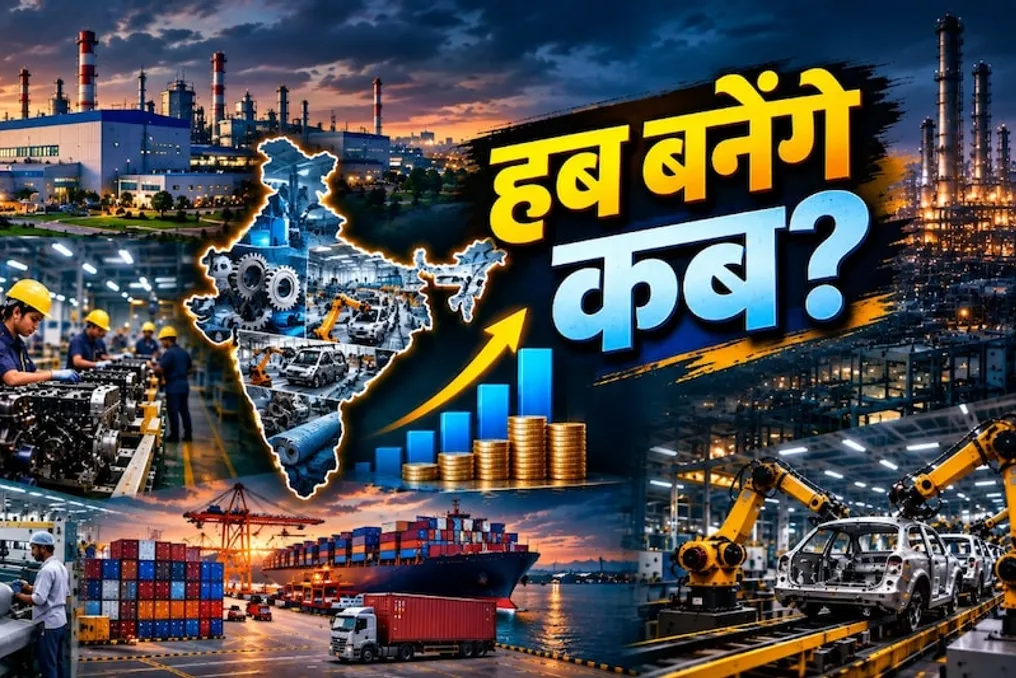
Comparison of Indian and Chinese Production Capacities: Prospects for Becoming a Global Manufacturing Hub
Read more
Aaj Tak
www.aajtak.in

Comparison of Indian and Chinese Production Capacities: Prospects for Becoming a Global Manufacturing Hub

There is an aspiration to make India a major manufacturing center. The global community is paying attention to India because the status of a manufacturing hub is critically important for strengthening any country's economy. However, the question arises: can India become the next global manufacturing hub?

When goods such as automobiles, mobile phones, and clothing begin to be manufactured in the country, import costs are significantly reduced. This leads to job creation for millions of young people, increased household income, and prevention of liquidity problems in the market. Furthermore, when a country begins to meet its needs and export products, foreign currency flows into the country. This is why the establishment of an Indian manufacturing hub is a key element of its economic stability and self-sufficiency.

India relies on production to realize its dream of transforming into a developed nation by 2047. As part of this process, India has intensified its industrial activities under the slogans 'Make in India,' 'Atmanirbhar Bharat,' and with the help of the 'PLI Scheme.' Nevertheless, the question remains open: when and how will this goal be achieved? Where does India stand in this global race, and how far behind China is it? What challenges does the country face?

Analyzing statistical data, India has achieved an initial advantage in the production race, but it is still far from the ultimate goal. India's share in the total global production volume is about 2%. Although India has already become the fifth-largest manufacturing country in the world, its scale remains limited.

On the other hand, China is rightly called the 'world's factory.' Its share in global production approaches 30%. China's annual industrial output exceeds $4.5 trillion, while India's figure is around $500 billion. Thus, China surpasses India by approximately nine times in terms of production volume.

The truth is that India cannot overtake China overnight, but changes have already begun. Global corporations are now adopting a 'China plus one' policy, meaning they aim to locate their factories in countries other than China. This presents a golden opportunity for India, especially considering the growing trade tensions between the US and China. Many American companies operating in China are viewing India as an attractive alternative.

The US also intends to break China's monopoly, but simultaneously does not want to allow India to become an 'economic superpower.' The recently passed US law, the 'Graham Sanctioning Act,' grants the right to impose high tariffs on countries purchasing Russian oil, which poses a challenge even for India. Since production is closely linked to energy, India imports over 85% of its required crude oil. Rising crude oil prices directly increase the cost of transporting goods, electricity tariffs, and raw material prices in India. This raises the cost of production in India, making it more expensive than goods from China, Vietnam, or Bangladesh.

The high cost of oil procurement depletes significant foreign exchange reserves of India. When government and company funds are spent on paying oil bills, capital for investment in infrastructure, new technologies, and research and development (R&D) becomes insufficient.

Over the last decade, India has made significant adjustments to its industrial policy. Under the 'Make in India' and 'Atmanirbhar Bharat' initiatives, production processes have been simplified, and special emphasis has been placed on 'Ease of Doing Business' to increase domestic production.

In accordance with the PLI programs, multi-billion dollar incentives have been provided for more than 14 sectors, including electronics, semiconductors, automotive, pharmaceuticals, and solar panels. As a result, India is now the second-largest mobile phone producer, and a significant portion of iPhones is assembled there.

Production in India will only grow if infrastructure is strengthened. In this regard, over the last decade, the construction of expressways, dedicated freight corridors, the PM Gati Shakti project, and new ports has helped reduce both the cost and time for transporting goods within the country. Simultaneously, India has attracted large investments in chip production, which is the foundation of future technologies.

Despite all efforts, the share of production in India's GDP has remained at 16–17% in recent years. The main reasons for this are four serious obstacles.

1. High logistics costs: The cost of transporting goods from factories to ports in India accounts for about 13–14% of GDP, whereas in China or Vietnam, this figure is maintained at 8–9%. Reducing this gap is a top priority.

2. Complex legislation and bureaucracy: Although attention has been paid to simplifying rules in recent years, at the state level, procedures for obtaining land acquisition permits, labor legislation, and environmental assessments can still take months. Active work is being done on this.

3. Skills shortage: India has a huge youth population, but modern factories and automation require different competencies.

Similar stories

Ashwini Vaishnaw stated that India is rapidly becoming a semiconductor manufacturing hub
Read more
www.aajtak.in

Ashwini Vaishnaw stated that India is rapidly becoming a semiconductor manufacturing hub

Union Minister Ashwini Vaishnaw noted that the history of the semiconductor industry's development in India has been quite fascinating. Initially, there were significant doubts regarding this sector, but the government's clear vision and honesty allowed these concerns to turn into reality.

During a meeting with CEOs of global semiconductor companies, the Union Minister presented them with the current state of affairs in the country with great respect.

On Modi's 76th Birthday: 17 Initiatives Defining India's Shift from Startup India to Build India
Read more
yourstory.com

On Modi's 76th Birthday: 17 Initiatives Defining India's Shift from Startup India to Build India

For most of the last decade, the focus has been on startups: entrepreneurship, venture capital, unicorns, and digital business. However, today the discussion has taken on a deeper character. Questions are arising about who will develop India's artificial intelligence models, who will design its chips, who will fund laboratories, rocket programs, biotechnology platforms, and quantum computers, and whether future entrepreneurs can emerge from every district, not just Bengaluru, Delhi, and Mumbai.

Over the past twelve years, and especially intensely in the last year, the government under Prime Minister Narendra Modi has been answering these questions through capital, computing power, and national missions. In celebration of his 76th birthday, 17 key steps significant for India's engineers have been presented, outlining what they lay down for the coming decade.

Funding Research and Innovation

The Research, Development, and Innovation Fund may prove to be the most significant intervention this year. It is designed to attract long-term, low-cost capital into complex areas such as biotechnology, space, robotics, quantum technologies, energy, and AI. The Cabinet approved this fund on July 1, 2025, and the Prime Minister launched it on November 3, 2025, at ESTIC, allocating ₹20,000 crore for the 2026 fiscal year. Funds have already started flowing: the Technology Council signed the first agreements with five deep technology companies and made the first payment on May 13, 2026. It is important to note that India has never lacked entrepreneurial ambition, but deep technology requires something more complex—patient capital.

Startup Support and Access to Capital

Furthermore, in February, the Cabinet approved the Startup India Fund of Funds 2.0 with a capital of ₹10,000 crore, prioritizing deep technology, technology-driven manufacturing, early founders, and investments outside major metropolitan areas. The next startup cycle is planned to be distinct from the consumer internet cycle that spawned India's first unicorns.

Access to seed capital has become easier thanks to the startup credit guarantee scheme, which doubled the maximum coverage per borrower from ₹10 crore to ₹20 crore in the 2026 fiscal year. By the end of the year, over 410 loans worth more than ₹1,250 crore were guaranteed. For founders, this means access to working capital that does not always require giving up equity in the company.

Public capital has stimulated private investment. The initial Fund of Funds demonstrates how the government can support startups without selecting them directly. By the end of the 2026 fiscal year, over ₹7,000 crore was directed to more than 135 Alternative Investment Funds (AIFs), which in turn invested over ₹26,900 crore in more than 1,420 startups. This ratio is nearly four rupees of private money for every one rupee of public money. The goal of FoF 2.0 is to replicate this multiplier effect for deep technologies.

AI Infrastructure and National Missions

The biggest hurdle for serious AI companies is no longer talent, but computational power. Under the IndiaAI Mission, over 38,000 Graphics Processing Units (GPUs) are available to startups and researchers at a subsidized rate of about ₹65 per hour, and another 20,000 were announced in February, with a target of 100,000 by December 2026. The necessary foundations are being built so that entrepreneurs can build upon them.

India is moving from using AI to creating its own indigenous AI, supporting domestic foundational models instead of assuming that the base level of AI must come from outside. Twelve startups have been selected to create multimodal foundational models on India-specific data, and Sarvam presented two open-source models—30B and 105B—at the AI Impact summit in February. There is a shift in focus from adopting AI to owning it.

Semiconductors as an Industrial Mission

This is one of the biggest bets of the current year. On July 15, 2026, the Cabinet approved Semicon 2.0 with allocations of ₹1,27,500 crore. This program aims to address the shortcomings of the first phase, namely the excessive dependence on imported equipment and specialty chemicals. Twelve enterprises were approved under the first phase, three of which are already supplying chips, and the first front-end factory in Dholera is expected to begin commercial production in 2028. The question for founders is no longer whether India can produce chips, but what share of the design, equipment, and intellectual property around them Indian companies can own.

Expansion of Scope

Deep technology fields such as quantum computing, robotics, space, biotechnology, and advanced materials were previously secondary to the Indian venture market. The RDI Fund defines them as strategic. This is important because India's most valuable companies in the 2030s may take ten years to create, not ten months.

The private space sector continues to evolve. India's deeper history of space reforms is related less to rockets and more to creating an ecosystem that allows private companies access to what was previously inaccessible. A ₹1,000 crore venture fund, a ₹500 crore technology adoption fund, and access to ISRO's infrastructure, experience, and mentorship now coexist with validation in orbit on the ISRO POEM platform. Space is transforming into an industry, not just a program.

Biotechnology has bridged the gap from lab to market. India possesses enormous scientific potential, but the problem lay in translating this knowledge into finished products. The Bio-RIDE scheme, amounting to ₹9,197 crore, which includes a new component for bioproduction and biofactories, aims to solve this problem, alongside promoting bioproduction under the BioE3 policy.

Quantum computing has moved from a dream to a full-fledged ecosystem. The National Quantum Mission provides allocations of ₹6,003.65 crore over eight years and covers four thematic centers: computation, communication, sensing, and metrology, as well as materials and devices. The task now is to transform the research conducted in these centers into independent companies.

Scaling and Democratization

The 2026 fiscal year was the largest for Startup India: over 55,200 startups were recognized, the highest figure in a single year. The total number of recognized startups exceeded 223 thousand by March 31, 2026, providing over 2.33 million direct jobs. The next critical metric is not the number of registered companies, but their ability to scale.

Entrepreneurship is extending beyond major cities: over 45 percent of startups recognized by DPIIT are now based in second and third-tier cities. This could be the most important story of democratization. India cannot build its entrepreneurial future by limiting itself to only five postal codes.

The increase in women in the formal startup economy is also noticeable: over 48 percent of more than 107 thousand recognized startups have at least one female director or partner. The next stage of development is capital: what volume of funds will reach women who founded and manage companies?

Innovation is becoming infrastructure. Fiber-optic communication lines, 5G, computing power, and capital markets are not separate stories but interconnected elements. Over 218 thousand Gram Panchayats are ready to be served thanks to BharatNet, and 5G covers 99.9 percent of districts. These are the 'rails' on which the next founder can build, regardless of where they live.

India's innovation ranking continues to rise: the country climbed from 81st place in the Global Innovation Index to 38th, and also became the sixth global leader in patent applications, filing over 63,000 applications in 2024. Rankings themselves are not the final goal, but they indicate the direction of movement.

New Vector of Development

For many years, the main question was: can India create successful startups? Today the question is different: can India own the technologies that will define the next 25 years? This concerns AI models, chips, rockets, quantum computing, biotechnology, robotics, energy, and advanced manufacturing. This unites most of the decisions made—the transition from Startup India to Build India, from adoption to invention, from entrepreneurship to technological sovereignty.

A birthday is a moment for summing up. However, for Indian entrepreneurs, a more interesting question is what comes next. The government has laid the foundation: accessible capital, viable computing power, and missions defining the boundaries of possibility. Now the task for founders becomes more complex: turning registrations into sustainable companies, participation of women into women's capital, research in centers into finished products, and Indian chips into Indian intellectual property.

The government can build the rails, but capital can provide the fuel, and institutions can open the doors. But entrepreneurs must do the building.

In honor of Prime Minister Narendra Modi's 76th birthday, the most significant indicator of the path forward will not be the number of registered startups, but the number of sustainable companies, technologies, and jobs that India creates. The next chapter of Startup India must be Build India.

India's Next Industrial Revolution: From Market Opening to Nation Building
Read more
www.aajtak.in

India's Next Industrial Revolution: From Market Opening to Nation Building

Some economic reforms yield immediate results, while others transform the very structure of the economy, creating opportunities that bear fruit over decades. The government of Narendra Modi's decision to open strategic and technological sectors to private companies falls into the latter category.

For many years, areas such as aerospace, space industry, and advanced electronics were entirely state-dependent. The private sector had limited scope for building its strength, making large-scale investments, or competing globally. The Modi government recognized that for India to become a developed economy, it could not remain the primary player in all strategic industries; instead, it needed to become a supporting element, developing policies, incentives, and infrastructure that allow private capital and business to significantly advance India's potential.

These changes have begun to shape a new industrial landscape in fields such as space, semiconductors, data centers, electronics, solar panel manufacturing, and aerospace.

The scale of this opportunity is enormous. According to a recent Jefferies assessment, India's growing industrial revolution could boost the country's space economy to approximately $45 billion by 2030. The data center sector has investment potential of around $45 billion. About $20 billion has already been invested in semiconductors, with an additional incentive program amounting to $13 billion. Furthermore, by the end of this decade, it is expected that 90% of the solar panel manufacturing supply chain will be established in India. As India deepens its involvement in manufacturing and global supply chains, the electronics and aerospace industries are also opening up vast prospects.

These figures should not be viewed in isolation, as they pertain to different sectors and different timeframes. However, they clearly demonstrate that India is simultaneously creating numerous new, multi-billion dollar industrial systems.

The space sector is the best example of what happens when government policy and private enterprise converge. The decision to open the space sector to private participation in 2020 completely transformed the industry. Startups like Skyroot, Agnikul, Pixel, and Digantara are now manufacturing rockets, satellites, earth observation technologies, and other items previously restricted to the public sector. The Indian space economy is projected to grow from approximately $8.4 billion to $44 billion by 2033, including about $11 billion in exports.

The significance of this extends far beyond statistics. India is creating its own commercial space sector, where the technical might of the public sector can be combined with private capital, new ideas, and speed. This model is now being applied in other strategic domains.

Semiconductors are critically important as they form the foundation of modern industries: automotive, smartphones, telecommunications, artificial intelligence (AI), defense systems, and industrial machinery. Therefore, India's mission in semiconductors is not limited to chip production. It aims to create an ecosystem encompassing chip manufacturing, packaging, and testing, chip design, necessary components, equipment, and the entire related industry. The investment of about $20 billion already poured into this sector, along with the $13 billion incentive package, marks the beginning of a process toward self-sufficiency in an area where excessive dependence on foreign nations was a serious weakness.

Electronics demonstrates how successful this approach can be. Electronics manufacturing in India has grown from approximately ₹1.9 lakh crore in 2014–2015 to ₹13.11 lakh crore in 2025–2026. Electronics exports have increased from approximately ₹38,000 crore to ₹4.24 lakh crore. Mobile phone exports have risen from about ₹1,500 crore to approximately ₹2.59 lakh crore. India has transitioned from a country that primarily imported mobile phones to an exporting nation, and nearly all phones sold in the country are now manufactured domestically.

This is the crucial path: manufacturing goods domestically, strengthening the entire component ecosystem, scaling up production, and then competing in global markets.

Data centers represent another emerging area. Data center capacity in India is growing very rapidly and could increase from 2 gigawatts to 5–10 gigawatts in the coming years. This could generate investment opportunities worth around $45 billion in power, cooling, construction, network technology, and digital infrastructure. As AI, cloud computing, and digital services grow, India's engineering talent, digital adoption, and low cost could establish it as a major digital infrastructure hub in this sector.

Solar panel manufacturing adds another vital strategic link. Establishing the entire solar energy supply chain domestically reduces reliance on imported components and fosters an industry that is rapidly evolving in global markets.

Popular