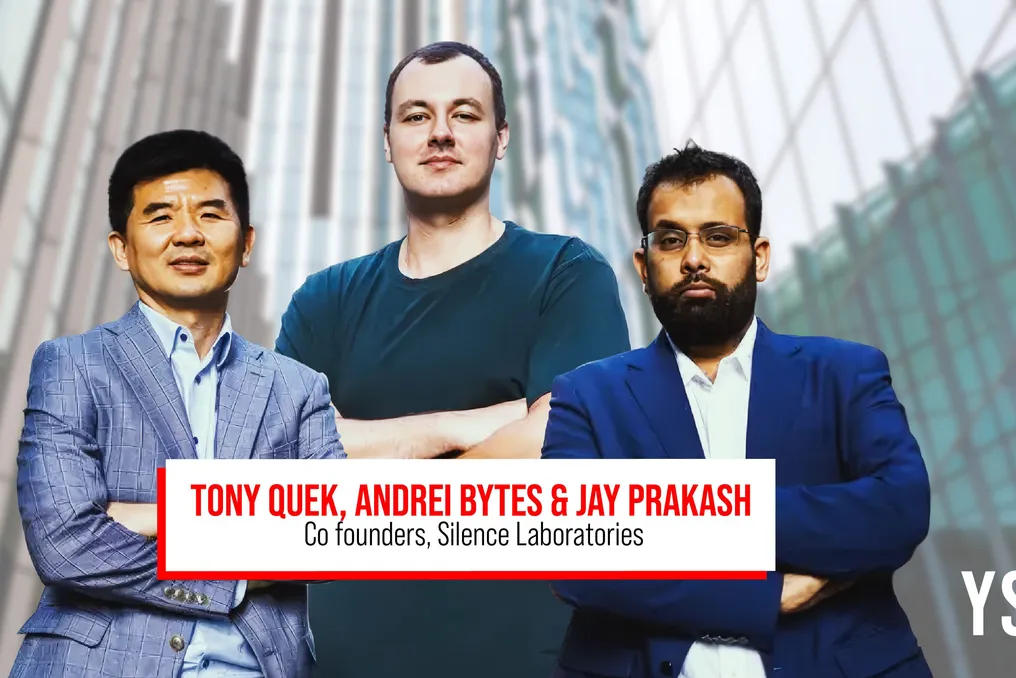
The startup Silence Laboratories is creating cybersecurity technologies that place privacy at the forefront. The company's foundation is built on scientific research, and its products are based on ideas derived from the doctoral dissertations of each founder.
CEO Jay Prakash stated that one of the company's earliest products was related to audio space. They worked on merging sound waves and radio frequency (RF) waves to verify proximity. The goal was to use sound signals and wireless transmissions to confirm the physical closeness of an entry device and a token device during authorization.
It was this early work with silent, inaudible signals that gave the startup its name. Despite the company expanding beyond audio and moving into a broader range of cryptographic and privacy-enhancing products, the name remained the same.
Today, Silence Laboratories operates as a cryptographic company specializing in developing technologies that enhance cryptographic privacy. Prakash notes that their products allow organizations to perform computations over encrypted and distributed data sources without the data ever being revealed to any participating party.
Besides Prakash, the Palo Alto-based startup was founded by CTO Andrei Bytes and CISO Tony Keck. Their team of 30 people is spread across 14 countries and includes former executives from companies such as VMware, Snap, A.T. Kearney, and Oracle. Together, the founders possess over 40 years of experience in cybersecurity.
Prakash emphasized that the team's research experience is reflected in over 10 Tier-1 publications, as well as collaborations with Microsoft and IISc. Recently, the startup won the Accenture Tech Next Challenge 2026 in the cybersecurity category. This victory, according to Prakash, confirmed the value of their technology and the growing market need for collaborative processing of private data.
Silence Laboratories' products are based on a Cryptographic Computation Virtual Machine (CCVM)—a secure virtual environment that allows applications to perform computations on encrypted data without revealing the underlying information. This technology is built on the principles of Multi-Party Computation (MPC) and Zero-Knowledge Proofs (ZKP).
MPC enables multiple parties to jointly compute on shared data without revealing their private information to each other. ZKP allows anyone to prove a statement without disclosing the information underlying it. Prakash believes this distinguishes their technology from traditional approaches.
He explains that most data exchange schemes rely on policies, contracts, and third-party intermediaries to ensure data security. The company replaces this reliance on trust with trust in mathematics and cryptography. The guarantee of privacy, he says, is not just a promise in an agreement; it is ensured by the cryptographic protocol itself, regardless of who participates or how they behave.
Practically, this means that partners always retain control over their own data. Raw data never leaves the organization's boundaries. Parties themselves determine what can be computed and for what purpose. Each participant receives only the agreed-upon result, not the private input information of another.
The company has been working in this field for about six years, although the founders' work on core cryptography began much earlier. Although the methods themselves existed in academic literature for decades, the team focused its efforts on transitioning these methods from theory to practice, making them robust, performant, and scalable.
Currently, Silence Laboratories serves about 35 clients worldwide, including banks, asset custodians, fintech companies, and payment ecosystems. The company has participated in cross-border initiatives, including Project Mandala with the Bank for International Settlements (BIS), as well as collaborating with Proxtera to ensure the portability of cross-border credit data. The latter participation earned them the G20 2025 TechSprint award.
Prakash reported that parts of their Agent-Type Privacy Protocol (AP3) were open-sourced through the Linux Foundation Decentralized Trust, with early design partners including Networks for Humanity, Weilliptic, and EigenLabs. The client base also includes one of the largest banks in the US, as well as participants in the digital asset and fintech sectors, such as BitGo, MetaMask, Fold, Finvu, Biconomy, Okto, Zengo, and Easycrypto.
Prakash points out that a significant portion of modern digital infrastructure still relies on signature schemes that were not designed to withstand quantum threats, which particularly endangers digital assets. Consequently, quantum readiness has become a priority in Silence Laboratories' research and products.