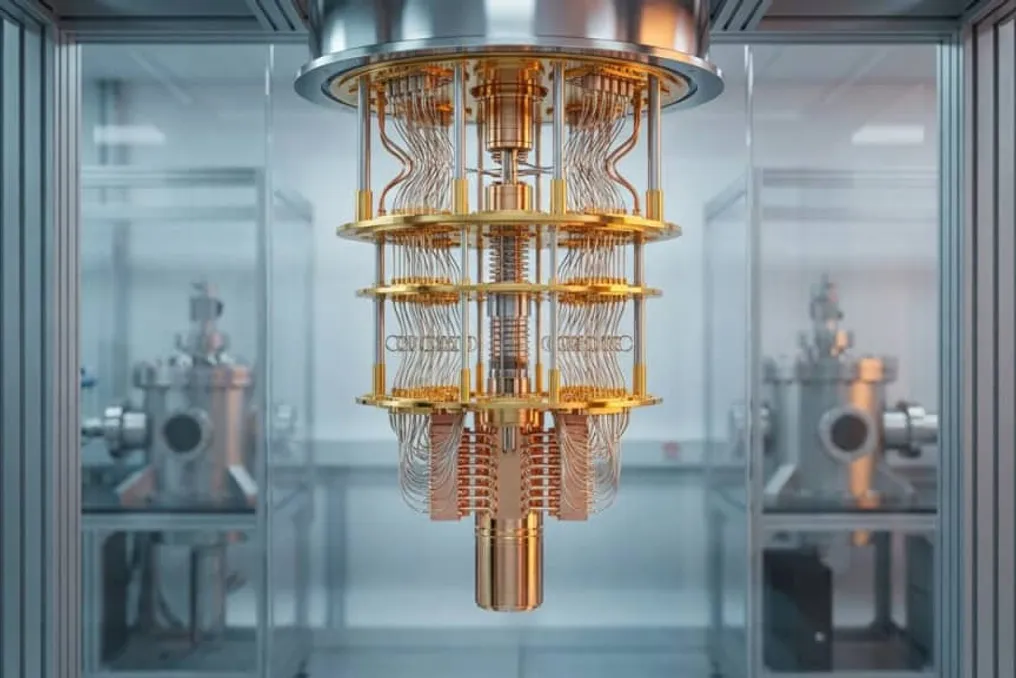
A new benchmark developed to compare quantum computers on a unified scale revealed significant differences between advanced machines and demonstrated that the technology still lags considerably behind performing some of the calculations for which it was created.
This test, named Quantum Universal Operation Performance System (QUOPS), was created by a team led by Sandia National Laboratories in the United States. Researchers applied this benchmark to systems from Google, IBM, and Quantinuum to measure not only the speed of the machines but also the size of the corresponding quantum circuits they can successfully execute.
The most important result was that the best performance recorded on physical hardware was 1824 QUOPS. However, tasks considered serious challenges for quantum computing require between 250 million and 340 million QUOPS.
This means that current quantum computers need to increase their computational power by approximately 100 thousand times to reach such a level of application.
Comparison of Architectures and Performance
The tests showed noticeable discrepancies between the analyzed computers, which is related to the architectures used to create them. Helios-1, an ion trap processor from Quantinuum, managed the most complex calculations among the evaluated systems, achieving a result above 1500 QUOPS. The advantage of this architecture lies in the flexible placement of qubits, allowing them to interact with any other qubit. Nevertheless, moving ions takes time, making the system relatively slow.
Superconducting processors from Google and IBM use a different approach. In these, qubits are organized in rigid lattices on chips, which limits the connection between certain qubits. Consequently, these systems showed results around 200 QUOPS. On the other hand, superconducting machines are significantly faster; Google's Willow processor reached a speed of 20 million operations per second.
Limitations of Speed Measurement
The results also illustrate why measuring only the speed of a quantum computer can be misleading. A machine may perform operations very quickly but fail to implement a sufficiently large circuit to solve a useful problem. This is the difference that QUOPS aims to capture.
The potential of quantum computing is linked to extremely complex problems, such as cracking RSA-2048 cryptography, widely used in digital security, and modeling complex molecules for chemical applications. Performing these calculations requires approximately 250 to 340 million QUOPS, whereas the highest result on physical hardware currently stands at only 1824 QUOPS.
Thus, there is a difference of about five orders of magnitude in practice between the current capability and what is required to solve these problems. Overcoming this huge gap will require progress in various aspects of the technology, including a significant reduction in error rates, an increase in the number of physical qubits, or the development of more efficient quantum computer architectures.
The authors conclude the complexity of the task, stating that computational power must increase by five orders of magnitude, emphasizing the importance of fault-tolerant approaches to quantum computing. The comparison also shows that there is no clearly superior architecture in all assessed aspects: Helios-1 executed larger circuits but slower, while Google and IBM achieved much higher operating speeds but with lower QUOPS scores. These differences are directly related to the choices made during the development of each system.
For researchers, having a common standard can help more transparently track the evolution of quantum computing. Instead of analyzing isolated metrics, such as the number of qubits or the speed of specific operations, QUOPS aims to measure the actual ability of machines to execute circuits of a corresponding size. The goal is to allow scientists and other technology developers to monitor the progress of systems and independently verify their computational capabilities. The study presenting this benchmark, titled 'Benchmarking the computational power of quantum computers', was published on the arXiv preprint server. The article 'Novo teste coloca computadores quânticos lado a lado e revela quanto falta para máquinas úteis no mundo real' first appeared in Olhar Digital.