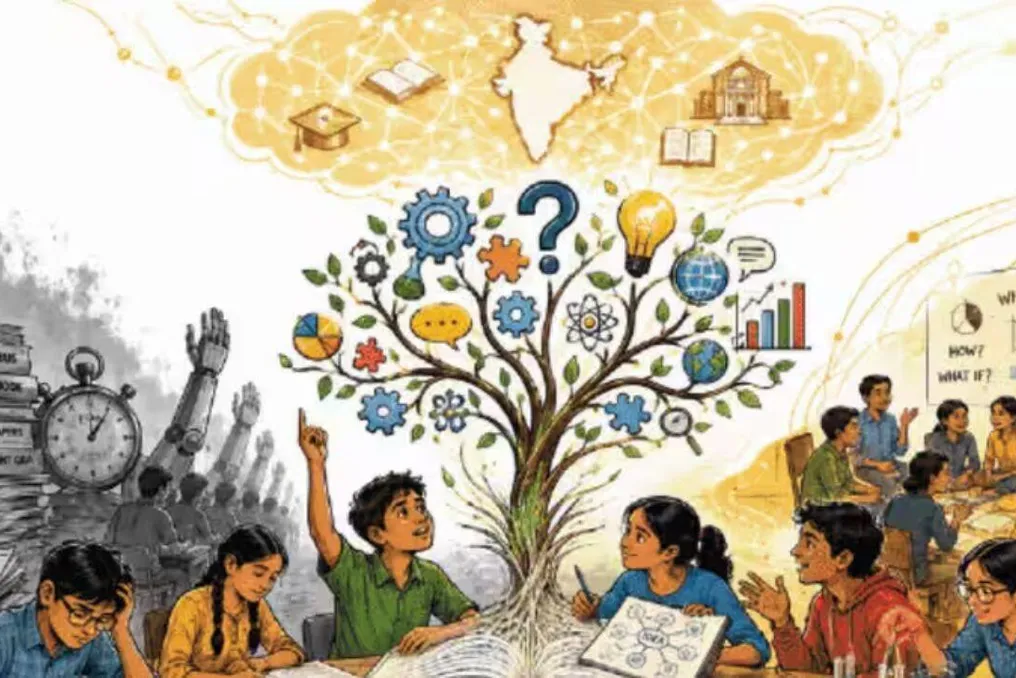
Critical thinking is defined not only by knowledge of information but also by the ability to analyze meaningfully. During the AM/NS India Times Critical Thinking Championship 2026, organized and conducted by Times Foundation, eight experts presented various views on what makes a person a critical thinker.
The experts concluded that today the main task is not about obtaining answers, but about how we use the knowledge we gain. Since artificial intelligence can generate arguments and information in seconds, delegating judgment to a machine can weaken rather than strengthen the thinking process. Knowledge, curiosity, and the ability to ask the right questions remain indispensable for evaluating any information provided by technologies.
Discussion on Critical Thinking, Pedagogy, Practice, and Policy
The panelists discussed how AI can stimulate the development of young minds. They examined the importance of curiosity in classrooms, independent decision-making in the workplace, and the challenges of teacher training, many of whom faced the problem of mechanical memorization. Ira Singhal, Deputy Secretary of the Department of School Education and Literacy of the Ministry of Education, highlighted the risks of blind dependence on technology, citing the example of her niece who received incorrect answers from AI when solving math problems without understanding the process.
According to the panelists, the need to question established assumptions goes far beyond the use of AI. Ruchi Ghanshyam, former High Commissioner of India in the UK, explained how asking questions can transform routine administrative work into a meaningful action. Instead of asking 'Why must this be done?', she learned to ask 'Why not?', which leads to more complex questions about how it can be implemented.
Professor Dinesh Singh, former Vice-Chancellor of Delhi University, urged students not to fear AI but to interact with it rationally and curiously. He advised against using AI mechanically, but rather cultivating curiosity, constantly asking questions, and not being afraid to admit ignorance to harness the potential of AI.
Gurcharan Das, thought leader and former CEO of Procter & Gamble India, placed curiosity at the center of critical thinking. He contrasted an adult's cautious walk through a puddle with a child's jump, which they do for discovery. According to him, critical thinking is born not from intellect, but from wonder, which leads to questioning, doubt, searching for evidence, judgment, and ultimately, mental independence.
He warned that educational systems often suppress curiosity by rewarding repetition instead of exploration, leading to the creation of a 'nation of parrots,' whereas students need the confidence to question authorities and teachers.
The discussion also linked these ideas to the intellectual history of India. Professor Shailendra Mehta, former President and Director of MICA, Ahmedabad, traced the connection between critical thinking and the Sanskrit concept of Anvikshiki, which represents the process of studying and interpreting what is observed. He noted that Anvikshiki was considered the foundation of learning, action, and proper conduct, referencing Chanakya's tutelage of Chandragupta Maurya.
Moving to situations where independent judgment can have serious consequences, Major General K Narayanan from NITI Aayog stated that in the armed forces, critical thinking involves analyzing information without falling into 'analysis paralysis.' He described the process through a cycle of observation, orientation, decision-making, and action, noting that decisions must be made in the field with incomplete information and in wartime.
A similar need for clear judgment arose in organizational leadership, especially when making decisions under pressure. Deepak Kapoor, former Chairman of PwC India, argued that critical thinking is inseparable from effective leadership, particularly in a crisis. Leaders must avoid biases, keep alternatives open, and allow colleagues to ask questions without fear or internal political games. This same ability is necessary when working with AI, as its usefulness depends on smart prompts, bias checking, and considering multiple viewpoints.
At the level of daily work, critical thinking is presented not as an abstract concept but as an integral part of applying knowledge. Sandeep Achantani, Director of NAMTECH School of Technical Education, linked this to professional skills, pointing out that real-world problems are rarely presented with all variables. A machine operator diagnosing a failure or a mechanic tracking a breakdown must check numerous possible causes before finding a solution. He concluded that knowledge lays the foundation, critical thinking transforms this knowledge into skills, and skills into quality professional practice.
These examples brought the discussion back to classrooms and environments where youth thinking habits are formed. The discussion also touched upon how the constant flow of information affects the formation of views and judgments in young people.
Ashutosh Telang, Director and VP of HR and Administration at AM/NS India, advised using technology and AI, but not delegating one's judgment. Technology should complement thinking, not replace it. It is important to listen to dissenting opinions, remain open to better evidence, and use one's own thinking to solve problems.
Other participants in the event included Aruna Goenka, Pushpendra Rajput, former UPSC Secretary, and Vikas Yadvendu, Head of CSR at AM/NS India.
Other guests emphasized the importance of asking questions. Guest of Honor Sanjay Kumar, who recently served as Secretary of the Department of School Education and Literacy of the Ministry of Education, stated that what children learn, how they learn, and how they ask questions largely depends on their assessment methods. He insisted on the need to change evaluation models and turn classroom interaction into a two-way process, encouraging every child to ask questions and participate in discussions.
Guest of Honor Lieutenant General Sanjay Kulkarni (Retd.), former Chief of Staff of the Indian Army Infantry, expanded the message from the classroom to life, advising against fearing failures or questions. He recommended viewing failures as challenges, identifying shortcomings, and improving. He added that while knowledge and hard work are important, attitude determines the difference, urging the development of a positive mindset, learning to say 'yes,' and finding solutions.