A new generation of space telescopes promises to expand our understanding of the Universe, allowing us to observe galaxies formed in the first billion years and study the composition of distant planetary atmospheres. This marks the beginning of an unprecedented astronomical revolution.
Among the most anticipated technologies capable of transforming space science is the LISA observatory, developed by the European Space Agency (ESA) in collaboration with NASA. The mission was officially approved for construction in early 2024, and its launch is scheduled for 2035 aboard the Ariane 6 rocket. The project aims to redefine modern astrophysics by monitoring the fabric of space with exceptional precision.
LISA, which stands for Laser Interferometer Space Antenna, is perhaps the most innovative project among next-generation equipment because it functions differently from a traditional telescope. It will not use any type of light—visible, infrared, or X-ray—to observe the sky.
As explained by astronomer Marcelo Zurita, President of the Paraíba Astronomy Association (APA), member of the Brazilian Astronomical Society (SAB), technical director of the Brazilian Meteor Observation Network (Bramon), and columnist for Olhar Digital, this observatory will be fundamentally different from the tools we are accustomed to. 'It will be a telescope designed not to see the Universe, but to feel its vibration.'
Instead of light radiation, LISA will use gravitational waves—distortions of the space-time fabric itself, predicted in Albert Einstein's General Theory of Relativity in 1916. Zurita explains that thanks to this instrument, scientists will be able to 'study the cosmos through gravitational waves, tiny oscillations in spacetime, predicted by General Relativity.'
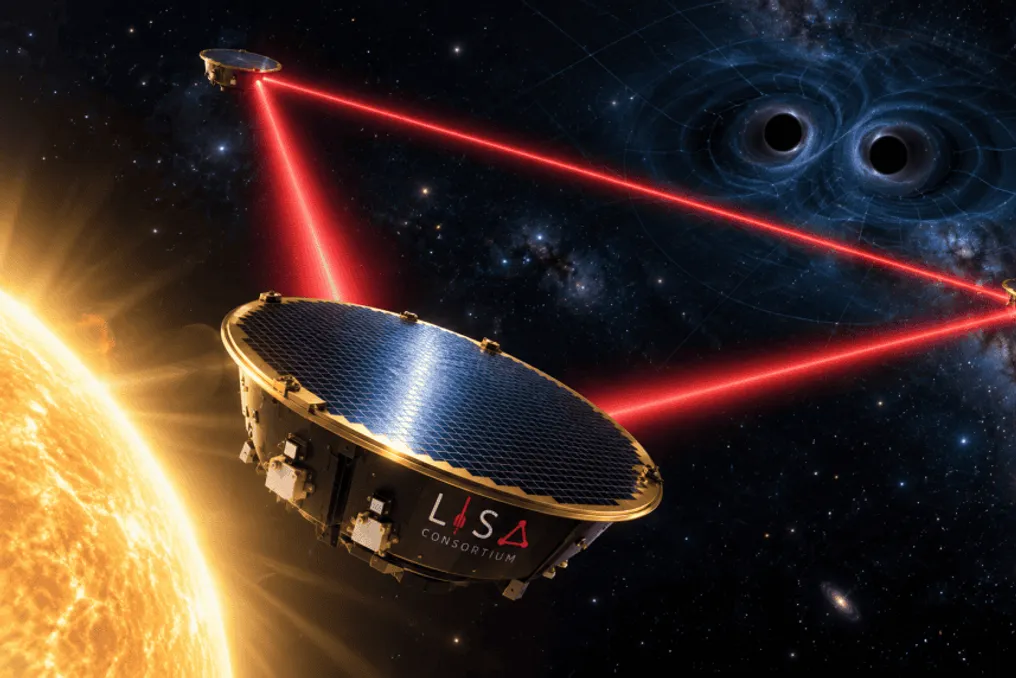
The mission will consist of a trio of identical satellites that will be sent into space to orbit the Sun, following Earth in a heliocentric orbit. The astronomer describes the operating principle in detail: 'Three spacecraft will be separated by a distance of about 2.5 million kilometers, moving in formation and exchanging laser beams between each other.' Inside each device, cubes made of a special alloy of gold and platinum float freely, serving as test masses in a state of absolute free fall.
The three spacecraft will use continuous laser beams to measure the distance between the floating cubes with a precision less than the diameter of a single helium atom. According to Zurita, the slightest changes in these distances 'will allow the detection of gravitational waves caused by the merger of supermassive black holes or compact star systems, for example.'
When a powerful cosmic event occurs in space, it generates these waves, which propagate through space at the speed of light. When these invisible oscillations pass by the spacecraft, they stretch and compress the space between them, which is instantly recorded by the system's lasers.
On Earth, facilities such as the Laser Interferometer Gravitational-Wave Observatory (LIGO) in the United States use four-kilometer vacuum tubes to register these distortions of space. However, LIGO is limited to capturing high-frequency and short gravitational waves produced by the collisions of smaller black holes or neutron stars. Furthermore, ground-based detectors are constantly subject to unavoidable interference from noise and seismic vibrations of the planet itself.
Thanks to isolation in space and millions of kilometers of measuring arms, LISA will be able to capture extremely low frequencies and continuous signals from truly colossal events. It will record the merger of supermassive black holes in the centers of distant galaxies and the spiral movement of thousands of binary star systems in our own Milky Way Galaxy. The mission will allow testing the limits of gravity in extremely strong fields.
The technical feasibility of this monumental architecture was successfully demonstrated between 2015 and 2017 by the ESA's LISA Pathfinder mission. This experimental satellite proved in space that it is entirely possible to isolate the test cubes from external forces, such as solar wind pressure, keeping them in almost perfect free fall. The absolute success of this test provided the final green light for the construction of this constellation.
The scientific project is also distinguished by working in harmony with other major new-era space instruments, such as the James Webb Space Telescope and the future Athena X-ray Observatory. While optical and infrared telescopes capture light and radiation from stars, LISA will provide additional gravitational data.
As Zurita emphasizes, the project 'will become the first gravitational wave observatory in space and should open a new window into the Universe, complementing light-based astronomy.' This combined approach, known in astronomy as multi-messenger astronomy, will allow the analysis of the same cosmic event from opposite physical perspectives. As the specialist summarizes, 'instead of just observing the radiation from a cosmic phenomenon, LISA will be able to directly detect the gravitational disturbances caused by some of the most extreme events in the Universe.'
The data collected by LISA will help scientists understand how supermassive black holes grew to billions of our Sun's masses in the early stages of the Universe. Moreover, the precise measurement of gravitational waves will provide a new independent tool for calculating the expansion rate of the Universe, known in cosmology as the Hubble constant, helping to resolve one of the greatest discrepancies in modern physics.
With this monumental structure, LISA will give humanity a completely new understanding of modern astrophysics. Where scientists once simply looked at the Universe through the light emitted by stars, humanity will now be able to listen to it directly through the vibrations of the very fabric of spacetime. This historical shift in perspective promises to reveal deep secrets that have been completely hidden since the dawn of our cosmos.