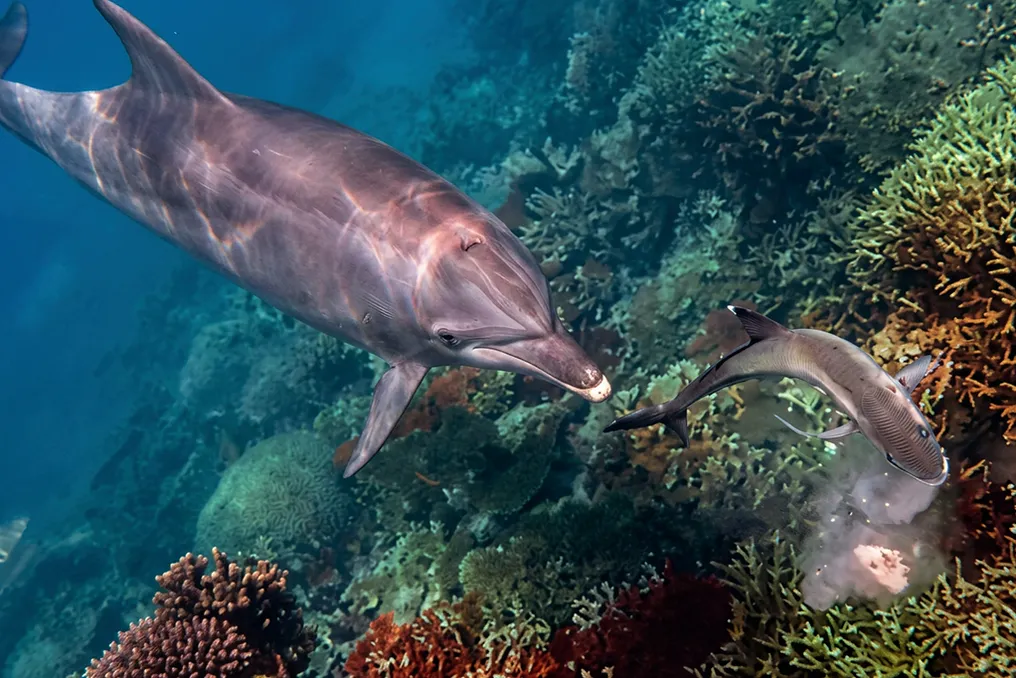
Off the coast of Australia, a dolphin was observed employing an unprecedented feeding method. This animal pursues a fish, causing it so much stress that it vomits, and subsequently consumes the regurgitated contents.
The records of this behavior were published in the journal Ecology and Evolution. According to the study's description, this represents one of the first well-documented cases of kleptoparasitism—the act of stealing food from another animal—among cetaceans, which include dolphins, whales, porpoises, and tuna.
The first indications of this peculiar feeding habit emerged in 2017. In the coral reef area of Lady Elliot Island, located in the Great Barrier Reef of Australia, a male bottlenose dolphin named Bubbles was filmed chasing parrotfish (Caranx sexfasciatus), a practice that, according to reports, was recurrent.
Given this, researchers opted to monitor the situation in greater detail. Between June 2021 and October 2025, a team of marine biologists positioned GoPro cameras to document the dolphin's feeding method.
Subsequent videos clarified the dolphin's action on the frightened fish. The procedure follows a constant pattern: the animal approaches a school, assesses the group, and selects a specific fish as a target. After the selection, the dolphin swims behind the victim until it regurgitates its stomach contents. Finally, it quickly ingests the returned food and swims away.
During the observations, the dolphin repeated this cycle persistently. Scientists recorded up to ten pursuit attempts in just half an hour, totaling twenty instances of this behavior, with the dolphin succeeding in eleven of them.
At the time of the attack, the dolphin emitted specific vocalizations. Before approaching the school, it produced clicking sounds, and during the chase, these clicks combined with other low-frequency noises. Asia Armstrong, the study coordinator, stated in an interview with Scientific American that echolocation allows dolphins to discern subtle variations in the shape, size, and structure of their targets, suggesting that the dolphin may use this ability to choose the fish that will bring it the best reward. Additionally, it is plausible that these sounds help induce vomiting in the fish, although more research is needed to confirm these theories.
It is not yet known whether this behavior is a peculiarity exclusive to Bubbles or if he learned this tactic from other dolphins or other types of cetaceans. Armstrong commented in the same interview that it is quite likely that other species use this strategy, emphasizing that dolphins and whales employ various unique tactics to find food, demonstrating their intelligence, adaptability, and aptitude for learning and sharing information socially.