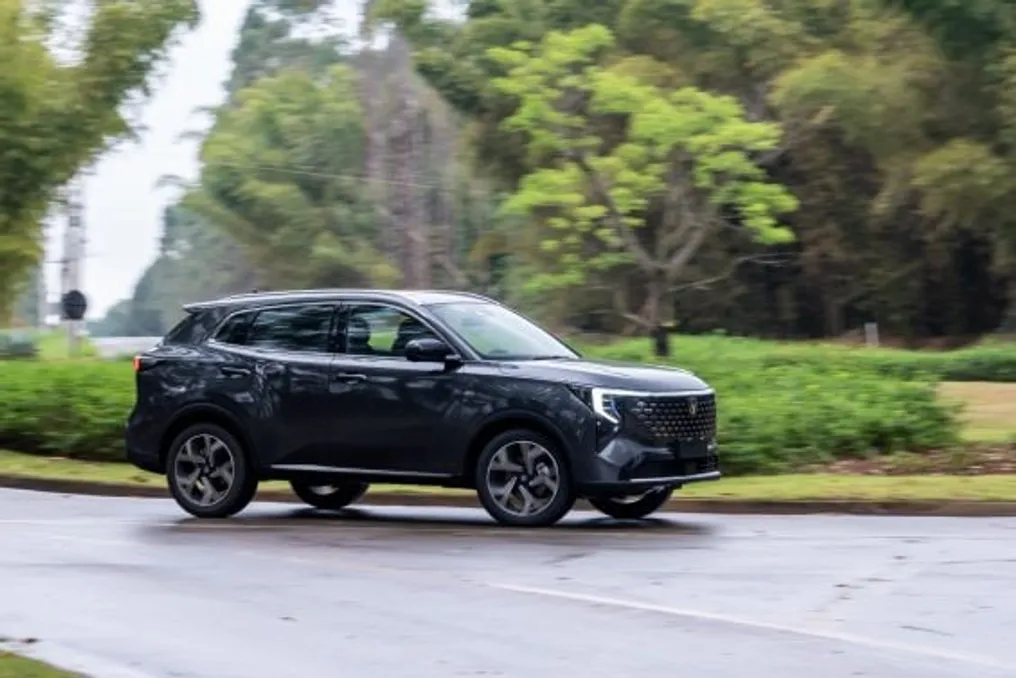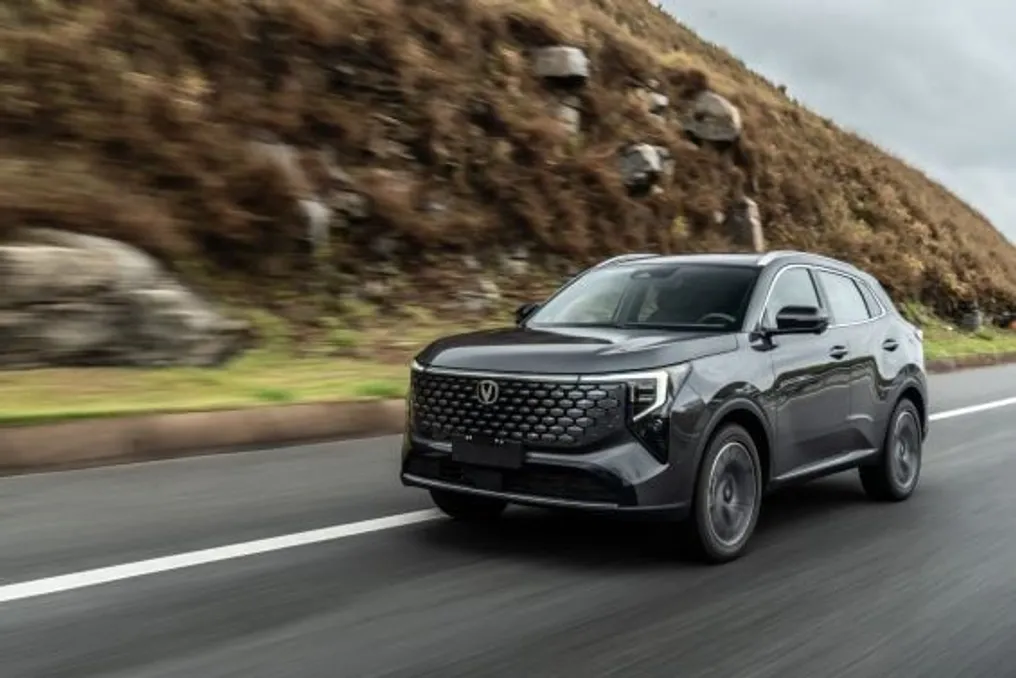
Caoa Changan opted to launch the CS55 model in the intermediate Infinity version as a market positioning strategy. While the Prime version, priced at R$ 144,990, and the plug-in hybrid PHEV, costing R$ 189,990, are available only by reservation, the Infinity version, priced at R$ 154,990, is the only one immediately available. Thus, those who wish to acquire the manufacturer's new flagship vehicle right now will have access to this configuration. Despite this, the package offered at this price and specifications is considered quite balanced.
This vehicle is configured as a mid-size SUV with dimensions of 4.55 meters and a trunk capacity of 525 liters, featuring top-of-the-line finishing items for a value that, in the Brazilian context, usually acquires a compact sport utility vehicle. The central question is whether this SUV lives up to its qualifications.
Comparison with Mid-Size Rivals
The CS55 has a length of 4.55 m, a width of 1.86 m, a height of 1.67 m, and a wheelbase of 2.65 m, typical characteristics of a mid-size SUV. However, most of its competitors start in this category above R$ 170 thousand. The Jeep Compass, a benchmark in the segment, has a wheelbase of 2.64 m, and the Volkswagen Taos offers 2.68 m.
The two cited competitors are significantly more expensive, starting at R$ 174,990 for the Compass and R$ 199,990 for the Taos.
In terms of mechanics, the CS55 features independent suspension on all four wheels (MacPherson in the front and multi-link in the rear), disc brakes on all four corners, and 19-inch alloy wheels with Pirelli 225/55 tires in all its versions, with the Infinity having a bicolor diamond finish.
Its load capacity is stated at 525 liters, which can reach 1,415 liters with the rear seat folded down. This volume surpasses similar-sized competitors: the Taos holds 498 liters, the Toyota Corolla Cross has 440 liters, and the Compass registers 410 liters according to VDA standards (although Jeep advertises 476 liters measured in water).
When compared to compact SUVs in the R$ 150 thousand range, the difference is even more noticeable, since most of these vehicles offer between 370 and 420 liters. For those who prioritize large luggage space, this represents a considerable advantage.
Finishing and Safety Features
The Infinity version adds features typically found only in the most complete versions of rivals, such as a 24.9-inch integrated dashboard, a 14.6-inch multimedia system with wireless connectivity for CarPlay and Android Auto, an eight-speaker sound system, full LED headlights, panoramic sunroof, dual-zone air conditioning, electric tailgate, leather upholstery, and electrically adjustable front seats, in addition to ventilation, heating, and memory for the driver.
The assistance package includes Level 2+ ADAS, which comprises forward collision warning with pedestrian detection, lane keep assist, and adaptive cruise control. This set allows the car to manage steering and speed simultaneously on highways, a functionality that in models like the Compass and Corolla Cross requires more expensive versions.
The factory warranty extends for seven years or 150,000 km, which helps mitigate the uncertainty inherent in buying a brand-new model in the market. Furthermore, production takes place in Anápolis (GO), a positive factor for parts availability.
Transmission and Performance
The vehicle uses a seven-speed dual-clutch automated transmission. Although not an intrinsic problem, the prejudice associated with this type of gearbox should be considered. The solution is efficient in terms of consumption and fast in gear changes, but historically, models like the Ford PowerShift gained a bad reputation. However, the current Chinese gearbox is lubricated, unlike the old American one which had a dry clutch, although negative perception may influence buyers.
The manufacturer itself signals the prices as promotional, implying the possibility of a table increase after the first batches. The company's recent history suggests caution, as the CS75 had its price reduced by R$ 20 thousand shortly after launch, harming those who paid the full price in pre-sale.
The 1.5 Turbo TGDI flex engine generates 180 hp and 29.2 kgfm, reaching 0 to 100 km/h in 8.1 seconds. Although these figures are not excessively sporty, they fulfill their function, being suitable for both urban use and travel.
However, it surpasses competitors like the Compass 1.3 (176 hp) and the Corolla Cross 2.0 (175 hp) in terms of torque, presenting 27.5 kgfm, superior to the Boreal's 27.5 kgfm, the Corolla Cross 2.0's 21.3 kgfm, and the Taos's 25.5 kgfm.
Market Challenges and Strategy
Although Caoa already has established operations in Brazil, Changan is new, and the CS55 lacks a depreciation history, service costs, or dealership capillarity. In this aspect, the Compass, Corolla Cross, and T-Cross have a clear advantage, and the price difference upon purchase may decrease or disappear at the time of trade-in.
Caoa Changan's strategy consists of positioning the Infinity to compete with mid-size SUVs due to its size, while simultaneously entering the price range of compacts and entry-level mid-size versions.
In direct comparison by size, the Jeep Compass starts at R$ 174,990, with offers that reached R$ 147,990 cash in September. The Toyota Corolla Cross XRE costs R$ 194,790, but was announced for R$ 179,990 in a monthly promotion. The Volkswagen Taos exceeds R$ 190 thousand. All are more expensive on the list, smaller, and less equipped for the same price, but they offer a consolidated network, known resale, and, in the case of Toyota, the hybrid option.
Internally, the Caoa Chery Tiggo 7 is a particularly competitive rival: its Sport version costs R$ 147,990, lower than the Infinity, and the line extends up to the Pro Plug-in Hybrid at R$ 209,990. This internal competition is real, and the Tiggo 7 already has years of market presence and resale history in Brazil.
In the exact R$ 150 thousand range, the CS55 competes with well-equipped compacts such as the Volkswagen T-Cross, Chevrolet Tracker, Hyundai Creta, Honda HR-V, Nissan Kicks, and Fiat Fastback. These models are smaller, have reduced trunks, and generally offer fewer features for the same investment. It is against this group that the argument of offering more car for the same price works best, and this is the audience Caoa Changan seeks to attract.
In summary, the Infinity provides space, trunk capacity, power, and a set of equipment that no SUV at the current price offers in the country. On the other hand, consumers concerned about resale and an established dealership network may not find what they expect.