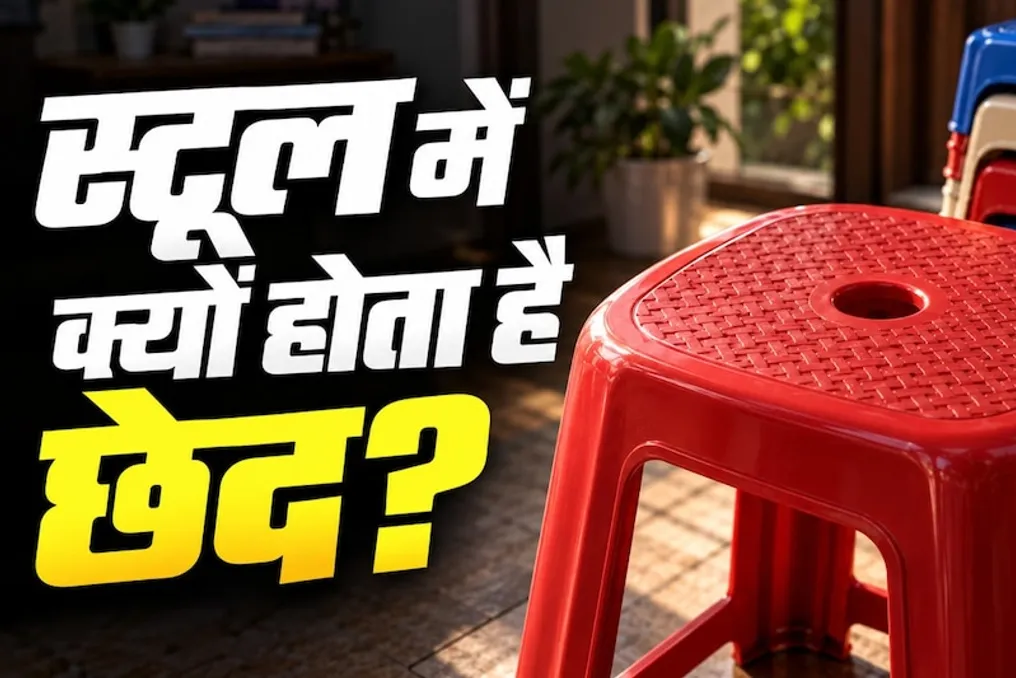
When you buy a plastic chair in a store, you see many colors and designs. However, one detail remains unchanged across all models—the circular hole in the center of the seat. Regardless of the brand or color, every chair has this hole. At first glance, it might seem like a mere design element; some believe it makes the chair lighter, while others think it is a grip handle. However, in reality, there are not one, but many reasons behind this small hole.
This hole not only aids in lifting the chair but also performs several other functions. Below, we explain in detail why such a hole is located in the center of a plastic chair.
Firstly, the hole helps when stacking chairs on top of each other. Plastic chairs are often stacked to save space. But if the plastic surface sticks together, air can get trapped between them, making separation difficult. The hole ensures air circulation, reducing the likelihood of a vacuum forming between the chairs and making them easier to separate. This feature is especially useful in homes, stores, schools, or at events where numerous chairs are used.
Secondly, it serves as a convenient handle for lifting. Many people have lifted the chair through the central hole. Because the grip is located roughly in the middle, the chair's balance is maintained, which is often easier than lifting it from the edge.
Plastic chairs are used not only indoors but also outdoors, in bathrooms, on balconies, or in yards. In such conditions, water can accumulate on the seat during rain or cleaning. The central hole allows water to drain freely, preventing prolonged moisture on the seat and reducing the risk of the chair becoming wet or slippery.
Furthermore, this hole affects the cost and weight of the chair. During the manufacturing of many plastic chairs, the molding process is used. Removing excess plastic where it is not required by the design allows for reduced material consumption. This contributes to decreasing the overall weight of the chair and helps control production costs in large volumes, which benefits the manufacturer.
The hole also helps distribute the pressure exerted by the seated person's body. When a person sits down, the weight is distributed unevenly. The presence of a circular hole in the design allows the surrounding material to cope with the load differently. It is important to note that the circular hole lacks sharp corners that could be subjected to excessive pressure and cause cracks.
The benefit of the hole is also evident during the molding stage. When producing plastic items, hot plastic is placed into a mold and then cooled. If any part is too thick, it may cool differently from other parts, which can lead to deformation of the mold or other production problems. The presence of a small void in the center simplifies maintaining uniform plastic thickness and its correct cooling.