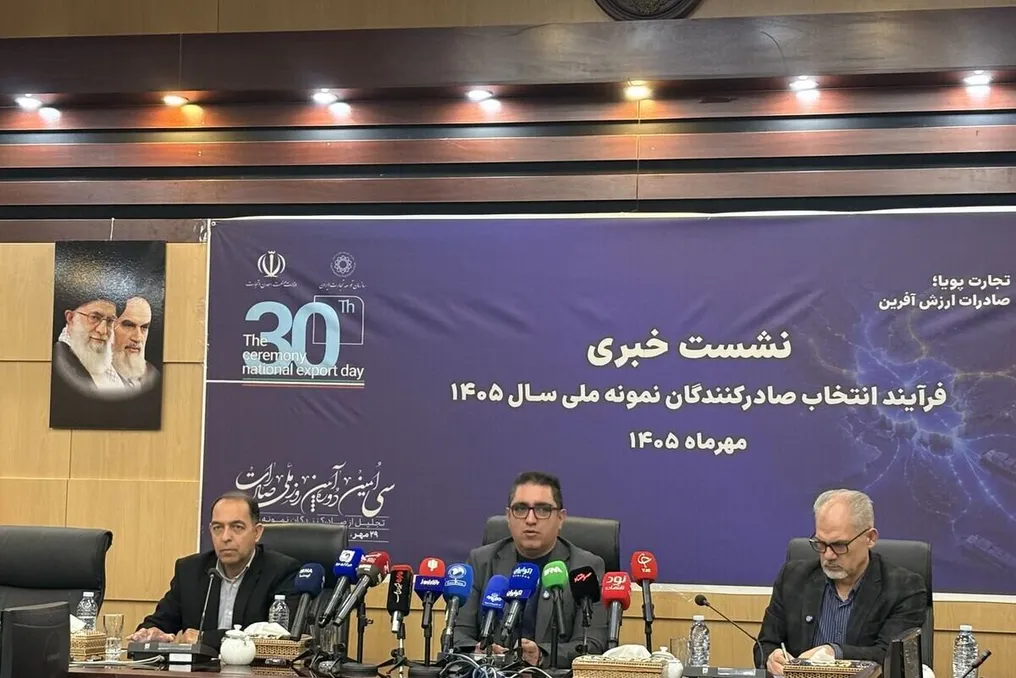
Amir Roshanbahsh Ghanbari, Deputy for International Business Development at the Iranian Trade Promotion Organization (TPO), stated at a press conference that Iran is negotiating with China to establish railway routes for goods transit. Some Iranian cargo is already being sent to China via the Yazd Dry Port.
He emphasized that transport is a fundamental issue in trade, and current circumstances present certain limitations. Last year, Iran exported about 155 million tons and imported approximately 42 million tons, with the majority of these operations conducted by sea.
Due to limited trade routes, the TPO has developed a set of measures divided into short-term, medium-term, and long-term. Short-term steps include increasing the capacities of executive agencies, border management, and utilizing border provinces. Ghanbari noted that in Bazargan, the increase in traffic and truck queues are partially related to insufficient receiving capacity on the opposite side, meaning that not all problems can be solved solely within the country.
Railway capacity is limited: one train carries about 55 wagons and transports approximately 1500 tons, whereas a vessel can carry about 100,000 tons. Transporting the same volume by trucks would require about 3000 trucks. Therefore, it is necessary to use railway and land capacities in parallel with sea routes. Alternative routes require cooperation with neighbors and trading partners, as well as infrastructure on both sides.
Ghanbari also stated that the recent situation demonstrated the need to reform the trade management and transport infrastructure system after the current period ends, otherwise similar import and export problems may recur. He added that although trade finds ways, alternatives must exist when main arteries are blocked.
On the 30th National Export Day, the focus will be on trade infrastructure and sustainable routes, starting on Monday, 20 Mehr. A joint event with the Ministry of Roads and Urban Development will address transport and eco-friendly export routes. The second day will be dedicated to increasing export value and services.
Regarding National Exemplary Exporters, 367 people applied for evaluation; 277 completed the documentation package and passed the final review: 235 in the commodity sector, 26 in knowledge-based goods, and 16 in services. There are a total of 42 commodity groups and seven service groups.
The average value of Iranian exports is about $300–$350 per ton, but some high-tech and knowledge-oriented products can reach $1500–$2500 per ton. Service exports reached approximately $3 billion in 1404, including $1.8 billion in technical and engineering services, which is higher than the figure of $790 million in 1403.
The TPO has also launched an Export Atlas, which provides data on trade by goods and countries, as well as information on competitors, intermediaries, monthly growth trends, and production and export shares by province. Further meetings are planned to cover issues such as financing, export management companies, standards, trade legislation, diplomacy, and exporter requirements, including direct deals between importers and exporters.