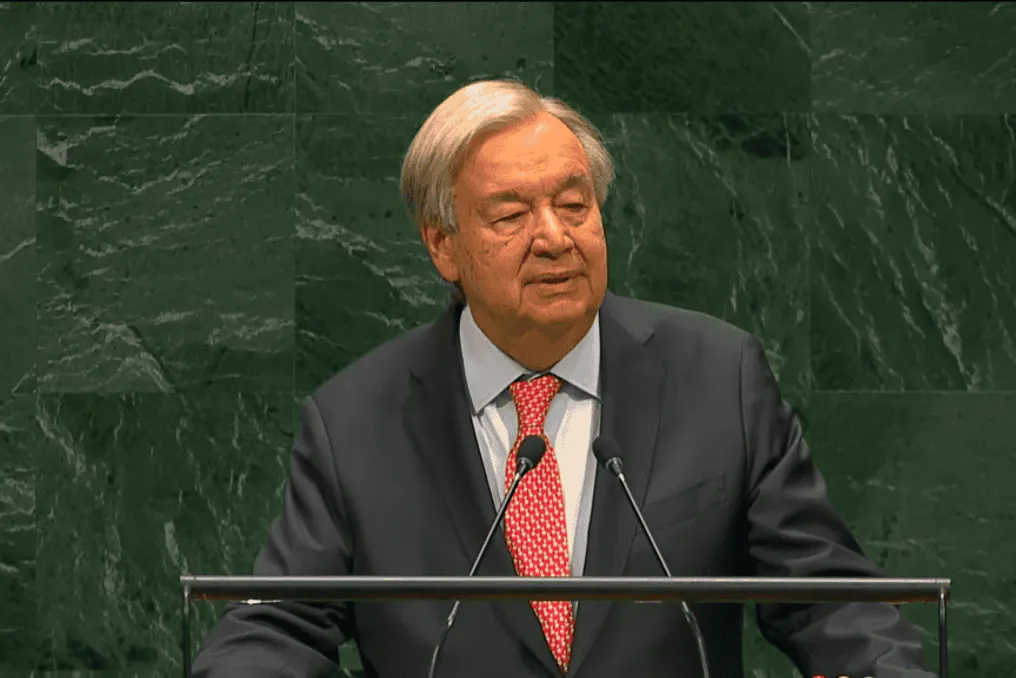
The UN Secretary-General, António Guterres, in a speech during the opening of the 81st United Nations General Assembly this Tuesday (22), issued a warning about the inherent risks of the rapid advancement of artificial intelligence (AI). He stressed that the evolution of this technology is surpassing humanity's ability to fully understand its implications.
Guterres stated that even the creators of AI are expressing concern, feeling blind before its development. The Secretary-General categorized AI as one of the four major future 'power tests,' alongside issues of war, peace, inequality, and climate crisis.
During his speech, Guterres drew an analogy between the challenges posed by AI and the dangers of nuclear weapons during the Cold War. He observed that even in a scenario of intense rivalry among great powers, countries recognized the need to manage risks that could impact all of humanity.
The Secretary-General pointed out that the transfer of power to machines is happening progressively by human beings. This is already manifesting with 'artificial intelligence agents going out of control' and with lethal autonomous weapons migrating from science fiction to military reality.
For Guterres, existing global governance structures have failed to keep pace with this transformation. He stated that world governance institutions and systems still mirror the power dynamics and interests of a considerably outdated era.
Additionally, the Secretary-General warned about the risk of competition between nations for technological dominance, cautioning that an 'arms race for AI control' cannot lead the world into the abyss. He advocated that countries implement collaboration mechanisms, similar to those established during the Cold War, to manage shared risks, as AI demands a sense of urgency and clarity of purpose.
Guterres explained that AI represents a concentration of power based on data, computational capacity, and algorithms. This new power is centralized in a few entities, advances at an extraordinary rate, and is ahead of human capacity to grasp all its consequences.
Despite the risks pointed out, the Secretary-General recognized the positive potential of the technology, describing AI as a truly transformative tool. He cited potential benefits such as advancements in medicine, acceleration of scientific discoveries, expansion of opportunities, and general improvement in quality of life.
However, Guterres emphasized that the problem does not lie in the technology itself, but in its irresponsible application: 'capacity without supervision; decision-making without transparency'. He reinforced that the developers of these systems themselves are issuing warnings.
For this reason, he demanded that governments take responsibility for public safety, especially those with greater capacity to develop AI. Leading countries in this technological revolution should share information about emerging security threats, collaborate on assessments, and create common safeguards to protect everyone.
Guterres also called for multilateral action for technological governance, given that the UN is the only forum where all countries can influence the future of AI. He mentioned initiatives such as the Global Digital Pact, the Global Dialogue on AI Governance, and the Independent International Scientific Panel on AI.
As next steps, he advocated for conditions for responsible AI development and the creation of a multilateral risk management framework, supported by independent and reliable oversight. His final vision was that 'artificial intelligence must be shaped by humanity, with humanity, and for all humanity.'
The Secretary-General also stressed the protection of children against unregulated systems, stating that they must never be used as test subjects. Furthermore, he prohibited vital decisions from being delegated to machines, concluding that 'killer robots should not have a place in our future.'
In Guterres' analysis, the risks of AI are linked to a broader shift in how power is exercised and distributed. He argued that crises are not isolated, but rather 'chapters of the same story: the story of power.'
He reiterated that AI is reconfiguring the distribution of global power, being present in almost all sectors of life, including water systems, electrical grids, health records, economy, and military forces. Guterres concluded that AI has the potential both to solve and exacerbate global challenges.
Concluding his speech on the topic, the Secretary-General summarized the challenge in one sentence: 'to govern artificial intelligence before it governs us.'
The president of the 81st session of the UN General Assembly, Khalilur Rahman, also addressed AI in his opening speech. For him, the technology represents one of the greatest current transformations and can drive human progress.
Rahman agreed that AI can be a strong catalyst for human advancement, arguing that innovation should not be blocked. However, he also signaled negative impacts, such as job losses and increased digital disparity, while not ruling out the risk of artificial general intelligence (AGI) threatening human survival itself.
Given this, Rahman proposed implementing evidence-based 'guardrails' aimed at protecting global public interest without stifling innovation. He insisted on the need to immediately open the doors of the UN to AI developers and users, as delays are constant.
The President of the General Assembly also emphasized that the technology is already integrated into various social spheres, requiring joint participation from governments, companies, innovators, scientists, civil society, and academia in the discussion of its governance.