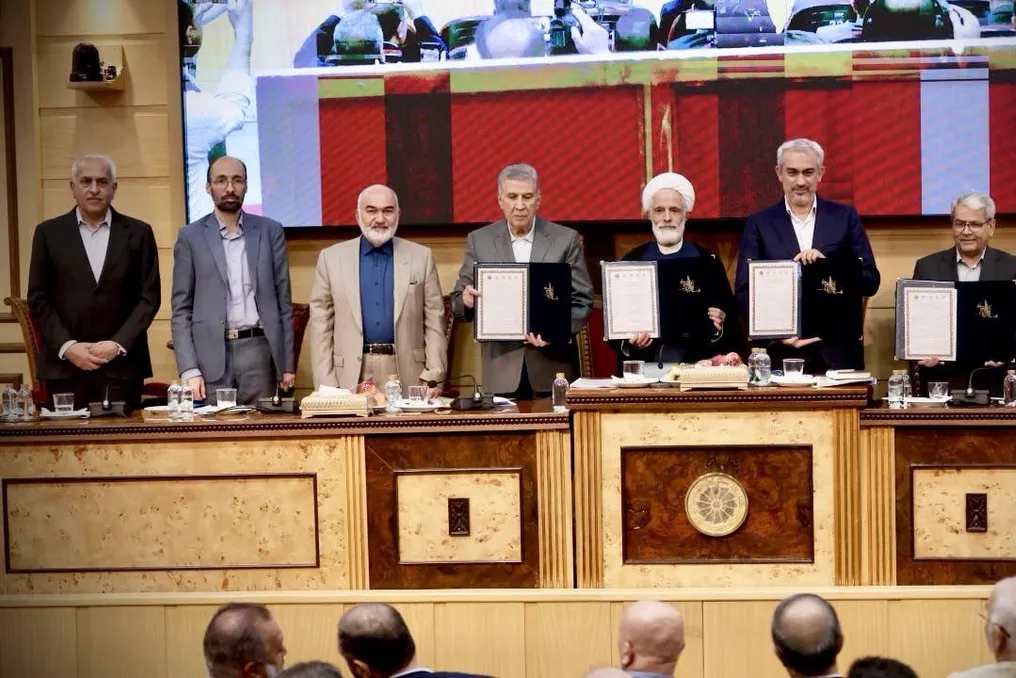
A five-party memorandum of understanding was presented during the 138th meeting of the Dialogue Council between the government and the private sector at the Tehran Chamber of Commerce. The parties involved were the Iranian Ministry of Economic Affairs and Finance, the Legal Deputy Presidency, the Ministry of Interior, the Government Commission Office, and the Tehran Chamber of Commerce for Trade, Industry, Mining, and Agriculture.
Samad Hassanzadeh, Secretary of the Dialogue Council, highly praised the participation of ministers, deputies, parliamentarians, and officials, emphasizing the need to continue cooperation between the state and the private sector to eliminate economic barriers. He noted that this memorandum is the result of a year's efforts and can serve as a basis for sustainable interaction and solving the problems faced by economic entities.
Hassanzadeh added that with continuous cooperation and the involvement of relevant officials, obstacles and ambiguities faced by businesses should be identified and resolved more quickly. He stressed that the country's economic problems cannot be solved by one organization, and advancing economic goals requires coordination among various structures.
He thanked various bodies, including the Ministry of Interior and the Judicial System, stating that further cooperation will help remove some obstacles to businesses and the country's economic process. Hassanzadeh described stability and predictability as the main demands of the private sector.
The Chairman of the Tehran Chamber of Commerce emphasized that the business environment is shaped not by the decisions of a single institution, but by the totality of laws, regulations, policies, executive procedures, and decisions of various bodies. Therefore, reform will only be effective and long-term if these components are aligned and synergy is created.
He listed stability, transparency, consistency, and predictability as necessary conditions for economic activity. According to him, an economic entity must have the ability to assess the consequences of decisions and norms before their application, and the opinion of the private sector must be taken into account when developing policy and regulation. The Chamber of Commerce views the memorandum as a step towards strengthening national coherence in the business environment, reducing decision fragmentation, and increasing consistency in policy-making.
The Chairman also specifically noted that it is important not only to sign the memorandum but also the stage of its implementation and fulfillment of obligations. A coordination working group must be established to hold regular, targeted, and effective meetings for the continuous execution of joint tasks.
Five-party cooperation, in his opinion, should become an effective mechanism for synergy in economic management and continuous improvement of the business climate, which should manifest in reduced barriers, increased trust among economic entities, and an improved business atmosphere.
Kivan Kashefi, Deputy Secretary of the Dialogue Council, reported that under the memorandum between the Tehran Chamber of Commerce and the Legal Deputy Presidency, 10 thematic axes and 16 joint strategic programs were defined. Most of these were implemented in the past and current years. Activities included systematizing fragmented data on the business environment, expanding economic entities' access to legislation and regulations, ensuring private sector participation in rule development, and preparing guides to clarify the rights of economic entities.
In tenders, auctions, and public deals, special attention was paid to the participation of private sector representatives in drafting regulations. The specialized potential of economic associations was utilized in decision-making meetings through the organization of these associations. Kashefi noted that improving the business environment requires coordination between government bodies and effective private sector participation, which is why the bilateral memorandum was expanded to five-party cooperation.
The Ministry of Economic Affairs and Finance joined due to its responsibility for the business environment, investment security, as well as financial and tax regulation. The Government Commission Office was included because of its role in monitoring the implementation of state policy and approvals. The Ministry of Interior joined due to its responsibility for executive coordination in the provinces. The memorandum came into force in mid-July and implements seven main areas: improving the business environment, strengthening stakeholder participation, effective implementation and improvement of laws and norms, empowering private sector entities, technological development, and increasing transparency and access to information.
According to Kashefi, the integration of government bodies, decision-making institutions, and private sector associations in the fields of legislation, licensing, management, and implementation will improve coordination and economic processes.
Seyed Ali Madanizadeh, Minister of Economic Affairs and Finance and Chairman of the Dialogue Council, thanked the Chamber of Commerce and the Legal Deputy Presidency for promoting the five-party memorandum. He called this agreement a foundation for strengthening partnership between the state and the private sector and improving the business climate.
Referring to the large number of laws, rules, and subordinate acts, he noted that the state has become a kind of 'regulation factory,' and a significant part of this regulation creates new barriers instead of facilitating the activities of economic entities. He also pointed out that even norms intended to promote economic activity can contradict or overlap with existing rules, causing confusion.
He emphasized that the Chamber of Commerce, being on the ground and directly interacting with the problems of economic entities, can help improve the business environment and identify obstacles. The Legal Deputy Presidency, the Government Commission Secretariat, the Ministry of Interior, and the Ministry of Economic Affairs and Finance are all related to legislation and can assist in developing higher-quality norms, clarifying laws, and resolving conflicts. He insisted on the necessity of continuing cooperation to take practical measures.
Majid Ansari, Legal Deputy Presidency, highly praised the role of the private sector in supplying goods during the war and called the cooperation between the government and economic entities important for meeting societal needs and increasing resilience. He stated that the overall system policy has always been oriented towards the economy, but the central role of the private sector, reduction of state ownership, and withdrawal of state and quasi-state structures from economic activity have not been properly realized. Within the Consensus Government, these goals must be implemented more seriously.
He specified that the mission of the Legal Deputy Presidency is deregulation, improving the business climate, and achieving the desired state. He noted that the support from the Chamber of Commerce made this cooperation operational, unlike many memoranda. However, he also stressed that other relevant bodies must participate. The Ministry of Economic Affairs and Finance welcomed this, and the Parliamentary Research Center cooperated. With stronger synergistic interaction between chambers and associated institutions, the process can accelerate.
Ansari mentioned that there are about 90,000 regulations in the country, and new ones continue to appear, expressing hope that subsequent steps will eliminate obstacles and burdensome factors for the private sector. Implementation will be carried out through the Business Support Committee.
Mehdi Dosti, Deputy for Economic Affairs at the Ministry of Interior, thanked the Chamber and the Legal Deputy for identifying and studying regulatory obstacles to production. He reported 228 provisions in regulations and executive processes related to production in the provinces. Inspections revealed a lack of uniformity in procedures between provinces: standards applied in one province are not applied in another. He stated that if obstacle removal requires provincial-level action, the Chambers of Commerce will be involved, and governors are ready to distribute tasks among provinces and solve existing problems.
Seyed Kamel Taghavinejad, Secretary of the Government Commission, referred to the history of nationalization and the revision of Article 44 of the Constitution. He emphasized the need to change the approach to policy-making and economic implementation. The Government Commission believes in the private and cooperative sectors and seeks to reduce state intervention, eliminate burdensome laws, and ensure real public participation. He insisted on moving from formal and non-operational memoranda to turning commitments into executive actions.
Furthermore, the meeting discussed objections to charging a separate amount of 12 per thousand of the customs value of imported goods in accordance with the Value Added Tax Law. Ebrahim Nagdi, Deputy for Legal Affairs and Supervision of the Iranian Customs, stated that according to the executive provisions of the Budget Law of 1405, Customs is obliged to collect this amount from covered goods. Basic goods and medicines are exempt from charges, and Customs acted without personal interpretation, based on the received directive.
Mohammad Reza Farouhi, Head of the Chamber of Commerce Customs Commission, indicated that the legal basis for allocating import duties resources to the Ministry of Interior is contained in Article 42 of the Permanent Provisions of Development Plans Law, and in previous years, these resources were distributed from import duties. However, a new revenue line No. 1655 was created in the distribution table, and a separate allocation was provided for basic goods and medicines so that Customs would not be in debt. He also noted that raising the base exchange rate for calculating import duties from 70,000 to 131,000 Tomans raised concerns about the increase in import costs and additional burdens for importers.
Farouhi added that Article 28 of the government decree on budget executive provisions may contradict the legislator's will, and this issue must be resolved through judicial bodies and Parliament. Resources from import duties must be distributed according to the law, and this distribution issue is not new. Until last year, the legal basis had not changed; only a new revenue line was created. A separate allocation was made for basic goods and medicines because their general customs duty rate is one percent.
He stated that despite the increase in the base exchange rate, an additional amount was collected instead of a reduction in customs duties. VAT remains at 12 percent, but importers also paid another significant sum, which he called additional incidental expenses. If a new mechanism was intended, its provisions should have been explicitly included in the budget's revenue and expenditure tables.
Abbas Soufi, Vice Chairman of the Parliamentary Civil Committee, criticized the implementation. He stated that the law clearly stipulates that the amount of 12 per thousand must be separated from the beginning and paid to municipalities. These funds belong to the municipalities and should not go into the treasury as general state revenue. In previous meetings of the Civil and Interior Committees, the transfer of funds to municipalities was emphasized, and protocols were prepared. Reducing municipal resources could force municipalities to pressure the population and collect more fees, so resources should not be cut now. He demanded an immediate resolution. Mohammad Asgari, Head of the Parliamentary Agricultural Committee, raised three objections.