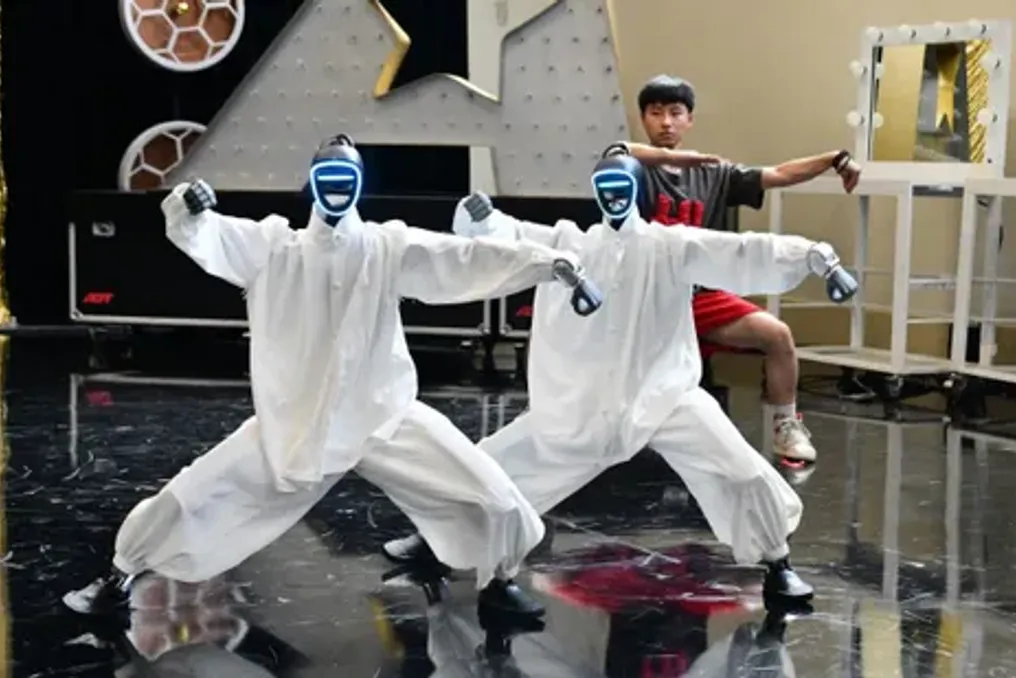
Chinese street dancer Wu Yuifei is performing with humanoid robots from Unitree Robotics ahead of the finale of Season 21 of 'America's Got Talent'. Although Wu Yuifei performed solo for most of his thirteen-year career, this year he has found new partners—a team of robots with graceful movements.
The 27-year-old resident of Sichuan, alongside other robotic performers, made it to the 'America's Got Talent' (AGT) final, an achievement he had long hoped for. Wu Yuifei told the AFP agency in Pasadena, California, that the joint dance with the robots in the Homies group gave him a 'very magical feeling.'
After several months of training with these robots, he noted that they stopped seeming like just 'cold, lifeless machines' and instead seemed to gain a sense of teamwork. He and the humanoid dance team created by the Chinese robotics group Unitree were preparing for the AGT finale this week.
Robotic dancing has become a real phenomenon in China after Unitree robots delivered an impressive performance at the annual Chinese New Year celebration, the country's most-watched television event. As a result, enterprises and event organizers across the country have begun actively hiring robots for performances to attract visitors.
According to industry experts, teaching robots to dance involves capturing complex human movements, conducting computer modeling, and then transferring the results to the robots themselves. Fan Zhenhua, the artistic director of Wu Yuifei's and Unitree's performances on AGT, compared the process of teaching a robot to dance to 'creating a soul.'
He admitted to the AFP agency in Shanghai that he was initially skeptical about the influence of artificial intelligence on dance performances or the influence of robots on dance, but over time, working with experienced engineers, whom he calls the robots' 'mothers,' changed his perspective.
Choreography Script
Training the robots requires the participation of human dancers and heavily relies on engineers for troubleshooting, especially during the actual performance. According to Liu Qizhuang, head of commercialization at the motion capture firm BridgeDP, significant fine-tuning is required. He added that perfecting a 30-second dance routine can take days, sometimes weeks, and performers must be prepared to compromise.
Liu Qizhuang noted that if dancers lack technical knowledge, many retakes will be necessary. In turn, Wagers Wei from the Limit Crew dance studio in Shanghai avoids movements that he believes will be difficult for the robots when developing choreography for them. He reported that if any elements look poor or the robots make mistakes, they are corrected.
Wei also mentioned that the robots handle rotational elements well, which street dancers call 'power moves,' as this only requires adjusting motor power and arm torque. However, movements requiring body flexibility are extremely difficult for robots. Another issue is musicality: robotic dance is mainly a scripted reproduction. As Wu Yuifei added, the machines are incapable of improvising or making spontaneous changes if the music suddenly changes.
Beyond Entertainment
While the general public in China primarily views robotic dance as entertainment, industry experts see it as an opportunity to demonstrate the design, capabilities, and reliability of robotics. Guo Jianze, founder and CEO of the robotics company Zeroth, stated that this is precisely why everyone strives to perform such highly skilled dances.
A recent report by Morgan Stanley predicts that China's humanoid robotics market could reach a value of $2 billion this year. The Chinese industry, which accounted for over 97 percent of global humanoid robot shipments in the second half of 2026, is also facing growing attention from investors and legislators. Many companies are struggling to find commercially viable applications for their humanoids beyond the entertainment sector.
Leaders of humanoid robotics companies have publicly acknowledged that the industry is still far from its 'ChatGPT moment'—the point at which robots become useful to ordinary people. Guo from Zeroth believes that everyone should give this industry time to unfold its full potential.
Unitree made a explosive debut on the Shanghai Stock Exchange in August, showing a 629 percent increase on the first day of trading, although its market capitalization has since dropped by about half from its peak. Returning to the AGT set in Pasadena, Wu Yuifei pointed out another advantage of robots—the speed at which his robot team can learn new routines. He emphasized that the robots' knowledge can be copied extremely quickly, and that not only one robot learns fast, but all of them can absorb the same material simultaneously, which he finds quite astonishing.