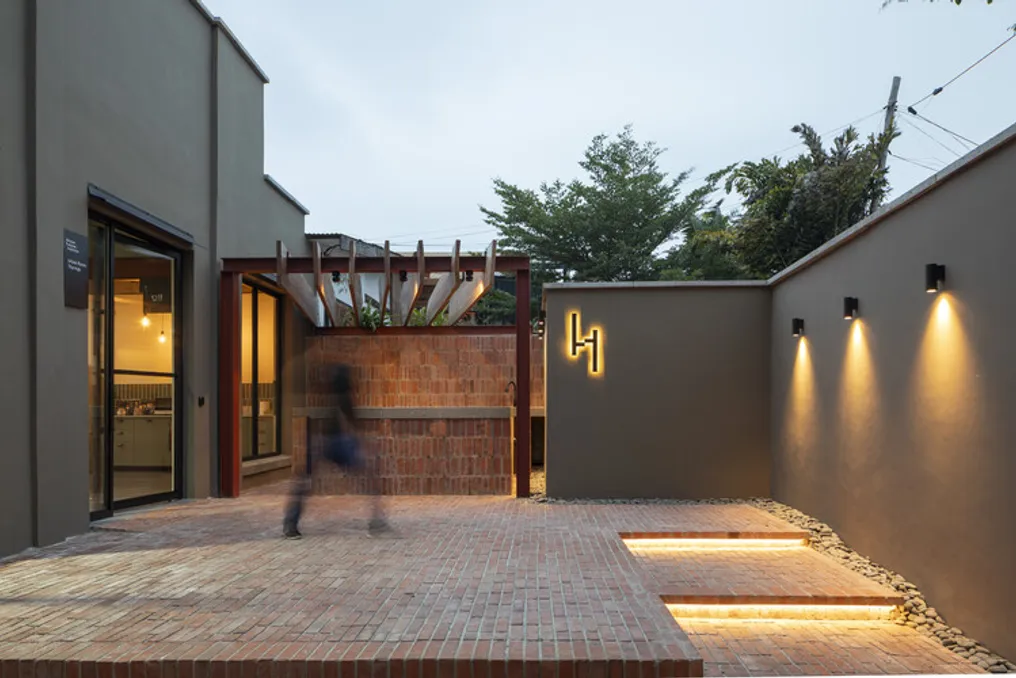
The African Futures Institute (AFI) has completed the construction of its new headquarters in Accra, Ghana. The project involved transforming an old warehouse located in the Osu neighborhood into a complex dedicated to architecture education, research, exhibitions, and hosting public programs.
The renovation maintained the original industrial structure of the warehouse while integrating new spaces designated for classes, workshops, presentations, displays, and meetings. With this completion, the institute establishes a permanent base in Accra, after operating for several years through programs, collaborations, and temporary locations across Africa and other continents.
The development of this project involved the participation of Professor Lesley Lokko OBE, Patrick Gentilezza from Buro Ghana, Patti Anahory, Laurence Lord, and Fred Swart. The team worked on various fronts, covering architectural direction, project planning, construction, and fabrication, following a practical method directly on the construction site.
Buro Ghana, which owns the property and is a partner of AFI, also actively collaborated in the remodeling of the warehouse and the implementation of the new headquarters. The existing warehouse served as the foundation for the project, preserving its industrial character and scale, rather than being replaced by an entirely new construction. The intervention added essential infrastructure for AFI's cultural and educational activities, utilizing the existing building.
The construction and design process occurred simultaneously, allowing the team to adapt the proposal as practical realities of the building emerged. One of the focal points of the headquarters is the Urban Room, a versatile space that can host lectures, studio sessions, exhibitions, film screenings, workshops, and meetings. Other areas of the building are used by the AFI team for archives, research studies, and teaching programs, configuring the headquarters as a functional space for both internal work and public events.
Lesley Lokko expressed the vision for a building capable of accommodating numerous futures, stating: 'Not a monument to an institution, but a structure for activity—a place that can be a school in the morning, a studio in the afternoon, and a public space at night. For us, architecture begins with the possibility of bringing people together.'
The new building will be home to AFI's educational programs, including the Nomadic African Studio, in addition to hosting lectures, exhibitions, film screenings, workshops, artistic residencies, and other public events. Its location in Osu integrates the institute's work into the daily life of Accra, the city where AFI was established. The headquarters also provides space for archives and ongoing research.
Founded in Accra in 2021 by architect and educator Lesley Lokko, the African Futures Institute began its operations focusing on education, research, and public events. It later expanded its activities to curatorial practice, exhibitions, and publications, participating in projects such as the Venice Architecture Biennale and the annual Nomadic African Studio program. The completion of this headquarters in Accra represents the institute's transition to a permanent space dedicated to this growing body of work.
In other recent news, the UN General Assembly approved the promotion of cartographic projections of equivalent areas, through a resolution presented by Togo, requesting greater use of maps that more accurately represent the relative size of continents. Additionally, the Great Green Wall continues to progress as a large-scale environmental and landscape initiative to combat desertification in the Sahel, while similar efforts in China aim at the Gobi Desert. Concurrently, the Museum of Modern Art in New York (MoMA) inaugurated the exhibition Architects of Liberation: Modernism in West Africa, which analyzes modern architecture in Benin, Cameroon, Ivory Coast, Ghana, Nigeria, Senegal, and Togo, covering the period from the late 1950s to the early 1980s.