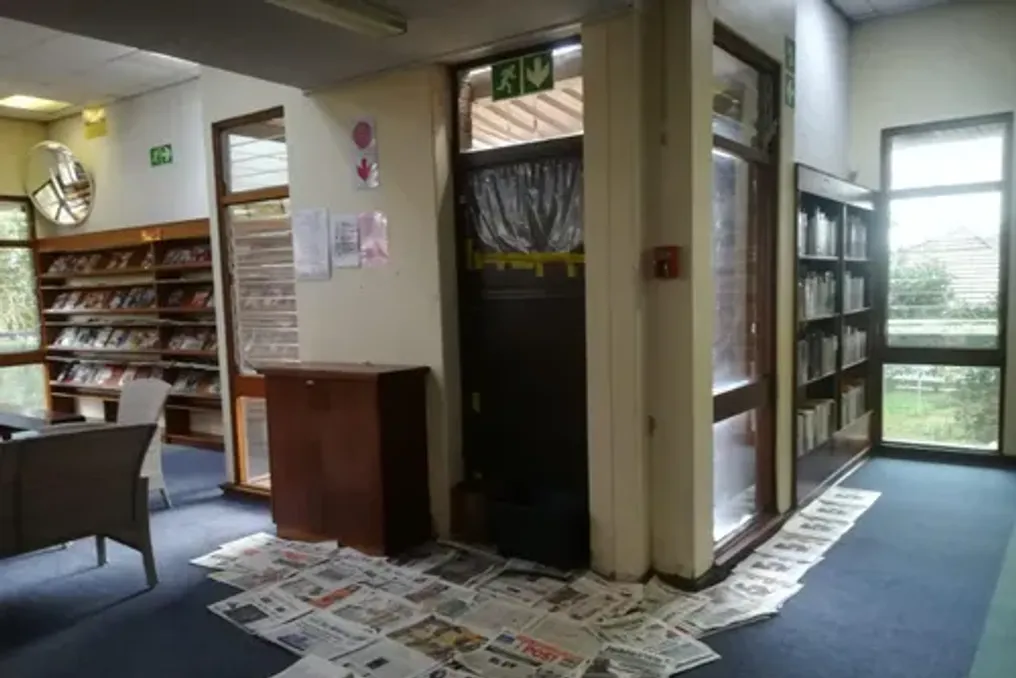
Westville library staff attempted to cope with roof leaks in the main reading room by covering carpets with stacks of newspapers.
From Pride to Neglect
Fifty years ago, in February 1976, Administrator Natasha van Hewman officially opened Westville's newest library. This library was significantly larger than the old one and reflected the rapid growth of Westville's population. Previously, there was a subscription library in Westville, but in August 1953, the town began receiving a small number of books from the provincial administration of Natal, which were housed in the municipal building. Mrs. Marion Doe was the first member.
At that time, Westville had only one school—Westville State School, which educated children from the first to the seventh grade. The city's growth over the next decade was astonishing. In 1956, Westville gained borough status, and the City Council chairman, Teddy Brown, was elected as the first mayor of Westville. By 1964, schools known today as Westville Junior Primary School, Westville Senior Primary School, Berea-West Senior Primary School, Westville Senior Boys' High School, and Westville Senior Girls' High School had opened. On January 28, 1964, Mayor R. E. Levitt officially opened Westville's first true library, and it was believed at the time that it would serve the citizens of the borough for many years.
The library, built with 45,000 rands, including a paved road and parking area, was described as being located in a 'secluded and peaceful place, ideal for a library.' It housed 10,000 books (compared to 4,000), and was managed by three librarians. Within ten years, the number of books increased to 33,000. Westville's growth continued unabated. By the mid-1970s, the library could no longer cope with the demand. Membership grew from 547 to 11,000 people, and the monthly number of books issued rose from 1,549 in 1964 to 30,000 in 1975. Since the costs of expanding the existing library were substantial, the City Council voted to build a new library.
Carol Farrrow helped move more than 30,000 books from the old library to the new one in December 1975. The move took three days.
The initial estimated cost was 120,000 rands, with the Natal Province providing a subsidy of 60,000 rands. The rise in construction costs eventually raised the total cost to 200,000 rands. At the official opening on February 6, 1976, Westville Mayor Darrell Dugmore mentioned in his speech the hope for an increase in the subsidy from the Province. In response, Administrator Natasha stated that she would take 'your accounts of financial hardship' into consideration in the next budget.
Guests at the opening included the library's first member, Marion Doe, who was still actively borrowing books, the library manager June Stowold, and the city secretary Johnny Kotsi, as well as the librarians who moved 33,000 books from the now 'old' library to the new one via the parking lot in December 1975. Their task was somewhat eased in the period before the big move, as members were advised to take twice or thrice as many books per card.
The library's design was open and bright, allowing maximum natural light into the public areas. A spacious children's section created an attractive space that would likely appeal to young readers. A huge advantage was the two group activity rooms, especially the large one. They are constantly in demand not only during the day but also at night. June Stowold encouraged their use, believing it attracted a wider community to the library. She also championed the creation of the Music Society, which met there one evening a month for many years. Her work and service were recognized with the Rotary of Westville award in 1990/91. Librarians knew their regular visitors and what books they preferred. Since 1976, members also had access to records, mainly classical ones, which could be rented (provided the needle was considered satisfactory).
After 1994, Westville lost its independent borough status, being absorbed by the eThekwini municipality. Maintenance was neglected or postponed to such an extent that routine repairs turned into larger and more expensive undertakings. Unreliable contractors, poor workmanship, and inflated estimates, which plague many metropolises, exacerbated the maintenance backlog. Recent rains in August and September 2026 exposed the extent of the library's deterioration. There are numerous places where water seeps into the building. Members watch staff moving books to safe places, covering carpets with newspapers and placing buckets under leaking roofs. The group activity rooms are no longer accessible—part of the ceiling in the larger room has collapsed. Where the library was once community-focused, it is now in decline.
An atmosphere of despondency hangs over what should be a valuable asset—a wonderful place to visit or work. It can be argued that the municipality cares little for its own assets, especially libraries. The budget for purchasing books and subscriptions to newspapers, magazines, and scientific journals has been cut. Calls to action from the public meet with indifference or excuses. The problem with accepting second best is that it quickly becomes third best, and then the norm. If repairs are not prioritized, the day the library must close is not far off. Has the City adopted this attitude: 'Oh, we have closed libraries before, so what difference does it make if we close another one, even if it is in a City-owned building'?
And what about the 1964 library? The Borough of Westville used it for several years for some of its administrative departments; the last tenant was IEC, which vacated the premises in December 2023. Since then, it has stood empty and subsequently suffered vandalism. The City has increased security to prevent further vandalism. However, its current state is the result of both vandalism and years of neglect.
In 1964, before the Borough transferred one of its departments there, the old library was leased to Nederduitse Gereformeerde Gemeente. After notifying IEC, couldn't the library have been leased to a suitable tenant, such as a professional firm needing offices? As Administrator Natasha noted in 1976, the Council viewed the old library as an asset.
When Westville gained borough status in 1956, it adopted the motto 'Adeamus cum Fiducia'—Let us go forward with confidence. That confidence withered the day the former borough found itself on a road leading backward.