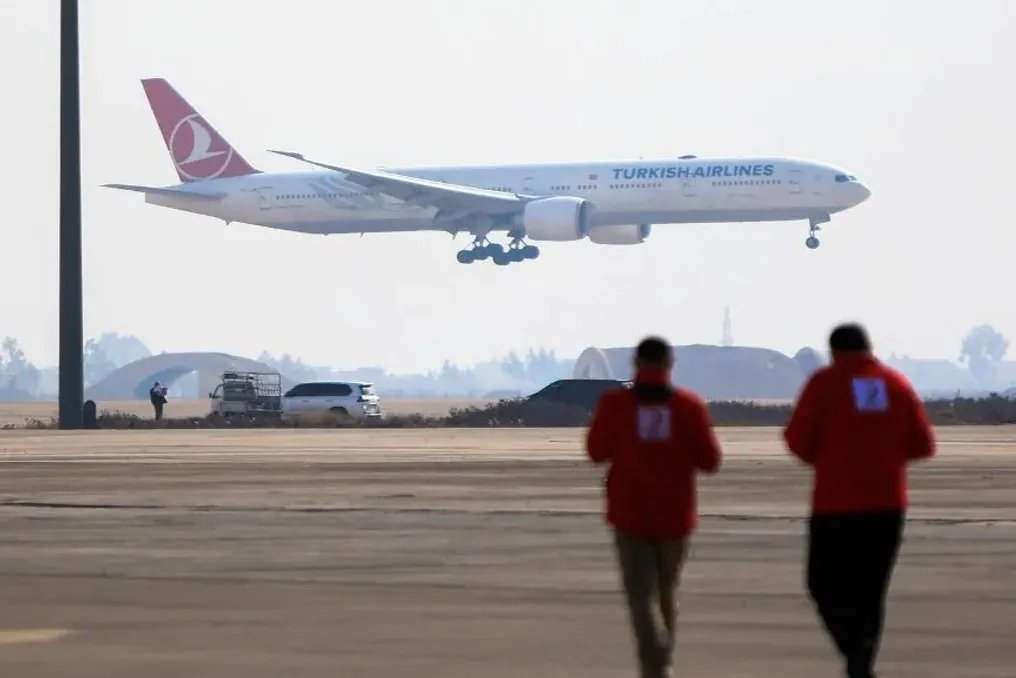
Due to the entry into force of US sanctions, Turkish airlines Turkish Airlines, as well as budget carriers AJet and Pegasus, have suspended flights to Iran, according to Middle East Eye.
Due to the entry into force of US sanctions, Turkish airlines Turkish Airlines, as well as budget carriers AJet and Pegasus, have suspended flights to Iran, according to Middle East Eye.
According to data from the websites of Turkish Airlines and AJet, flights to Iran will not resume until March. As for Pegasus, it appears that all its routes to this country have been removed from the booking system indefinitely.
A representative of Turkish Airlines told Iran International that there are no guarantees of resuming flights even after March 2027.
A source familiar with the issue told MEE that the US Treasury Department's sanctions against Iran's aviation sector were so severe that Turkish carriers were forced to suspend their flights.
This source added that while restrictions on American-made aircraft, such as Boeing, were understood, new sanctions also prohibited the flight of Airbus aircraft because they contain components of American origin. Carriers had no other choice.
A Turkish official noted that as of Monday, Mahan Air was the only Iranian airline banned from flying to Turkey, while other Iranian airlines could still maintain connections between the two countries.
Despite successive rounds of US sanctions against Tehran, Turkey and Iran maintain stable relations and extensive energy and commercial ties. However, Turkish President Recep Tayyip Erdoğan adopted a different approach after US President Donald Trump began increasing economic pressure on Iran.
Over the weekend, Turkey revoked the banking license of the Iranian bank Mellat, which had operated in the country for decades. Furthermore, the Turkish banking regulator took control of Golden Global Investment Bank last week after the US imposed sanctions on the institution for alleged transfers of funds to the Iranian government.
Mitsubishi has introduced the GLS version of the Eclipse Cross, expanding the mid-size SUV line and establishing a new entry point with a price of R$ 155,990. This value represents a reduction of R$ 21 thousand compared to the Rush, which was previously the most affordable configuration in the line, and the launch occurs approximately three months after the presentation of the 2027 lineup in Brazil.
However, this cost reduction implies certain changes in the equipment package. The GLS version does not come equipped from the factory with the 10.25-inch multimedia center, which is offered as standard only starting from the Rush. Furthermore, it omits the rearview camera and the Type A USB port located at the front.
In place of these items, the GLS features four speakers installed in the doors and has electrical preparation for sound. The seats are upholstered in fabric, following the Rush standard, and the manufacturer's online configurator shows only one available paint color: solid Fuji white.
Even as the lowest-cost configuration, the SUV preserves several important features, including seven airbags (covering front, side, curtain, and knee), 18-inch black-finished alloy wheels, LED daytime running lights, digital air conditioning, cruise control, electronic stability and traction systems, tire pressure sensor, color screen onboard computer, and leather-wrapped steering wheel.
The engine remains the 1.5 turbo MIVEC gasoline engine, generating 165 hp and 25.5 kgfm, and is always coupled with the CVT automatic transmission with eight-speed simulation. The GLS version is available exclusively with front-wheel drive. The suspension structure follows the line standard, using MacPherson independent suspension at the front and multi-link with coil springs at the rear.
The dimensions of the Eclipse Cross remain unchanged across all its configurations: 4.54 meters in length, 1.80 meters in width, 1.68 meters in height, and 2.60 meters wheelbase, in addition to a ground clearance of 21.5 cm. Mitsubishi has not yet released the official fuel consumption for this new version; however, in other front-wheel-drive configurations, the recorded figures are 10.3 km/l in the city and 11.3 km/l on the highway, using gasoline.
The price change repositions the model in the competitive landscape. With a value of R$ 155,990, the Eclipse Cross GLS now competes directly with intermediate versions of compact SUVs, such as the Volkswagen T-Cross 200 TSI (R$ 152,890) and the Hyundai Creta Comfort (R$ 156,590). Although it gains in size and power compared to these competitors, it suffers a loss in standard content.
This strategy aims to revitalize a name that had lost relevance in the segment. Between January and August 2026, the Eclipse Cross registered sales of 4,975 units in the country, a volume considerably lower than that achieved by its main rivals in the same period, such as Jeep Compass (36,431), Toyota Corolla Cross (25,564), and Caoa Chery Tiggo 7 (17,964).
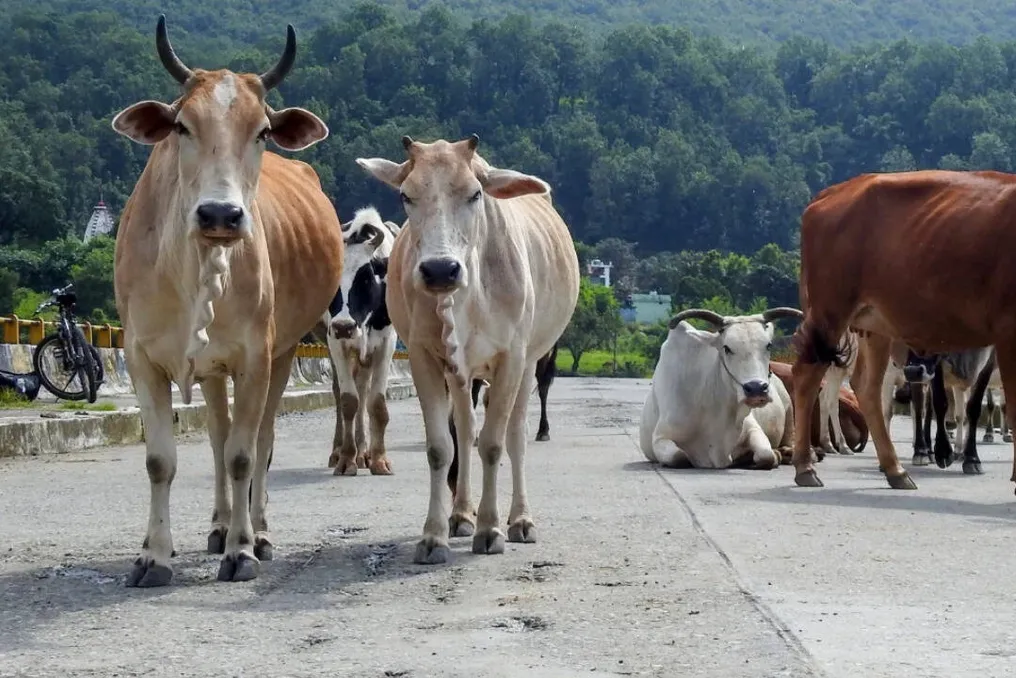
The National Highways Authority of India (NHAI) filed a petition with the Supreme Court on Monday, seeking to be exempted from the judicial obligation to create infrastructure for housing stray cattle and animals along the network of 72,000 kilometers of national highways. These animals are increasingly causing road accidents.
General Counsel Tushar Mehta requested an urgent hearing on NHAI's application. He asked that the case be heard by a special bench headed by Justice Vikram Nath, who had previously mandated NHAI to coordinate with states on removing stray animals and placing them in shelters across India near the highways.
Tushar Mehta stated that no law imposes such responsibility on NHAI, nor does the organization have the experience to establish shelters across the entire 72,000 km stretch, and furthermore, it would impose an additional financial burden of 7,000 crore rupees for the creation and management of these facilities.
The project team at Parque Chas presented several residential typologies, and this specific case involved the renovation of an old 'cajón house' located on an almost square plot, with interventions carried out during the 2000s.
When contacted by the clients, the team learned that their involvement would be limited to interior design, resolving internal circulation, and external areas, since the owners did not wish to expand the built area.
The concept of construction was translated through the creation of exclusive landscaping, transforming a patio into a vibrant space for outdoor life. This environment was defined by an irregular perimeter of vegetation, the inclusion of a pool, a staircase leading to a music studio, and the utilization of pre-existing fences.
The fences were recontextualized, ceasing to be merely a security feature to become a support for the growth and dominance of surrounding vegetation. The process also involved building identity and appropriation of the space.
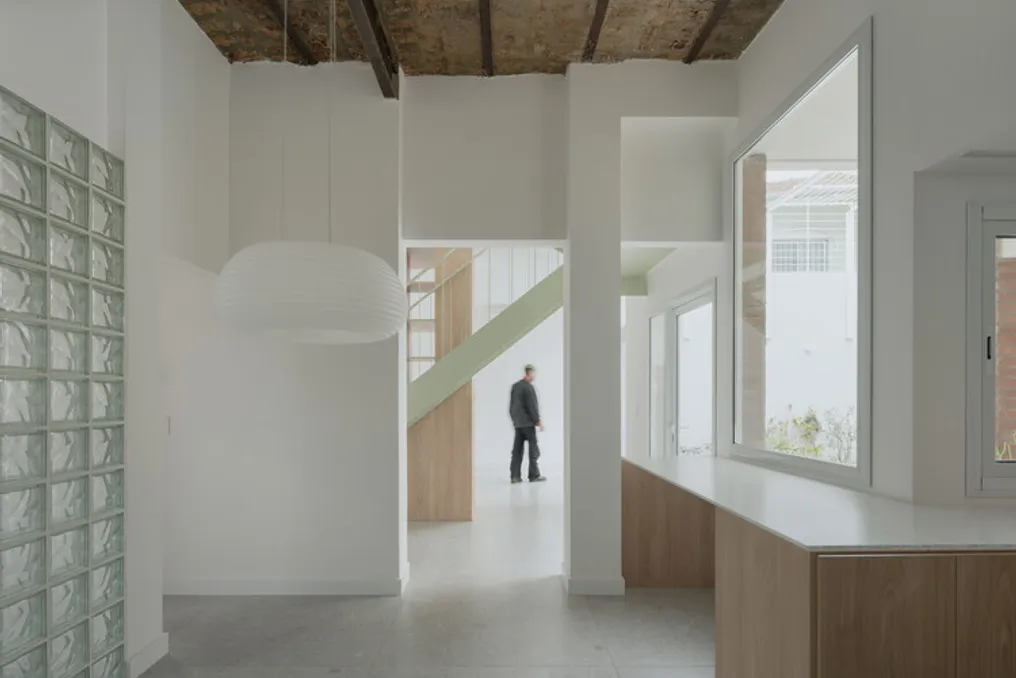
A specific palette of colors and textures was developed, integrating original elements, such as the brick arch and ceramic tiles of the patio, and combining them with simpler elements. Internally, there was a reconfiguration with the addition of a glass block wall and a new staircase, in addition to unifying the cladding between internal and external environments. Wooden furniture was used to subtly delineate the dining room circulation.
The facade was treated as a component belonging more to the social and urban fabric than to the individual owner. To harmonize with the context of Parque Chas, a new facade based on brick and light tones was proposed, aiming to give greater lightness to the scale of the street and the narrow sidewalk.
This transformation managed to change a post-modern facade with an industrial appearance into something more welcoming and softer in relation to its surroundings. Ultimately, the goal is for the space to be lived in, marked, and used in all its facets, because the greatest value of a work lies in losing its initial state of novelty to become a repository of lasting memories, stories, and experiences.